週一簡報 第 8 期 11月16日當週
Monday Brief — November 16

本文以英文撰寫。閱讀中文版
收聽這篇文章 · 8 分鐘
由合成語音朗讀。
The most important earnings call of the week comes from a company whose CEO quit four days ago over an alleged affair with a woman U.S. officials have linked to Chinese intelligence efforts. That is not a typo, and it is not the week's noisiest story. It is the one that actually matters, because Nvidia is still the hinge the entire AI trade swings on, and the people running it just changed overnight.
Here is the plain version. Nvidia lost its founder-CEO four days before its most-watched earnings report of the year, right as chip stocks were already sliding on their own. A Fed minutes release, a wall of retail earnings and a quiet consumer-sentiment number round out the week, but all three are secondary to one question: can Nvidia report clean numbers Tuesday without reopening the leadership story.
Jensen Huang resigned as Nvidia's chief executive on Thursday, four days after sending staff an internal message admitting he had been "unfaithful" to his wife. The resignation followed a New York Times report alleging an affair with an Nvidia executive, a woman named Alice Huang, no relation, who is reportedly based in China. The Times tied her to a suspected Chinese intelligence effort targeting Jensen Huang, citing an unverified hotel video from March. China's government called the allegations "baseless and purely slanderous." None of the core claims has been independently confirmed. What is not in dispute: Nvidia shares fell as much as 13% at Thursday's open and closed the day down roughly 5%, chief financial officer Colette Kress is now interim CEO, and the board, chaired by Harvey Jones, has opened a search for a permanent replacement. Nvidia is the third-largest public company by market value. A sudden CEO change at the center of the AI supply chain is governance risk stacked on an already-nervous chip sector, not a celebrity story that happens to involve a tech executive, and that is why it leads this brief. Source: ABC News
Friday's close
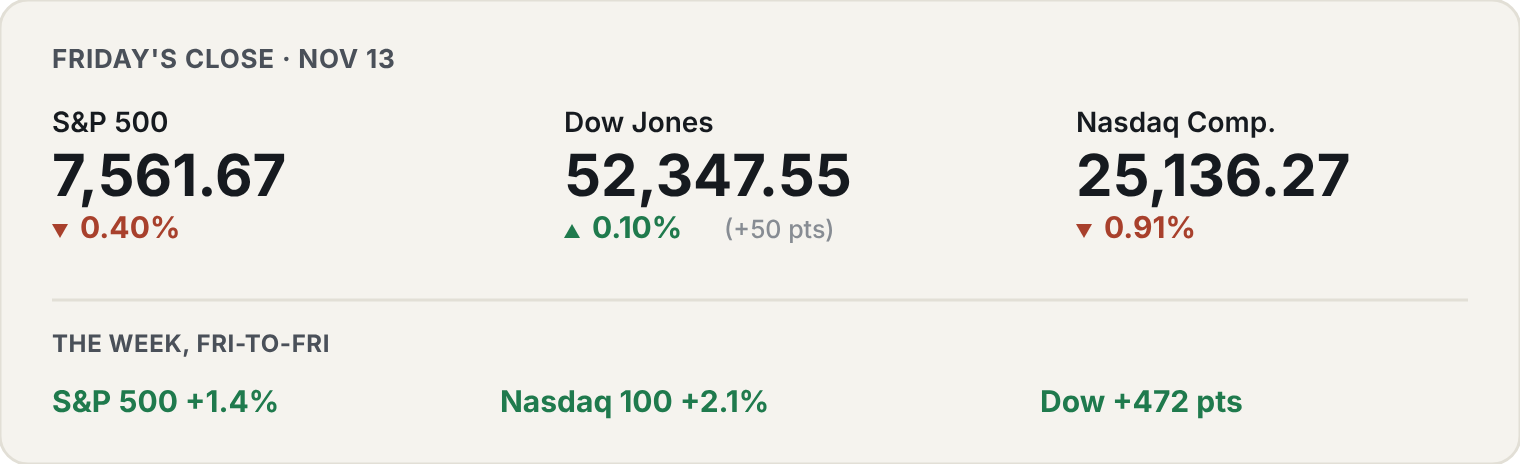
Friday's close and the net move for the week, major U.S. indexes. Source: Trading Economics
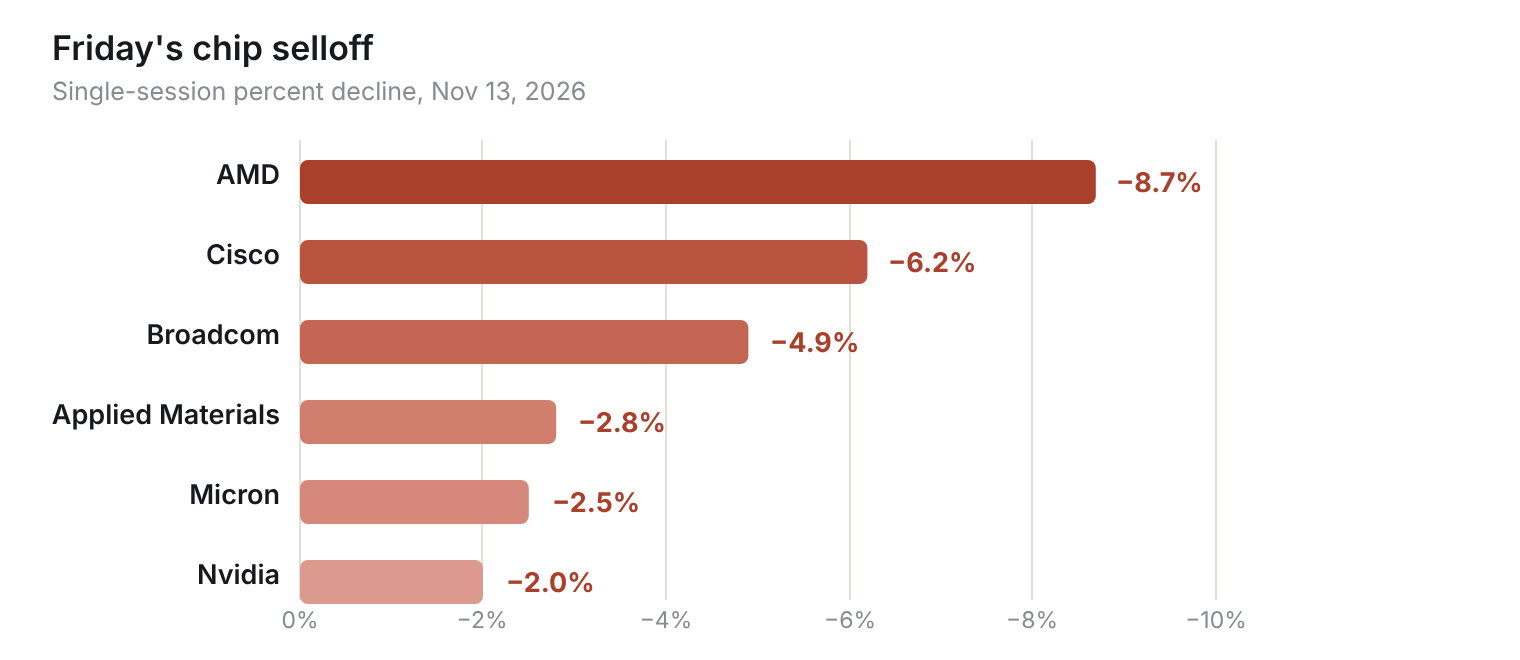
Chipmakers did the damage, and the Huang news had barely settled into the stock yet. AMD dropped 8.7%, Broadcom fell 4.9%, Cisco lost 6.2%, and Nvidia itself slid another 2%.
The S&P 500 finished down 0.4% at roughly 7,562, the Nasdaq Composite fell about 0.9%, and the Dow eked out a 0.1% gain, held up by Coca-Cola, Chevron and Walmart. Zoom out to the full week and the picture flips: the S&P still gained 1.4%, the Nasdaq 100 rose 2.1%, and the Dow added 472 points, because Monday through Wednesday were strong before Thursday's shock and Friday's chip selloff clawed some of it back. Source: Trading Economics
The five days ahead
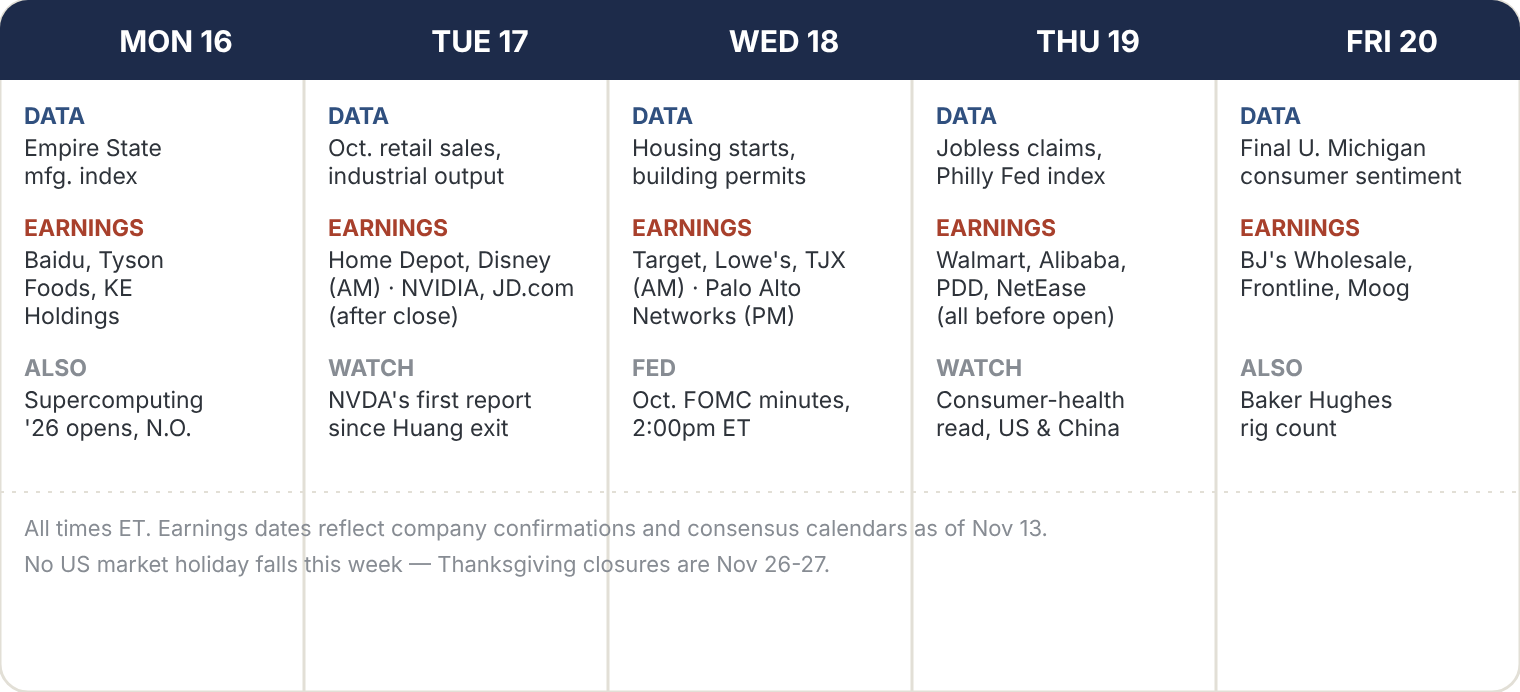
Nvidia reports Tuesday after the close, its first results since Huang's exit. Wall Street has penciled in roughly double last year's per-share earnings against August guidance of $108 billion in quarterly revenue, give or take 2%. That same morning, Home Depot and Disney report before the open. Wednesday brings the Federal Reserve's October meeting minutes at 2 p.m. ET, which matter more than usual because markets are still pricing in meaningful odds of a December move, alongside earnings from Target, Lowe's, TJX and, after the close, Palo Alto Networks. Thursday is the week's real consumer-health test. Walmart and Alibaba report before the bell, followed by Williams-Sonoma and Ross Stores, five retail and e-commerce earnings in three days that together say more about the American and Chinese shopper than any single data point will. Friday closes the week with the final University of Michigan consumer sentiment read. Tuesday's October retail sales figure, out at 8:30 a.m., sets the table for all of it.
The job market's quiet freeze
The Labor Department reported this month that paychecks are rising but buying power isn't: wages are up, yet inflation-adjusted spending power has slipped, a gap that shows up in a grocery receipt before it shows up in any official statistic. Source: AP via KPTV Layer onto that a wave of surveys, including one from Resume.org, finding roughly one in five employers have already paused entry-level hiring specifically because AI tools now handle work junior staff used to do; Gartner puts a comparable effect at close to a quarter of organizations. Source: Business Journal Daily If you are two years into a career, this is the story that touches you directly. The rungs below you are being pulled up, not the ones above.
Meanwhile Amazon's return-to-office enforcement has sharpened into something closer to an ultimatum, with the company reportedly blocking promotions for staff who don't comply, and 2026's tech layoff tally has already passed all of 2025's, with Verizon and HP among the firms cutting jobs this month. Source: TechRepublic Three separate pressures, one direction: fewer entry doors, harder mandates, thinner floors.
Before you book anything
No US market holiday interrupts this week; Thanksgiving closures are still ten days out. But it is a heavy conference week that will pull executive attention, with Supercomputing 2026 running in New Orleans through Friday and finance conferences stacking up in Miami, New York and Las Vegas. If your team needs a decision from someone senior, Tuesday or Wednesday morning is a better bet than Thursday.
Put these stories side by side and a pattern shows up that none of the individual sources spell out. The AI buildout is running on leadership that is one scandal, one earnings miss, or one hiring freeze away from visibly cracking, even as the market keeps pricing it as inevitable. Nvidia's governance shock, the entry-level hiring freeze, and the Dow's flat 0.1% gain on a day chip stocks got hammered are the same story told three ways: the market is separating "AI infrastructure demand" from "the specific companies and people building it," and that gap is where the next surprise lives. Watch whether Nvidia's Tuesday call spends more time on supply than on succession. If Colette Kress has to field governance questions for more than a few minutes, the market will treat that as a bigger deal than Friday's chip selloff suggested. This read would be wrong if Nvidia's earnings print clean and the stock recovers its Thursday losses by Wednesday; that would say the market genuinely has decoupled the company from its founder, faster than anyone expects.
One small, usable thing for the week: block 90 minutes before Tuesday's open or Wednesday's Fed minutes to read the actual numbers yourself instead of the headline reaction. That habit alone will do more for your week than any productivity app.
My own take: the governance risk at Nvidia is the signal worth tracking, and the Fed minutes are the one worth mostly ignoring. A rate-path debate that's already priced in at 75 to 85 percent moves nothing; a sudden CEO change at the company every AI roadmap depends on can move everything downstream of it, from cloud capex plans to the chip orders your own vendors are waiting on. If I ran procurement or product at a company building on Nvidia hardware right now, I would want a second source lined up for anything on a critical path, not because the chips are at risk this quarter, but because a board that's mid-search for a permanent CEO is not the board you want making a judgment call under pressure. The number I would actually watch Tuesday isn't the earnings beat. It's whether Nvidia's revenue guidance holds the same shape it did in August. If it does, the Huang story was personnel news dressed up as market news. If it doesn't, it was the first real crack.
Sources: ABC News, Trading Economics, StockTitan, eOption, LiteFinance, AP via KPTV, Business Journal Daily, Gartner, TechRepublic
每週一封信,收到 NeatRead 的精選文章
每週一封,不需要密碼,隨時可以取消訂閱。
或使用電子郵件繼續
使用電子郵件時,我們會寄登入連結給你。
留言
還沒有留言。來開啟話題吧。
登入後即可留言。只需要電子郵件,不用密碼。