Case Study No. 4
OpenAI launched first. Why is Anthropic going public first?

Listen to this post · 9 min
Read aloud by a synthetic voice.
ChatGPT grabbed the world's attention in 2022. Four years on, its quieter rival is the one heading to the Nasdaq. Here is what happened.
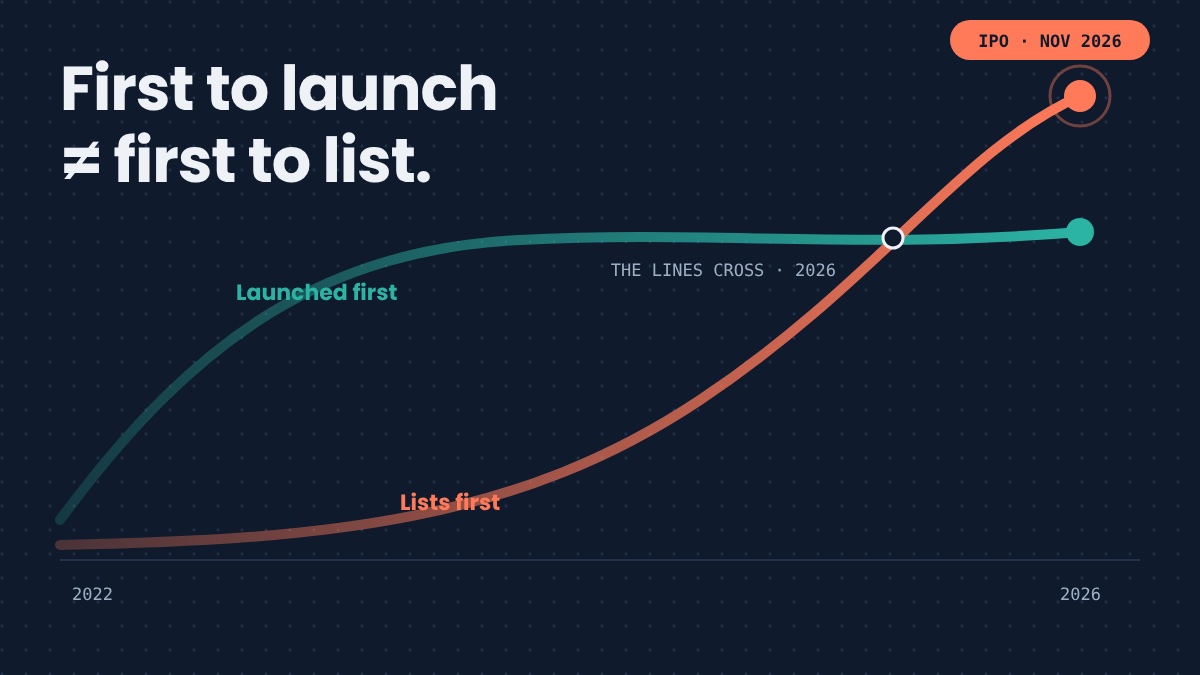
Think back to early 2023. Someone on your team pastes a messy email into ChatGPT and gets back something polite and clear in seconds. By lunch, half the office is trying it. That was OpenAI's moment, and it was a big one. ChatGPT launched at the end of November 2022 and became the way most people on earth first met modern AI.
Anthropic, founded in 2021 by a group of former OpenAI staff, released its own assistant, Claude, in March 2023. For a long time it looked like the runner-up: respected by developers, careful about safety, and nowhere near as famous.
Now the twist. Anthropic has publicly filed to sell shares on the Nasdaq under the ticker ANT, with reports pointing to a listing as soon as the week of November 16. OpenAI, the company that started the race, says it won't go public this year. So how did the second mover end up first in line for Wall Street?
The head start was real, but it was a consumer head start
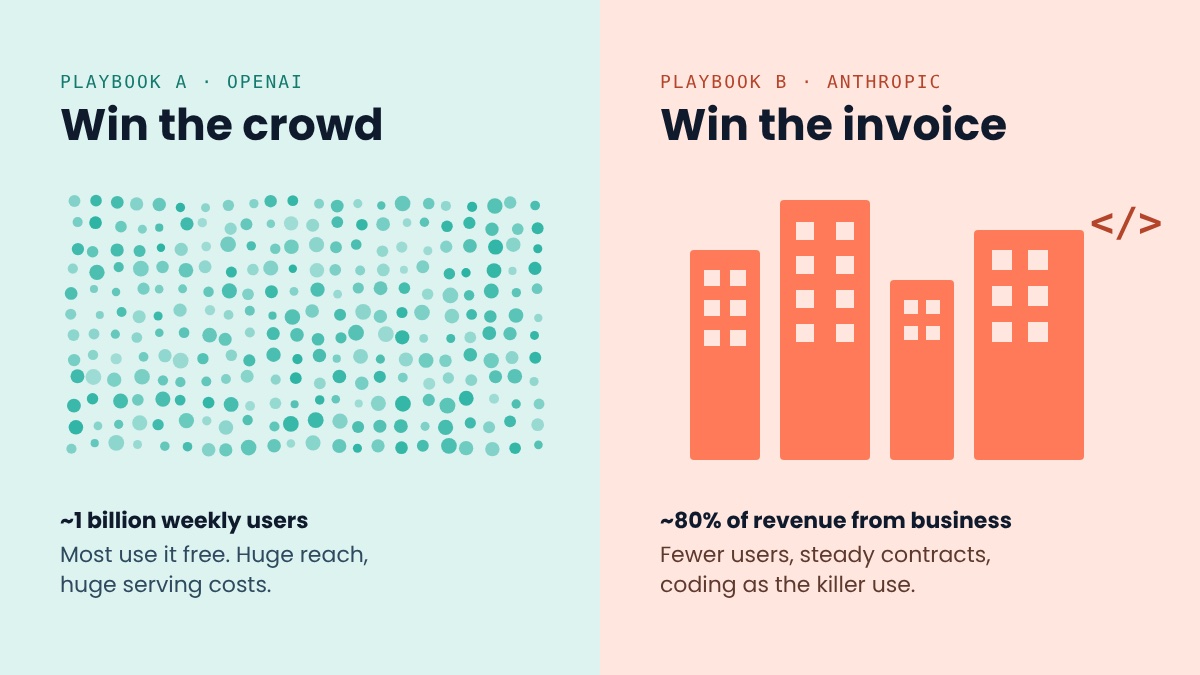
OpenAI won attention. ChatGPT is still one of the most used apps in the world, with somewhere around a billion people using it each week, depending on whose count you trust. That reach is a huge asset. It is also an expensive one. Most of those people pay nothing, and every question they ask costs money in chips and electricity.
Anthropic made a different bet, partly because it had to. Without a viral consumer hit, it sold to businesses: banks, software firms, consultancies and, above all, programmers. By 2026, roughly four-fifths of its revenue came from business customers, and its coding tool, Claude Code, became one of the most popular ways for developers to hand real work to an AI.
That difference matters more than it sounds. A free user is a fan. A company that builds an AI model into its customer service, its software pipeline or its contract checks is a customer that pays every month and rarely leaves. As one analyst put it to Yahoo Finance in August, the free users were OpenAI's head start, but a business with AI wired into its daily work is what actually brings in the money.
The moment the lines crossed
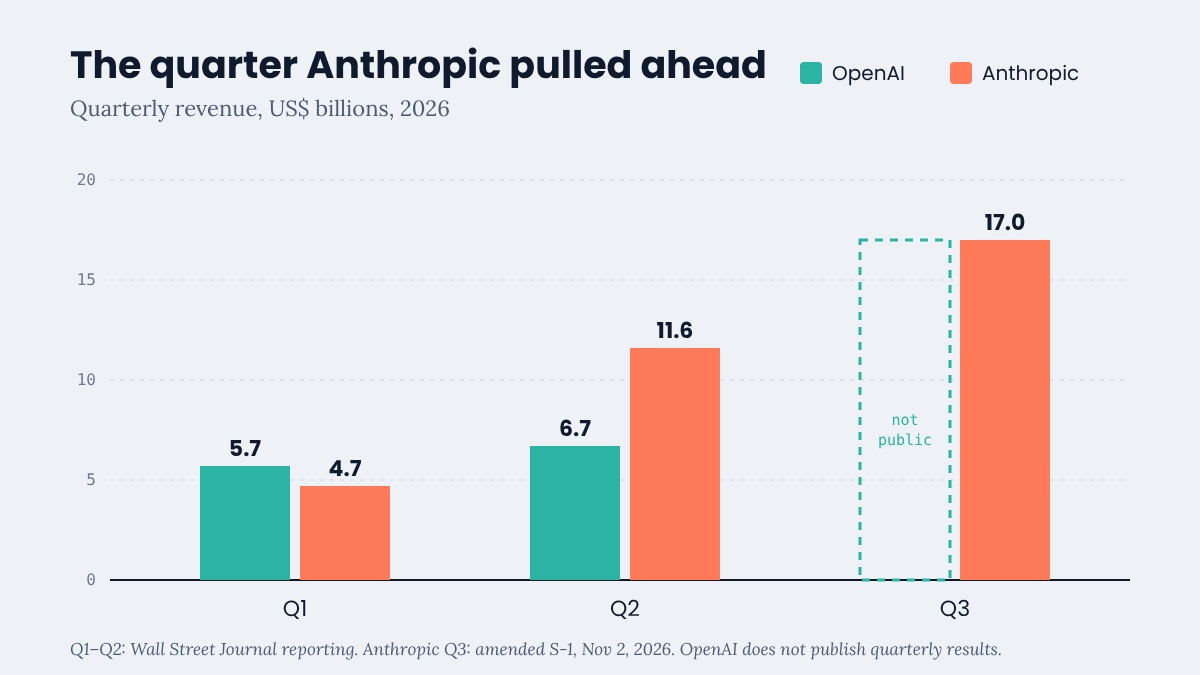
For most of 2025, OpenAI earned far more than Anthropic. Then the curve bent.
In the first quarter of 2026, OpenAI still led, $5.7 billion to about $4.7 billion, according to Wall Street Journal reporting. In the second quarter, Anthropic more than doubled to roughly $11.6 billion while OpenAI grew to $6.7 billion. In the third quarter, Anthropic's own IPO paperwork shows about $17 billion in revenue in three months, more than eleven times the same quarter a year earlier.
Surveys of company spending point the same way. Menlo Ventures data put Anthropic at about 40% of enterprise spending on AI models through APIs, against about 27% for OpenAI. In AI coding at work, Claude's share was reported at around 54%.
One caveat: the two companies don't count revenue in exactly the same way, and some figures come from leaks and press reports rather than audited statements. The direction, though, is hard to argue with.
Why Anthropic is listing first
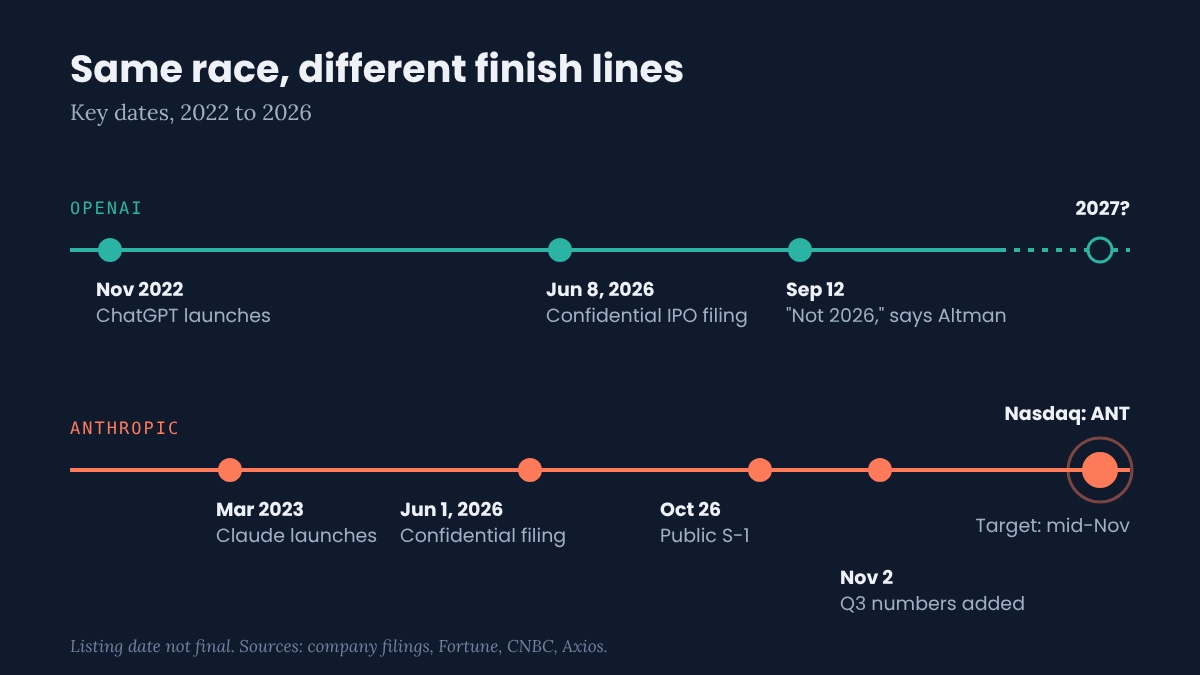
Both companies filed confidential IPO paperwork within a week of each other: Anthropic on June 1, OpenAI on June 8. Then their paths split.
OpenAI chose to wait. In a September interview with Fortune, Sam Altman said going public now would be ill-advised given the state of the AI safety debate, and that it would not happen in 2026. He has also pointed to OpenAI's unusual structure, with a nonprofit foundation still at the top, as a reason it needs room to make decisions that aren't purely about shareholders. Meanwhile OpenAI keeps raising money privately, reportedly at a valuation of around $1.25 trillion.
Anthropic chose to go. It filed its public prospectus on October 26 and added third-quarter results on November 2. Reports suggest it could raise around $100 billion at a valuation of $1.5 to $2 trillion, which would make it one of the largest stock market debuts ever.
Three things explain the choice:
- The numbers suit public markets. Investors like steady business revenue spread across many customers. Anthropic says no single customer made up more than a tenth of its revenue this year.
- The bills are enormous. The filing lists about $895 billion in commitments, almost all for computing power and data centers. Money on that scale eventually needs the deepest pool of capital there is.
- Momentum is a window. A company growing this fast wants to sell shares while the growth story is fresh. Wait a year, and investors judge you on slower numbers.
Before anyone calls it a win
The same filing that shows the growth also shows the strain. Quarter-on-quarter growth slowed to about 47% in the third quarter, down from 144% in the second. Anthropic swung from a $974 million operating profit to a $567 million operating loss, mainly because it had to buy extra computing power at short notice. Its net loss for the quarter was $23.3 billion, although most of that was an accounting charge, not cash leaving the building.
There are outside risks too. Anthropic warns investors that its clash with the U.S. Department of Defense could cost it revenue. Google's newest Gemini model beats Claude on several benchmarks. And OpenAI is hardly standing still: its annualized revenue passed $40 billion in August, and its consumer reach is still far larger.
Going public first is not the same as winning. It means Anthropic's numbers will be tested in public every quarter, by investors who are often less patient than private backers.
What this means if you work for a living
You don't need to buy a single share for this story to affect you.
- Your employer is choosing your AI. The tools that win inside companies are the ones that plug safely into real work. Expect more AI agents inside the software you already use.
- Being first is not a moat. OpenAI defined the category, yet a focused rival caught up in about three years by serving paying customers well. That lesson applies to products, teams and careers.
- Coding is the early signal. Software work is where AI spending grew fastest. Whatever your job, learning to hand well-defined tasks to an AI is becoming a basic workplace skill.
- Big IPOs come with big hype. If you invest, read the risk section, not just the headlines. Nothing here is investment advice.
The real lesson
OpenAI showed the world what AI could feel like. Anthropic showed businesses what it could be worth. One won the spotlight; the other won the invoice. When the opening bell rings on the Nasdaq, it won't settle who builds the best AI. It will confirm something every salesperson already knows: attention gets you noticed, but repeat customers pay the bills.
Sources: Anthropic Form S-1 and Amendment No. 1 (Oct 26 and Nov 2, 2026) as reported by CNBC, StockAnalysisand Axios; Fortune on OpenAI's IPO timing; Yahoo Finance / WSJ on quarterly revenue; SentiSight on Menlo Ventures share data; Empower on listing timing and valuation range.
Get NeatRead's best posts in one weekly email
One email a week, no password. Unsubscribe anytime.
or continue with email
With email, we send you a sign-in link.
By joining, you agree to the Terms and Privacy Policy.
Comments
No comments yet. Start the conversation.
Sign in to comment. It takes an email address, no password.