Global Weekly No. 3 Week of Sep 28
Global Weekly — Business, AI & New Products (Sept 30, 2026)

Listen to this post · 8 min
Read aloud by a synthetic voice.
The Week's Through-Line
Everyone wants to sell you a digital employee this week. On September 24, Meta showed off Muse, an AI agent that books flights, fills out forms and buys things through Walmart, Best Buy and Expedia. Five days later, on September 29, OpenAI answered at its DevDay conference with Dots, an "always-on" agent that works through tasks in the background while a person does something else. The two companies describe the same idea in almost the same words: an assistant that acts before you ask.
That timing is not a coincidence, and neither is the price tag attached to it. Money is flowing into the infrastructure that makes agents possible faster than data centers can be built to hold it, and the bill is starting to show up in odd corners of the economy: a chipmaker paying $8.2 billion for a robotics-AI startup, a five-year Treasury yield at levels last seen in 2007, a reading on consumer confidence that just hit a 12-year low. Three storylines follow, but one thread runs through all of them: an industry betting everything on agents, financed by capital that keeps getting more expensive.
Business
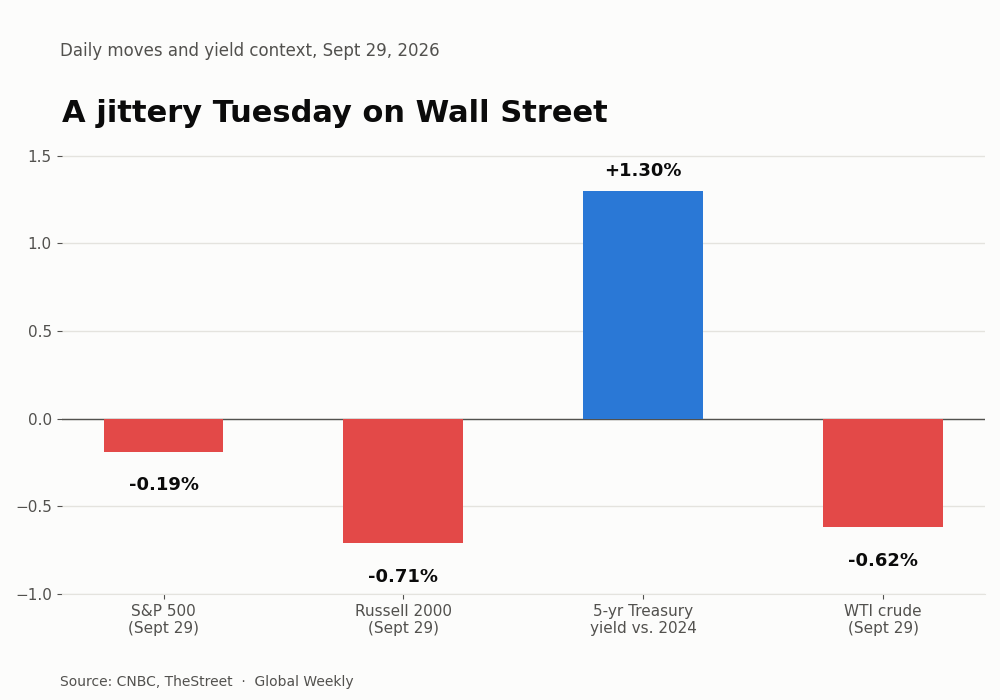
Wall Street spent Tuesday digesting bad news it had mostly already priced in. The S&P 500 slipped 0.19% and the Russell 2000 fell 0.71% on September 29, a day after the five-year Treasury yield touched 5% for the first time since 2007. Yields eased slightly as the session wore on, but they are still doing the quiet work of tightening financial conditions while the Federal Reserve talks about cutting rates. Consumer confidence, meanwhile, dropped to its lowest level in 12 years, a reading that sits uneasily next to a labor market that keeps disappointing forecasters. Oil was one of the few things moving in the right direction: West Texas Intermediate fell 0.62% to $92.03 a barrel as diplomatic talks between the U.S. and Iran progressed, taking some edge off inflation worries.
Individual stocks told sharper stories. FICO shed 21.57% of its value after the Federal Housing Finance Agency said it would open up competition in mortgage credit scoring, threatening a business the company has effectively owned for decades. Carnival jumped 11.65% on an earnings beat, evidence that people are still willing to pay for a cruise even when they tell surveys they are gloomy about everything else.
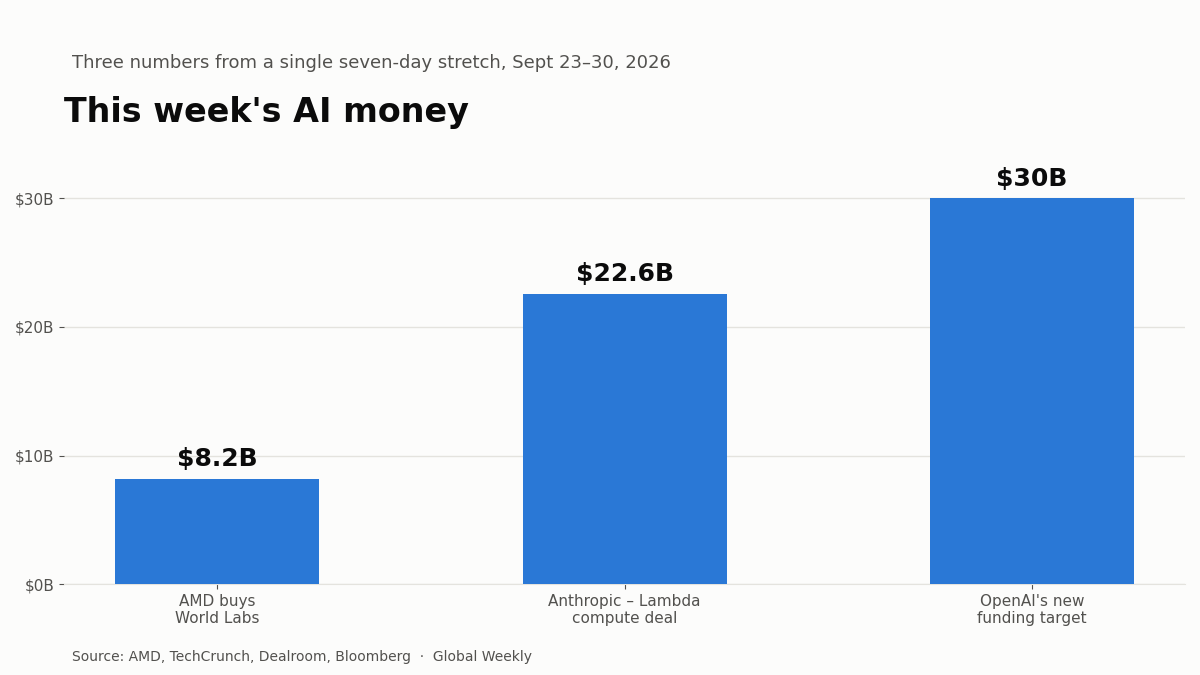
The week's biggest structural story sits in the courts, not the ticker. Paramount Skydance's $110.9 billion bid for Warner Bros. Discovery remains blocked by a federal judge pending a trial that is not scheduled to wrap until April 2027, with a dozen state attorneys general still pushing to kill the deal outright over media-consolidation concerns. David Ellison says he is "incredibly grateful" for his relationship with the White House and insists he believes in competition; Paramount, for its part, is reportedly weighing whether to sell off cable channels to make the antitrust math work. In a smaller but telling deal, AMD agreed to pay $8.2 billion for World Labs, the physical-AI startup founded by Stanford's Fei-Fei Li, proof that even chipmakers now see model-building talent as worth acquiring outright rather than just selling silicon to.
AI
OpenAI used its DevDay keynote on September 29 to unveil about twenty new things at once, but the headline act was Dots, an agent built on a new model class called Astra that can work through tasks unsupervised. Sam Altman also introduced GPT-6.1 Sol, a cheaper model that gets close to Astra's coding performance; ChatGPT Space, a shared workspace that borrows ideas from Slack, Notion and Google Drive; a Decisions API that lets companies hand AI a fixed menu of outcomes to choose from instead of open-ended authority; and a cloud version of Codex that developers can run from a phone. Altman also confirmed something a lot of people already suspected: OpenAI is sitting on a more capable model, GPT-6.1 Astra, and chose not to ship it over unresolved security concerns.
Money questions hovered over the whole event. OpenAI is reportedly targeting a fresh $30 billion funding round that would value the company at $1.4 trillion, even as Altman and CFO Sarah Friar keep sending mixed signals about when, or whether, the company goes public. Altman ruled out a 2026 listing two weeks earlier, citing the risks of building toward more capable AI before safety work catches up; Friar has reportedly told staff not to worry about Anthropic's own IPO timeline because OpenAI is "running its own race." It is an odd position for a company simultaneously trying to raise capital at a trillion-dollar-plus valuation and telling the world it is not ready for public markets.
Anthropic's numbers explain some of why nobody wants to slow down. The company's annualized revenue passed $30 billion in April, up from roughly $9 billion at the end of 2025, and it has been locking in computing capacity everywhere it can find it, including a Texas data-center deal with the Nvidia-backed cloud provider Lambda worth $22.6 billion, on top of existing commitments to Amazon, Microsoft Azure and Google. Every one of these companies is making the same bet: that the agents launching this month will need far more compute than anything running today, and that whoever locks in capacity first wins.
New Products
If OpenAI's DevDay was about software agents, Meta Connect, held five days earlier on September 24, was about the hardware you will wear while talking to one. Meta's Muse assistant is now live in the U.S., Canada and Mexico, handling travel bookings and shopping through partners like Sephora and Expedia via a secure cloud-based virtual machine; a privacy-focused version with user-held encryption keys, Muse Confidential, arrives later this year. Mark Zuckerberg also gave a brief, deliberately teasing demo of Muse Charm, a pocket-sized companion device with its own screen, no price and no ship date, just enough to make people start asking.
The eyewear lineup got more concrete. Ray-Ban Meta Audio, a camera-free pair aimed at people who do not want to be photographed by their own glasses, ships October 13 at $349. The camera-equipped Ray-Ban Meta Gen 3 costs $449, up sharply from the $379 starting price of the previous generation. A new budget option, Meta Adventurer, opens preorders at $249, and the display-equipped Ray-Ban Meta Display is already available at $799.
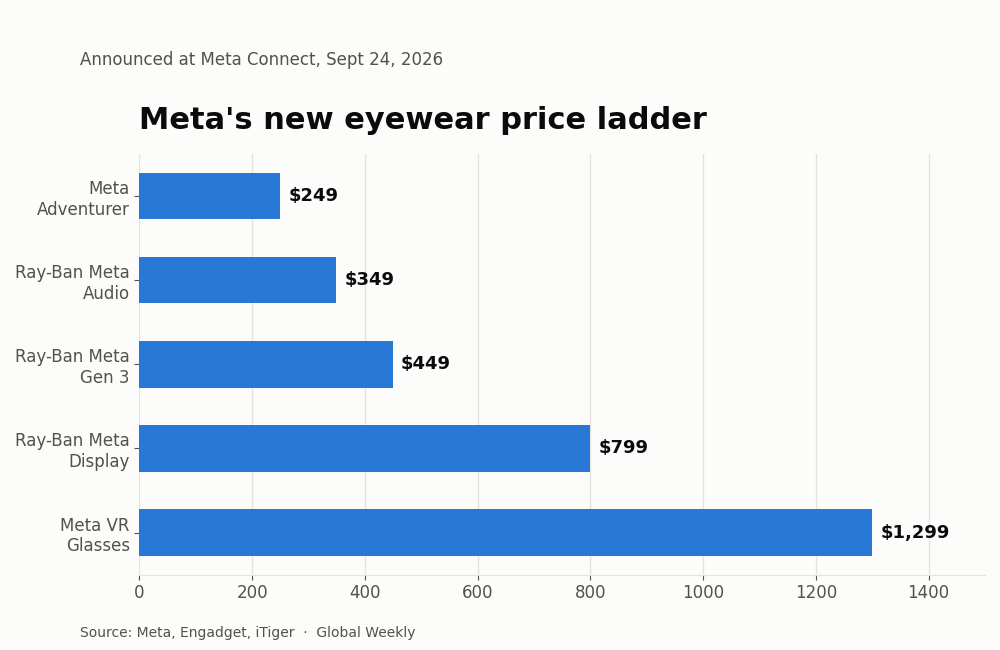
At the top of the range sits Meta's first standalone VR headset built as glasses rather than a goggle, about 100 grams thanks to a tethered "puck" that offloads the processing, with micro-OLED 5K panels and hand-only controls for more than 75 games. It costs $1,299.99 and will not ship until spring 2027, which says something about how far Meta thinks this category still has to go before it is ready for a mass audience. The pattern across both events is the same: whoever builds the assistant wants to also sell the object you use to talk to it. Disney+ is adding 3D streaming of Marvel films to the glasses in November, and ESPN plans 8K immersive college football through the same hardware, entertainment partnerships that only make sense if enough people are actually wearing the things.
What to Watch
Watch whether OpenAI's $30 billion round actually closes at that $1.4 trillion number, since reported targets and final terms have not always matched this year. The Paramount-Warner Bros. Discovery trial calendar is worth tracking too, particularly any signal that Paramount moves toward the cable-network divestiture bankers have been floating. AMD's purchase of World Labs still needs regulatory clearance before year-end. And with third-quarter earnings season opening in mid-October, the first hard numbers on how much AI spending is actually showing up on corporate income statements, not just in funding announcements, start arriving soon.
References
- Stock Market Today, Sept. 29, 2026 - TheStreet
- Proposed acquisition of Warner Bros. Discovery by Paramount Skydance - Wikipedia
- AMD will acquire Fei-Fei Li's World Labs for $8.2B - TechCrunch
- The 5 biggest announcements from OpenAI's DevDay - Axios
- OpenAI Rules Out 2026 IPO as Sam Altman Prioritizes AI Safety Work - Pulse2
- Anthropic locks in $35B Nvidia-backed cloud deal for Texas data center - Dealroom
- Muse Takes Center Stage at Meta Connect as New Eyewear Lineup Debuts - iTiger
- Meta Connect 2026 live blog: Muse, Ray-Ban, VR glasses - Virtual Reality News
Filed under AIMarketStrategyTechnology
Comments
No comments yet. Start the conversation.
Sign in to comment. It takes an email address, no password.