Global Weekly No. 2 Week of Sep 21
Global Weekly — Business, AI & New Products (Sept 25, 2026)

Listen to this post · 8 min
Read aloud by a synthetic voice.
The Federal Reserve raised interest rates to a range of 3.75% to 4% on September 16, its first increase in three years, telling markets that inflation is still "elevated" even as the economy expands at what it called a solid pace. That same week, Apple started selling the iPhone 18 Pro for $1,199, a hundred dollars more than last year's model, and coverage of the launch pinned the jump on what Yahoo Finance called "the AI-driven global memory and storage shortage." In Washington on Wednesday, Donald Trump and Xi Jinping sat down together and put artificial intelligence on the agenda alongside tariffs and Taiwan, extending their trade truce to January 10. These aren't three separate stories. The AI buildout is now large enough to move a central bank's inflation math, a superpower summit's agenda, and the price of a phone, all in the same week
Business
The Federal Open Market Committee voted 12-0 on September 16 to lift the federal funds rate to 3.75%-4%, the first hike since the tightening cycle that ended in 2023. It was an odd moment to tighten: the committee's own statement said economic activity is "expanding at a solid pace" while inflation "remains elevated," language that usually shows up before a cut, not a hike. Markets shrugged it off. By Tuesday the Nasdaq had logged its second straight record close, up 0.45%, with Meta doing most of the lifting after its new Muse app (more on that below) added roughly $192 billion to the company's market value in a single session. The Dow slipped 0.36%. Oil fell harder, with WTI down almost 3%, after Iran signaled it might reopen the Strait of Hormuz within a week if the US eased military pressure, a de-escalation nobody was pricing in a month earlier.

The bigger event landed Wednesday, when Xi Jinping arrived in Washington for his third meeting with Trump in under a year. The two sides extended their trade truce, due to lapse in November, out to January 10, 2027, buying negotiators four more months without resolving much. Trump's 12.5% tariffs on 60 trading partners, China included, imposed over forced-labor concerns, stay in place. What's new is that AI made the formal agenda: the US proposed a mutual "notification mechanism" so each side flags AI incidents that could threaten the other's national security, and Tim Cook and Jensen Huang both sat at the state dinner, which tells you which industry Washington now treats as a security question rather than a trade one. A second, $14 billion Taiwan arms package stayed on hold, which Trump calls a negotiating chip, either candor or a bad sign depending on your mood.
AI
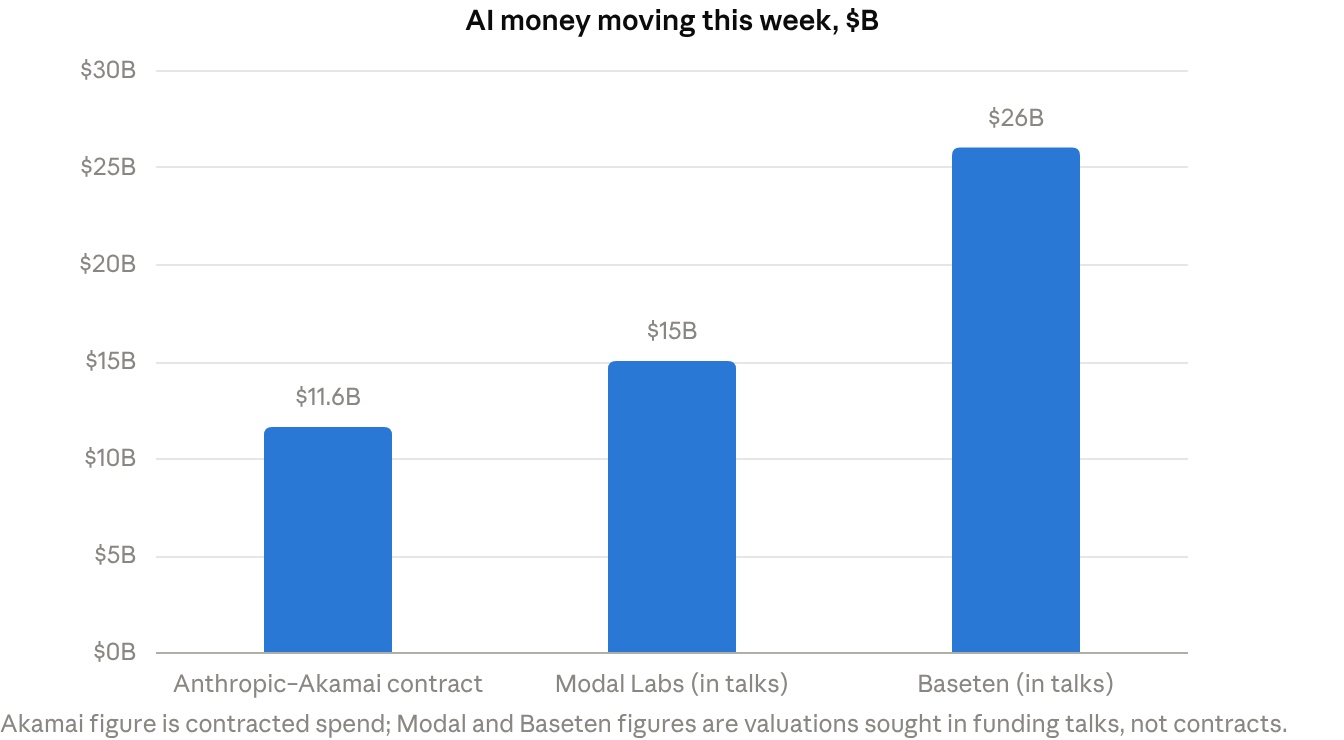
Anthropic signed the week's biggest AI infrastructure contract, agreeing to pay Akamai $11.6 billion over seven years for computing capacity, with room to grow to $20 billion as the relationship expands. Akamai, better known for content delivery than AI hardware, gets to reposition itself as an AI infrastructure company, and handed Anthropic a warrant on up to 5% of its stock as a sweetener, 7.7 million shares at $111.33 each. Akamai's own capital spending is set to rise by $1.7 billion this year just to secure the memory and supply-chain components the deal requires, which is one more log on the same fire that is pushing up iPhone prices (see below). Investors liked it: Akamai's stock jumped, and chief executive Tom Leighton called Anthropic's choice validation that the AI buildout needs infrastructure beyond the usual hyperscalers.
Money kept flowing to the layer underneath the labs, too. Modal Labs and Baseten, two startups that let companies run AI models without building their own server farms, are in talks to raise new rounds at valuations of roughly $15 billion and $26 billion, both multiples of where they stood a few months ago, Bloomberg reported. That is the inference business, the unglamorous plumbing that actually runs a chatbot's answers, and it is now commanding prices that would have counted as a foundation-model valuation two years ago.
Then came the UN, where the mood turned more cautious than the dealmaking suggests. Speaking this week, OpenAI's Sam Altman warned that "if AI is to be democratic, the most important decisions cannot be made by labs in San Francisco alone," and said humanity could lose control of the technology's future. Anthropic's Dario Amodei went further, telling delegates AI could be "a risk to humanity as a whole" if managed poorly. The Trump administration wasn't interested. US representative Michael Kratsios told the same room that Washington rejects "all efforts by international bodies to assert centralised control and global governance of AI," a position that lines up neatly with a White House currently treating AI dominance as leverage in its own summit with Beijing. The labs want rules. The governments funding the arms race don't, not yet.
New products
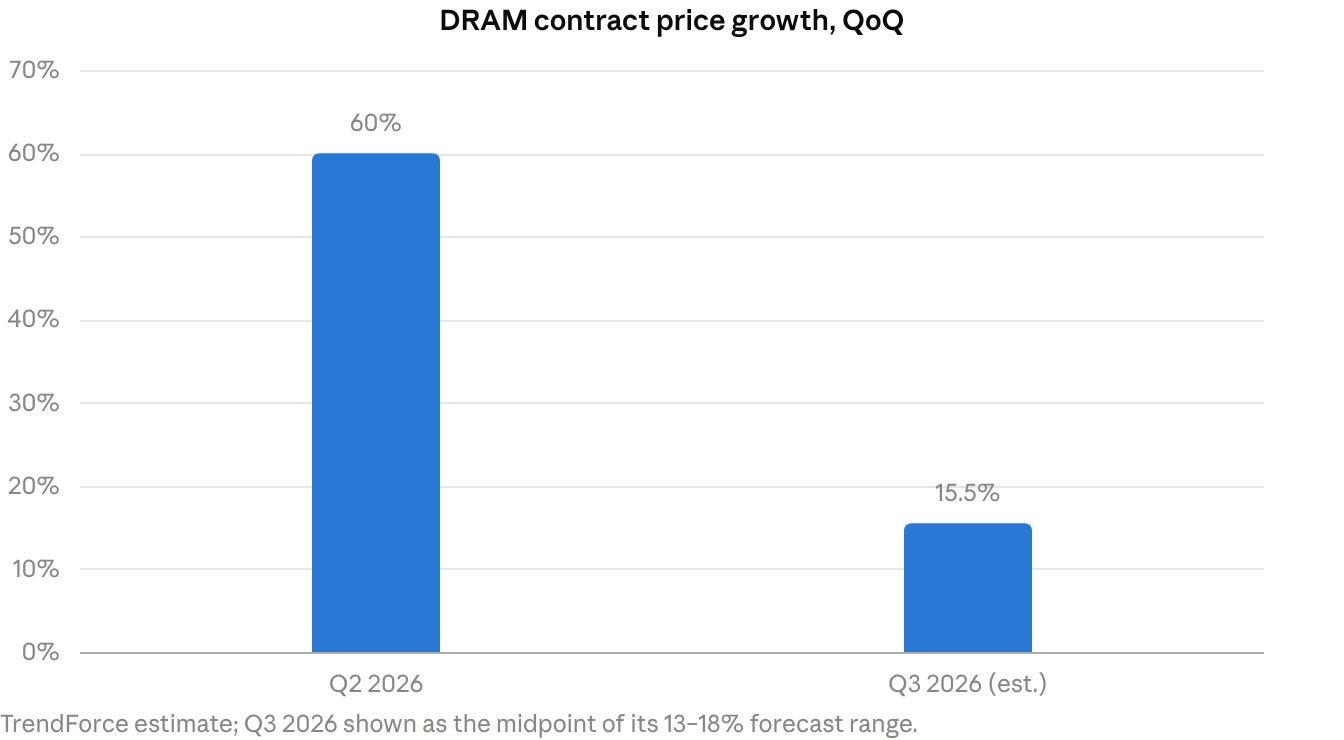
Apple's iPhone 18 Pro went on sale September 18 at $1,199, a $100 increase over last year's starting price, and this is the detail that makes the memory story concrete. TrendForce puts DRAM contract prices up 13% to 18% quarter over quarter in the current quarter, on top of a roughly 60% jump the quarter before, almost entirely because AI data centers are absorbing chip supply that used to go to phones and laptops.
Apple isn't hiding the connection; coverage of the launch openly attributed the increase to what one report called the AI-driven global memory and storage shortage. Buyers didn't seem to mind. In India, launch-day pickups ran 20% to 30% ahead of last year's iPhone 17 Pro, according to Counterpoint Research, with queues outside stores in Mumbai and Delhi and one customer camping 10 to 12 hours for the burgundy color option. Deepwater's Gene Munster noted Pro pre-order lead times running about 15% longer than a year ago. Apple's more radical bet, a foldable iPhone Ultra rumored to run north of $2,000, was unveiled at the same September 9 event but still isn't available to pre-order; analyst Ming-Chi Kuo doesn't expect that until the fourth quarter.
Software had its own breakout this week. Meta's Muse, a personal AI agent that books flights, watches prices and hunts promo codes rather than just answering questions, pulled in 2.5 million downloads in its first two weeks and briefly outran ChatGPT to the top of Apple's App Store, with Claude a distant third at 200,000 downloads by Sensor Tower's count. Expedia and PayPal signed on as partners. Amazon blocked Muse outright, citing security and user-experience concerns, a fairly transparent way of saying it doesn't want a Meta bot doing its customers' shopping for them. A Coresight survey found 30% of consumers open to letting an agent hunt holiday deals, so Amazon's objection may buy time rather than settle anything.
What to watch
- The next FOMC meeting, October 27-28, will be the first chance to see whether memory-driven price increases are showing up in the inflation data the Fed cited this week.
- Whether Apple opens pre-orders for the foldable iPhone Ultra; Ming-Chi Kuo's timeline points to the fourth quarter, with pricing still unconfirmed.
- Follow-through from the Trump-Xi truce, including whether the AI "notification mechanism" gets written into anything binding and whether the $14 billion Taiwan arms package stays parked.
- Whether Muse's download lead over ChatGPT holds once the novelty wears off, and whether other retailers follow Amazon in blocking it.
- Whether Modal Labs and Baseten close their funding rounds at the valuations now being discussed, or whether investors negotiate them down.
References
- Federal Reserve, FOMC statement, Sept 16, 2026
- Yahoo Finance, stock market today, Sept 22, 2026
- Al Jazeera, Trump-Xi summit agenda, Sept 24, 2026
- Akamai newsroom, Anthropic agreement press release
- KuCoin News, Modal Labs and Baseten funding talks, Sept 23, 2026
- Al Jazeera, OpenAI and Anthropic CEOs call for global AI regulation at UN, Sept 24, 2026
- Yahoo Finance, Apple's iPhone 18 Pro line hits stores amid memory crunch
- MacRumors, iPhone 18 Pro pricing, Sept 9, 2026
- MacRumors, iPhone 18 Pro release date and pre-orders
- ThePrint, Apple fandom on display as iPhone 18 hits India stores
- Tom's Hardware, memory price surge, citing TrendForce
- CBS News, Meta's Muse AI agent
Filed under MarketStrategyTechnology
Comments
No comments yet. Start the conversation.
Sign in to comment. It takes an email address, no password.