Global Weekly No. 9 Week of Nov 2
Global Weekly — Business, AI & New Products (Nov 5, 2026)

Listen to this post · 10 min
Read aloud by a synthetic voice.
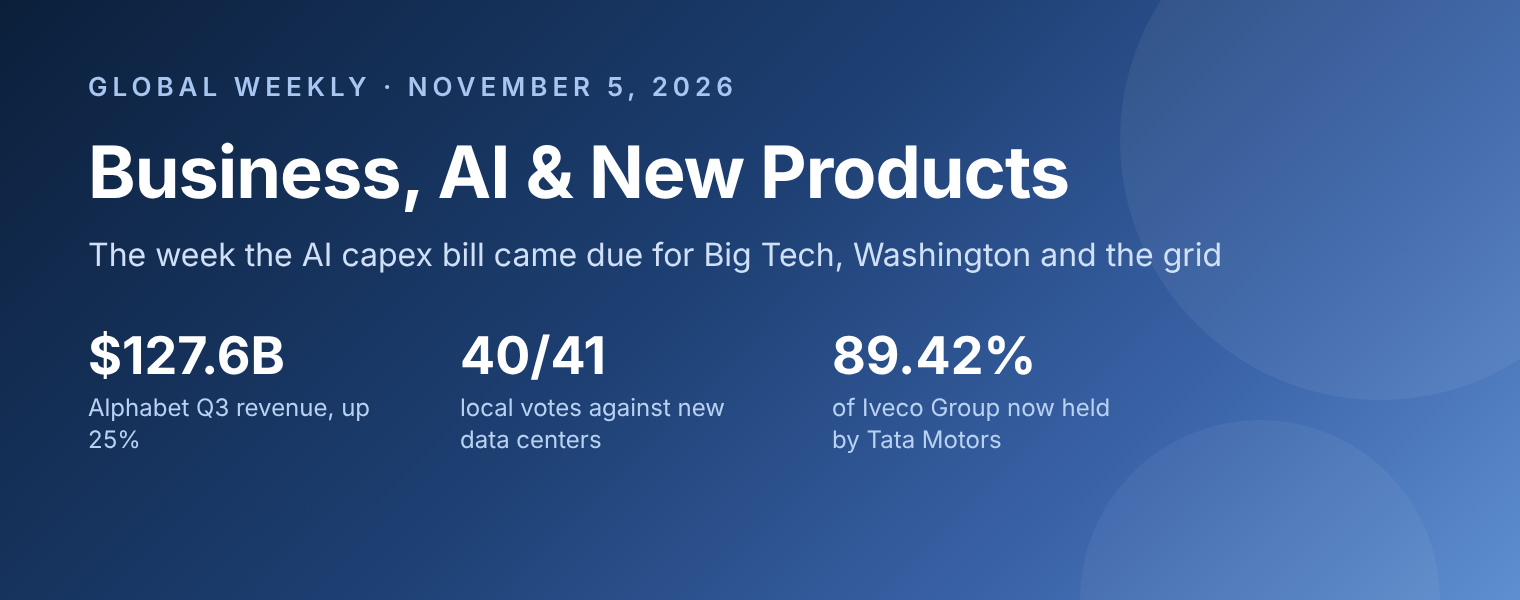
Spend enough time inside the past seven days of global business news and a pattern emerges: nearly everything comes back to how much it costs to build an artificial intelligence data center, and who ends up paying the electric bill.
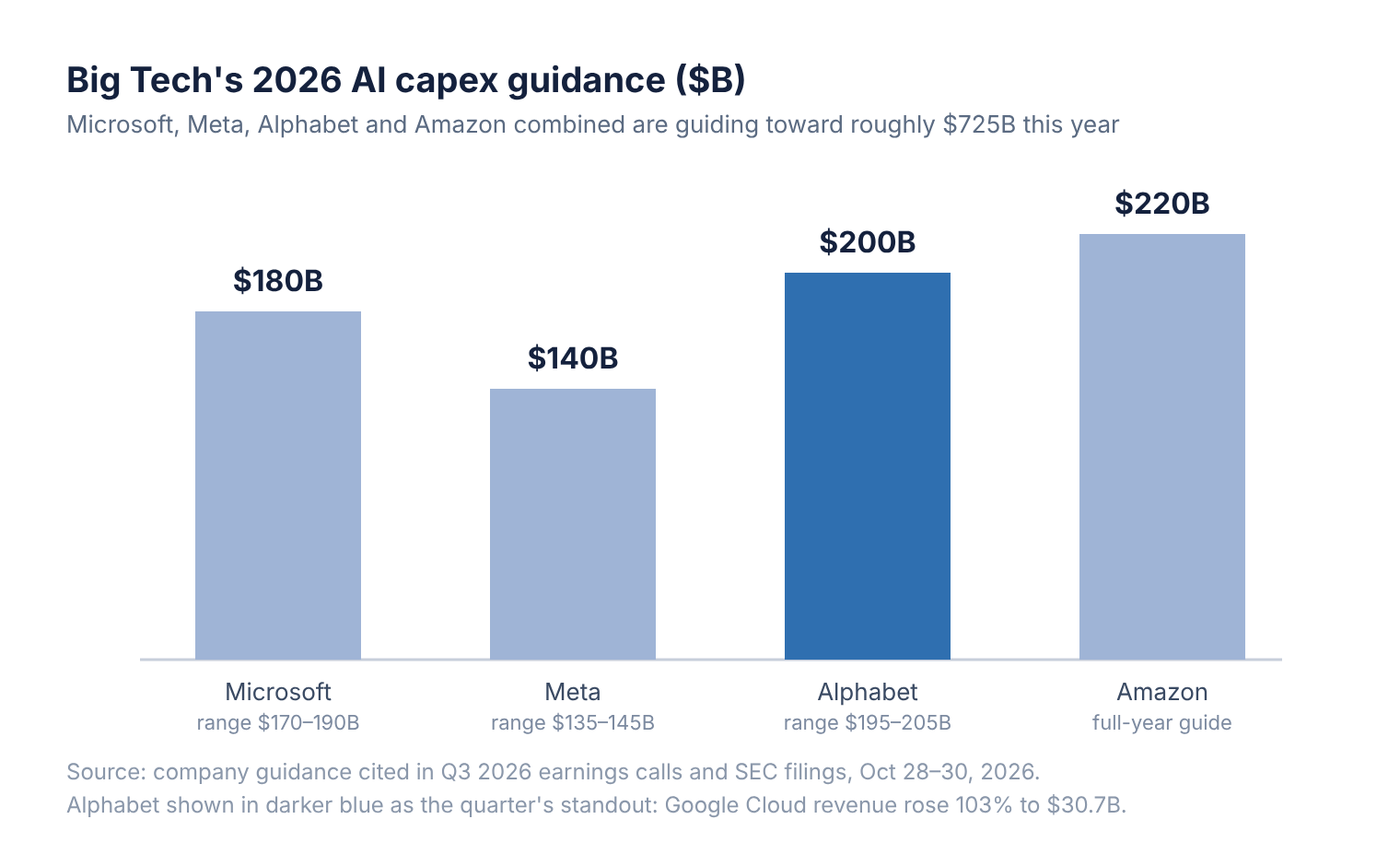
On October 28 the Federal Reserve left its benchmark rate at a target range of 3.75 to 4 percent, unchanged from September, a pause that gave markets one less thing to argue about just as the week's real story landed: Microsoft, Alphabet, Amazon and Meta between them are now guiding toward something like $725 billion in capital spending this year, most of it chips, servers and the power to run them. Alphabet's cloud business grew revenue 103 percent to $30.7 billion in the third quarter. Amazon's AWS grew 39 percent to $46 billion. Investors cheered the growth and flinched at the cash burn, and Amazon's stock fell even as the unit broke records.
That same spending is now colliding with the people who live near the data centers. On Wednesday OpenAI published what it calls a National Community Compact, promising to cover the full electricity and infrastructure cost of every site it owns after voters rejected new data centers in 40 of 41 local ballot measures held across ten states this cycle. Meanwhile Tata Motors took control of Iveco Group in a long-running €3.4 billion-plus tender offer, and Apple closed its fourth fiscal quarter under a new chief executive for the first time in fifteen years. Plenty of business this week, in other words, had nothing to do with GPUs at all.
Business
The Federal Reserve held its benchmark rate at a target range of 3.75 to 4 percent on October 28, matching where it had stood since a September move and leaving traders to argue over December without fresh data to settle it. Futures markets had priced the hold as the near-certain outcome going in, so the bigger economic story of the week came from corporate boardrooms rather than the Eccles Building.
Big Tech's third-quarter results, filed over October 28 and 29, told two stories depending on which line you read. Alphabet's revenue rose 25 percent to $127.6 billion, with Google Cloud nearly doubling to $30.7 billion and cloud operating income jumping to $11.1 billion from $3.6 billion a year earlier. Set against that: a roughly $8.7 billion hit from equity securities losses cut net income to $26.2 billion from $35 billion, and quarterly capital spending reached $51.4 billion against $24 billion a year ago, leaving the company with negative free cash flow for the quarter. Microsoft's Azure revenue grew 48 percent, pushing total revenue to $92.3 billion, up 19 percent; its own property additions rose to $39.4 billion from $19.4 billion. Amazon's AWS brought in $46 billion, up 39 percent, and posted record operating margins, yet the stock still fell on the results, an odd reaction to a beat that only makes sense once you notice the company is guiding toward roughly $220 billion in 2026 capital spending while running a trailing free cash outflow north of $42 billion.
Apple had a cleaner story. Reporting its fourth fiscal quarter on November 2, it posted record revenue of $114.5 billion, up 12 percent, and profit of $30.7 billion, in the first earnings call run by John Ternus, who succeeded Tim Cook as chief executive earlier this year. Cook, who ran Apple for fifteen years, now serves as executive chair.
Away from the AI-earnings vortex, Tata Motors took control of Iveco Group this week, settling the initial phase of its tender offer on October 30 and picking up about 89.42 percent of the Italian truckmaker's shares, just over 238 million of them, for roughly €3.43 billion at a price raised to €14.40 a share. The buyout isn't finished: the offer reopened for a second window from November 2 to 6, with further settlement due November 13, and Tata still has to work out how to mop up the remaining shares and delist Iveco from Milan. It barely registered as a headline next to Big Tech's numbers, but it's a reminder that plenty of heavy industry is still being bought and sold the old-fashioned way, in euros and share tenders, not GPUs.
AI
If there was a single AI story this week, it was less about a new model than about who pays for the ones already being trained. On Wednesday OpenAI published what it calls a National Community Compact, in effect a policy pledge that it will cover the full electricity and infrastructure cost at every data center it owns and operates, stop signing non-disclosure agreements with public officials, and disclose noise, water use and energy demand at its sites. The document, also described internally as a Compute Campus Policy Blueprint, follows an uncomfortable run of election results: voters rejected new data center projects in 40 of 41 local ballot measures held across ten states this cycle, and a Quinnipiac poll found 73 percent of registered voters oppose having a data center nearby. "This will help ensure that there is a very high floor in terms of how people move forward," said Chris Lehane, OpenAI's chief global affairs officer. The company is also putting money behind specific communities: an $80 million package in Effingham County, Georgia, that includes free school meals for all 14,000 students in the county, and a joint $6 million childcare commitment with SB Energy in Pike County, Ohio.
It's a striking position for a company whose entire business model depends on ever-larger data centers, and it says something about how fast the politics of AI infrastructure have shifted. A year ago the public debate was mostly about chatbot safety; this week it was about who absorbs a higher electricity bill.
Money kept moving regardless. Over the first five days of November, AI startups raised more than $2.3 billion across at least 14 disclosed rounds, led by the infrastructure company fal, which closed a $1.3 billion Series F. Further down the list, MMI, a robotic microsurgery startup, raised $125 million, and Munich-based Marble took in a $4 million pre-seed round from Heartcore Capital and Seedcamp, a sign that even as the headline numbers get stranger, plenty of ordinary-sized venture rounds are still getting done underneath them.
All of this sits on top of the capital spending detailed in the Business section above. The same companies pouring hundreds of billions into AI infrastructure are now also the ones writing community compacts and absorbing utility bills, because the industry has concluded, correctly, that the biggest risk to the AI buildout is no longer a bad model. It's a town council voting no.
New Products
Apple used its earnings week to quietly push out a run of hardware alongside the leadership news. Pre-orders opened in several markets for the latest iPad Mini, which carries an 8.5-inch OLED display, the new A20 Pro chip and IP67 water and dust resistance, the first OLED screen the Mini line has had. Behind it, an upgraded iMac built around Apple's M6 chip and a refreshed 14-inch MacBook Pro on the same chip family are both due in the first week of November, giving Ternus's first weeks as chief executive a product launch to point to alongside the earnings beat.
Elsewhere the smartphone calendar stayed busy on a smaller scale. Motorola gave its Signature 27 a global debut on November 5, the second phone in a series the company first showed off at this year's Snapdragon Summit; pricing and full specifications for most markets are still unannounced. Asus launched its 2026 Zenbook 14 lineup in India the same day, a Ceraluminum-built laptop offered in three finishes with processor options spanning Qualcomm Snapdragon, AMD's Ryzen AI 7 and Intel's Core Ultra 9 depending on configuration. Vivo is expected to round out the month with its X500 series, though neither pricing nor a firm release date has been confirmed.
None of it amounts to a single defining gadget of the week. This was a week of incremental refreshes and regional launches rather than a category-defining debut. But taken together with Apple's record quarter, it's a useful reminder that consumer hardware is still the part of the technology industry with a predictable, visible supply chain and a price tag a normal person can look up, in contrast to the AI infrastructure spending detailed above, where the real costs mostly show up later, on somebody else's utility bill.
What to watch
The Fed's last meeting of the year lands December 15 to 16, with markets split on whether October's hold was a pause or the end of the cutting cycle; expect that debate to dominate macro commentary through Thanksgiving. Watch whether other AI infrastructure players follow OpenAI's compact with pledges of their own, and whether the ballot-measure backlash spreads to state legislatures in the new year. Tata Motors' reopened offer window for Iveco shares closes November 6, with settlement due November 13 and the delisting process still to come. On the corporate calendar, Nvidia's next earnings report will be the clearest read yet on whether Big Tech's capex guidance is translating into actual chip demand, and Apple's holiday-quarter guidance will be the first full outlook issued under CEO John Ternus.
Sources
- Fed Interest Rate Decision (FOMC), October 28, 2026 — Forex Fundamentals
- FOMC Rate Decision October 2026 — Finance Calendar
- Big Tech Earnings: Google Cloud Up 103%, Azure 48%, AWS 39% — valueaddvc
- Microsoft, Meta, Google AI Capex Hits $725B (2026) — Tech Insider
- Apple Reports Q4 2026 Earnings: $114.5 Billion in Revenue, up 12% — 9to5Mac
- Apple Posts Fiscal Q4 2026 Results: $30.7B Profit on $114.5B Revenue — MacTrast
- Apple Leadership — John Ternus
- Apple Leadership — Tim Cook
- Tata Motors secures control of Iveco Group, new board takes office — Sustainable Bus
- Tata Motors takes control of Italian commercial-vehicle maker Iveco in 3.43 bn euro deal — ThePrint / PTI
- Breaking: Tata Motors to Acquire Iveco Group in €3.8 Billion Deal — Autocar Professional
- OpenAI to pay full data-center power costs, drop official NDAs — AI Weekly, citing CNBC
- November 2026 AI Funding Roundup — aifunding.me
- November 2026 Tech Launches: Motorola, Asus, Apple and Vivo Devices to Watch — Analytics Insight
As of November 5, 2026. Figures are as reported in company filings, earnings calls and the cited news coverage at time of writing and may be revised.
Comments
No comments yet. Start the conversation.
Sign in to comment. It takes an email address, no password.