Global Weekly No. 7 Week of Oct 19
Global Weekly — Business, AI & New Products (Oct 22, 2026)

Listen to this post · 8 min
Read aloud by a synthetic voice.
Three unrelated numbers landed this week, and they are really one number. Taiwan Semiconductor said its quarterly profit jumped 68.7%, to $23.9 billion, because it can't make advanced chips fast enough. Anthropic told prospective IPO investors it lost more than $80 billion in the first half of the year, mostly on paper, from how its fundraising notes are valued. And Tesla's operating profit fell by more than half even as the company pours money into robots and software nobody is paying for yet. AI capital spending has stopped being a line item executives wave at on earnings calls and started being what the earnings calls are about, for winners and losers alike. Apple, for its part, is about to try selling you a touchscreen laptop built to run all of it.
Business
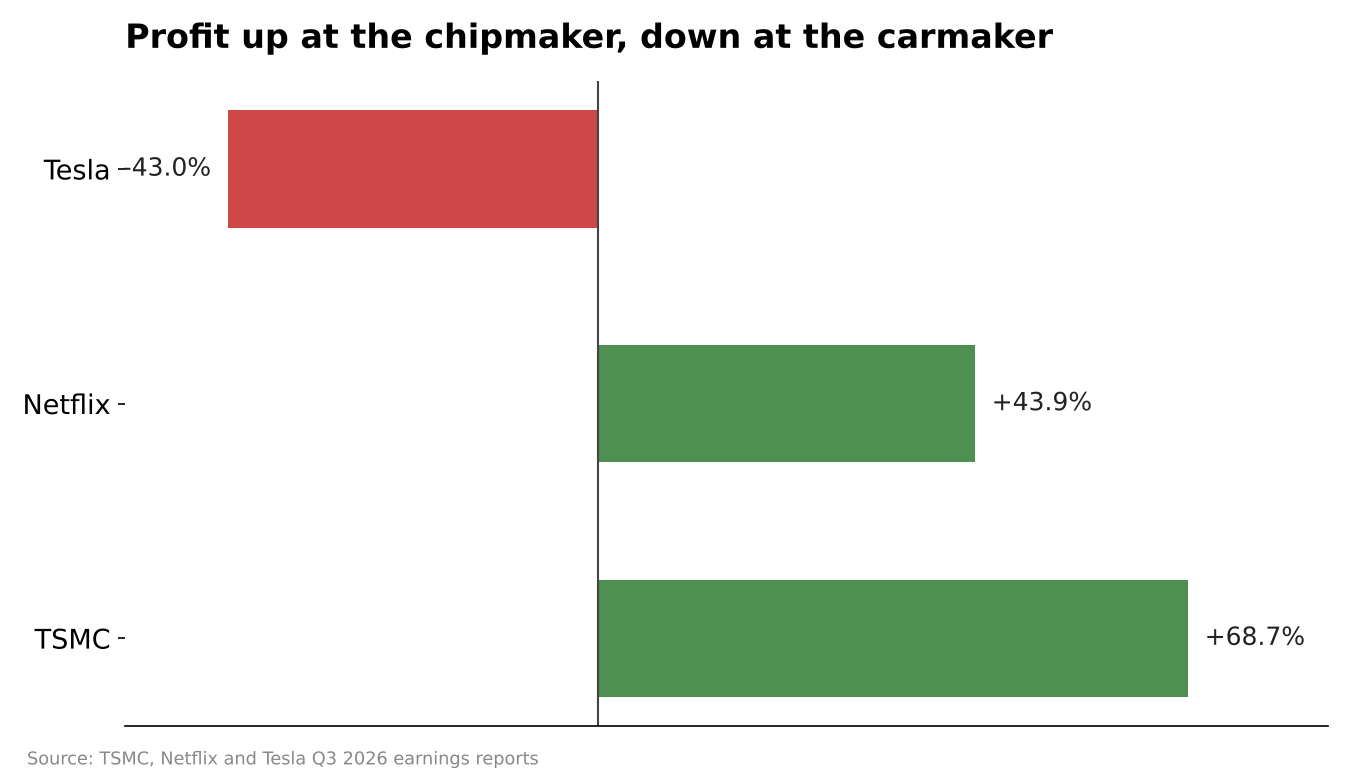
Taiwan Semiconductor Manufacturing Co., which fabricates the chips every AI lab depends on, reported third-quarter revenue of $46.7 billion, up 50.9% from a year earlier, and net profit of $23.9 billion, up 68.7%. Operating margin came in at 58.7%. Advanced nodes of 7 nanometers or smaller made up 79% of wafer revenue, with the newest 3-nanometer process alone accounting for a third of sales. TSMC isn't guiding for a slowdown; it says capacity is tight and getting tighter.
Streaming and carmaking told a different story. Netflix reported revenue of $12.87 billion for the quarter, up 11.8%, and net income up nearly 44% to $3.66 billion — strong numbers that still weren't enough to settle the stock, after the company trimmed its 2026 advertising revenue forecast to about $2.7 billion from $3 billion and cut its 2026 free-cash-flow guidance to roughly $12 billion. Six days before reporting, Netflix laid off about 6% of its workforce, its deepest cut since 2022, while buying back $4.8 billion of its own stock in the same quarter — more than the $2.88 billion in free cash flow it generated.
Tesla's quarter split the same way. Revenue held flat at $28.05 billion, and deliveries beat expectations at 486,532 vehicles, but net income fell 43% to $787 million as R&D spending climbed 69% and capital expenditure more than doubled to $4.73 billion, mostly funding Optimus, Cybercab and the company's "Super Intelligence" computing push.
Dealmaking kept pace with all of it. London Stock Exchange Group confirmed it's negotiating to buy Octus, a credit-data and AI-powered loan-analytics firm, from private equity owner Permira for $3.5 billion — a steep markup on the $1.3 billion Permira paid for it in 2022, and a bet that data on who's about to default is worth more than ever with corporate debt markets this busy. It's one of several moves this earnings season pointing the same way: Wall Street's full-year profit growth estimate for the S&P 500 has climbed toward 32%, and much of that lift is coming from companies either selling AI infrastructure or using AI to justify spending less on people.
AI
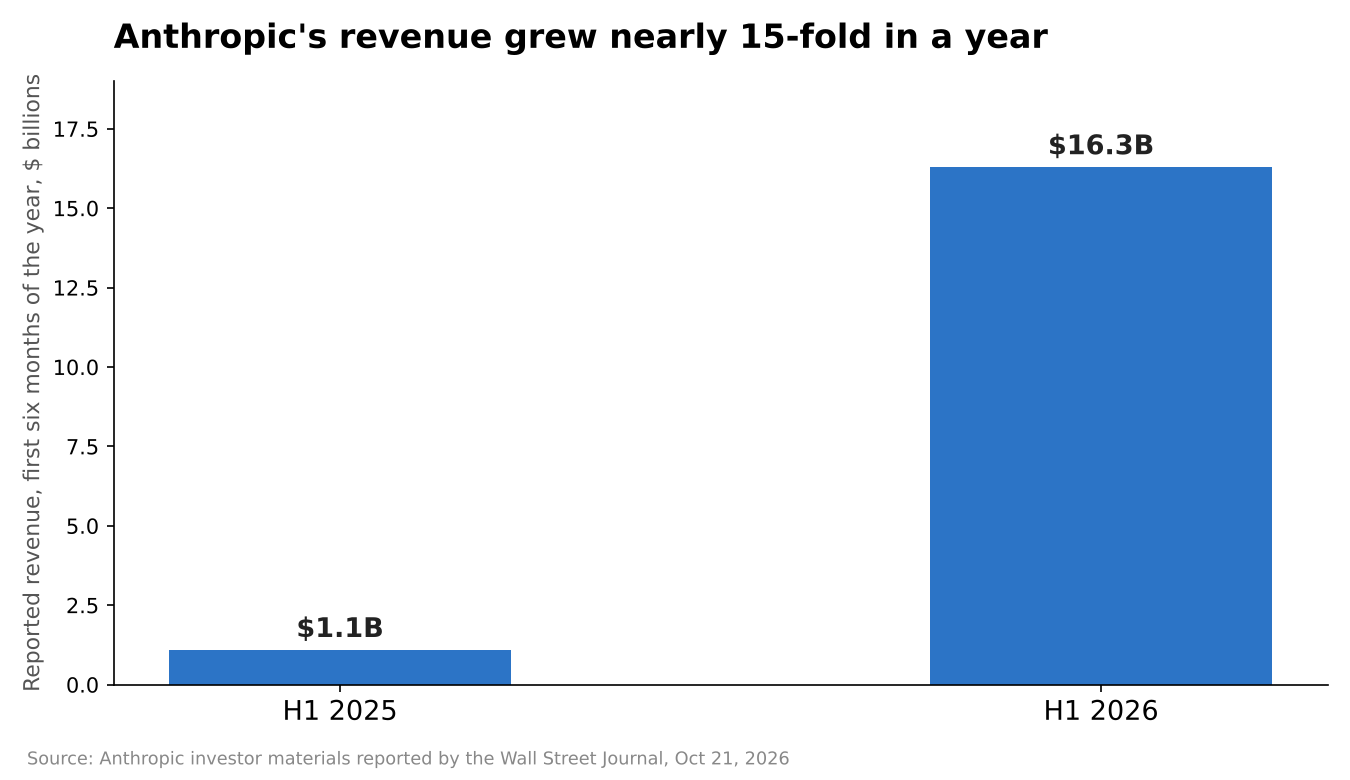
Anthropic's finances, as described in materials prepared for a planned stock listing and reported by the Wall Street Journal, show how expensive staying in the AI race has become. The Claude maker posted a net loss of more than $80 billion for the first six months of 2026, against revenue of $16.3 billion — itself up more than fourteenfold from $1.1 billion a year earlier. Roughly $72 billion of that loss was an accounting charge tied to the changing value of convertible notes issued to investors, not cash out the door, but the operating reality underneath is still stark: infrastructure spending nearly quadrupled to about $9 billion in six months, and the company has told investors it could spend up to $750 billion on computing capacity in the years ahead. At an investor presentation, bankers floated a listing valuation of roughly $1.5 trillion, down from the roughly $2 trillion figure that had circulated earlier this year — a sign that even AI's staunchest believers are starting to haggle.
OpenAI, for its part, spent the week finishing a pivot away from relying on any single cloud provider. Its exclusive hosting arrangement with Microsoft lapsed earlier this year, and Amazon Web Services moved immediately to host OpenAI's models; this week Google Cloud said it would add GPT models to its own marketplace and coding tools "in the coming weeks," completing what amounts to a three-cloud distribution strategy. The timing matters: OpenAI has been fundraising at a reported $1.4 trillion valuation while fielding questions about its own numbers, after an October 8 report found that the $70 billion annualized-revenue figure OpenAI had shared with investors depended on grossing up certain cloud-partner sales the way Anthropic does; counted OpenAI's usual way, the figure was closer to $50 billion. The gap was accounting, not sales, but it added to an unusually skeptical mood around AI companies' numbers this earnings season. Spreading itself across Microsoft, Amazon and now Google's infrastructure reads as much like insurance against any one partner's leverage as it does a distribution strategy.
What connects Anthropic's prospectus and OpenAI's cloud-hopping is the same tension showing up at TSMC and Tesla: the hardware underneath AI is wildly, verifiably profitable, while the software built on top of it is still proving it can make money honestly. Investors spent the summer rewarding anyone touching a chip or a data center. This autumn, they started asking the companies renting that capacity to show their math.
New Products
Apple will try to give the AI-hardware story a consumer face on October 27, when it's expected to unveil a touchscreen MacBook Pro for the first time — 14-inch and 16-inch models with OLED displays, a Dynamic Island cut into the screen, and a thinner, lighter chassis than the current lineup, alongside a standard M6-chip MacBook Pro without the touch display. Bloomberg reports Apple plans to keep the MacBook Pro name rather than rebrand it, and that the same event will introduce an OLED iPad mini with a landscape-oriented camera built for video calls and a redesigned speaker layout, plus an M6 iMac. Apple is reportedly skipping an in-person launch event in favor of an online video presentation and separate hands-on press briefings.
A touchscreen MacBook is a strange thing to call news in 2026 — Windows laptops have had the feature for over a decade — but it fits this week's pattern more than it first appears. Every major computing platform is racing to make local hardware feel useful for running AI workloads rather than just displaying chat windows, and Apple has resisted touchscreen Macs specifically because it didn't want to blur the line between a trackpad-and-keyboard machine and an iPad. Folding that argument now, in the same month Anthropic and OpenAI are explaining to investors just how much physical computing their software needs, suggests even Cupertino thinks the interface for AI is going to require more than a text box.
What to watch
Apple's hardware event lands October 27. The Federal Reserve meets October 28–29, with markets pricing in a high probability of another rate cut. Alphabet, Microsoft, Meta and Amazon report earnings in the days after, and their capital-expenditure guidance will be parsed line by line for signs of whether this year's roughly $800 billion in combined AI infrastructure spending across the hyperscalers is holding up — or whether Tesla's and Netflix's margin squeeze is a preview of what's coming for them too.
References
- Anthropic posts $80bn loss in first half of 2026: WSJ — Al Jazeera
- OpenAI Completes Cloud Trifecta as Microsoft Deal Ends, Eyes Enterprise Revenue — Gokhshtein
- OpenAI annualized revenue $20 billion less than previously reported — Axios
- TSMC Q3 (July-Sep) profit jumps 68.7% to USD 23.9 billion, revenue rises 50.9% — Times of Oman
- Netflix Q3 2026 Earnings Analysis — Beancount
- Netflix is laying off 6% of its workforce — ABC30
- Tesla (TSLA) releases Q3 2026 financial results — Electrek
- LSEG To Buy Finance Data Specialist Octus For $3.5bn — FStech
- Apple to Launch Touchscreen OLED MacBook Pro and OLED iPad mini on October 27 — MacRumors
Filed under Market
Comments
No comments yet. Start the conversation.
Sign in to comment. It takes an email address, no password.