Global Weekly No. 8 Week of Oct 26
Global Weekly — Business, AI & New Products (Oct 29, 2026)

Listen to this post · 8 min
Read aloud by a synthetic voice.
Over the past seven days, Wall Street's running tally of how much money the AI boom actually needs got bigger again. Meta told investors it now wants to raise $97.5 billion through stock sales, just a day after floating a $95 billion version of the same plan. SpaceX signed roughly $40 billion in lease commitments for computing hardware. DoorDash moved toward paying $17 billion for Instacart, a fifth the size of either AI financing deal, in a week when grocery delivery looked almost quaint by comparison. All of this happened while the Federal Reserve held interest rates at 3.75% to 4.00% and watched two of its own governors dissent — not toward a cut, but toward a hike. The numbers only make sense read together: the companies funding the AI buildout are moving faster than the economy meant to absorb it, and for the first time in a while, some of the people who set interest rates agree.
Business
The Federal Reserve held its benchmark rate at 3.75% to 4.00% on Wednesday, the second straight hold after September's cut, in a 10–2 vote that broke in an unusual direction. Governors Lisa Cook and Beth Hammack didn't want a smaller cut or a bigger one — they wanted the Fed to raise rates by a quarter point instead. That's a rare hawkish dissent from a Fed that spent most of the last two years cutting, and Chair Jerome Powell told reporters a December cut is "not a foregone conclusion," a line traders read as more cautious than his tone over the summer. Gold, which had rallied toward $4,130 an ounce on bets for an easier Fed, gave some of that back after the meeting; oil eased too, taking a little pressure off the inflation argument the two dissenters are clearly still having with their colleagues.
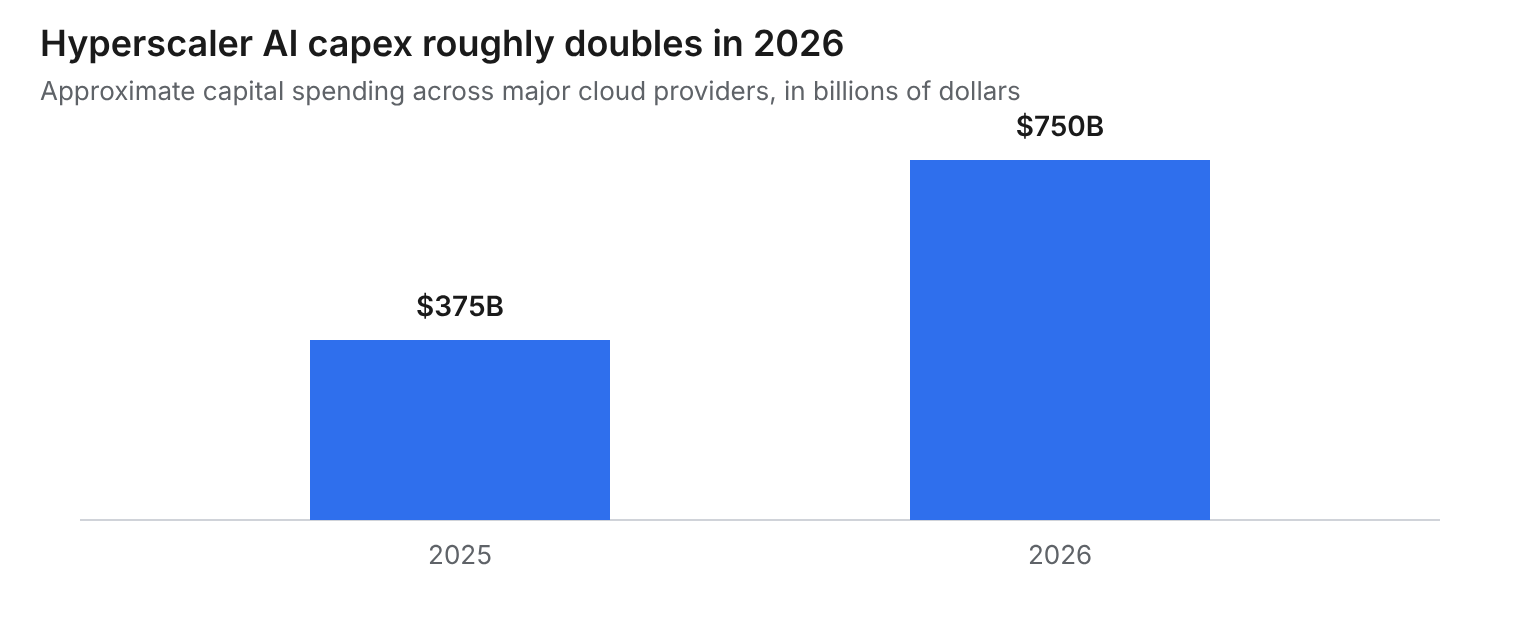
The timing mattered because this was also the week Big Tech tried to convince investors its AI spending will eventually pay for itself. Meta went first and went badly: when it reported on October 21, shares fell 7% and the company posted negative free cash flow for the first time since its 2012 IPO, even as it reaffirmed capital spending of $135 billion to $145 billion for the year. The Nasdaq had its worst single day since June on the news. Alphabet and Microsoft reported Wednesday, Amazon on Thursday, and between the three of them Wall Street is now tracking nearly $1.7 trillion in cloud contracts not yet billed against roughly $600 billion the trio plans to spend this year chasing it. Across hyperscalers as a group, 2026 capital spending is on pace to roughly double what they spent the year before.
Deal-making moved at a smaller, though still enormous, scale. DoorDash spent the back half of the week in advanced talks to buy Instacart for roughly $17 billion, according to the Wall Street Journal and Reuters — a deal that would fold grocery delivery's second-place player into the service that now handles close to 59% of category deliveries, up from 44% five years ago. Instacart's own stock, worth about $13 billion before the reports broke, jumped 8% on the news; DoorDash fell 6%. It's the same consolidation logic already playing out at Uber, which agreed earlier this year to buy Delivery Hero for $14.8 billion.
AI
If the Fed is worried about overheating, it might look at how AI companies are financing themselves. Meta's fundraising plan grew twice in two days: a $95 billion proposal floated Monday became $97.5 billion by Tuesday, built from roughly $35 billion in public stock and preferred-share offerings plus an at-the-market program that could eventually sell up to $60 billion more, mostly through new nonvoting Class C shares designed so Mark Zuckerberg doesn't dilute his control while the company dilutes everyone else's. Nvidia is putting in $3 billion of that round and will expand its Vera Rubin and Vera CPU systems inside Meta's data centers; AMD is in for $1 billion, with its Helios server racks and EPYC chips already running the infrastructure behind Meta's Muse AI assistant. Nvidia, AMD and Broadcom together have discussed buying as much as $5 billion more of Meta's ordinary shares. Chip makers are no longer just selling hardware to the AI buildout — they're underwriting it.
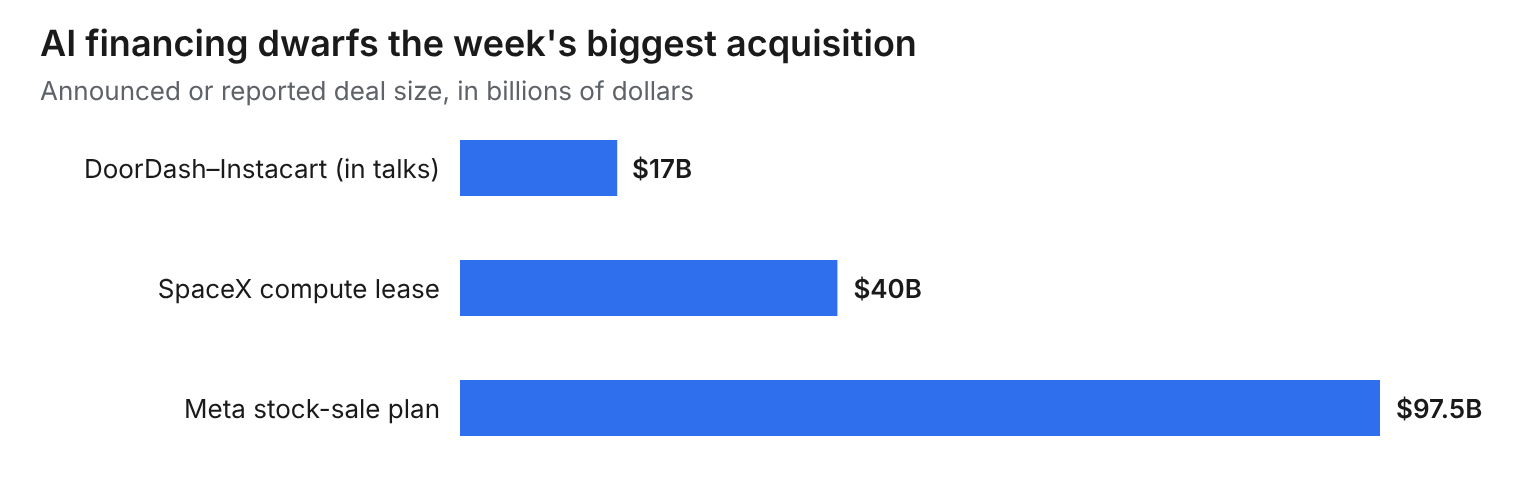
SpaceX took a different route to the same problem. The company agreed to roughly $40 billion in lease payments, arranged through a vehicle tied to Apollo Global Management, to secure data-center equipment and AI processors without buying any of it outright — a bet that leasing compute looks better on a balance sheet than owning it, at least for now. Nvidia, for its part, spent the week launching Minerva, a monitoring platform meant to catch failures across the GPUs, networking and storage inside what the industry now calls "AI factories" before they take a cluster down; IBM, Lambda and Tesla are on the list of early users.
Not every AI story this week was about money. The Washington Post reported that a security firm called Cathedral used AI agents to break into a limited set of Anthropic's internal sales, HR and IT systems in under 12 hours, reaching Slack conversations and meeting notes but not, Anthropic says, customer data, model weights or source code. Anthropic frames it as an authorized research exercise that went past its disclosure rules rather than an attack; it disabled the affected connections and restored them once the holes were patched. Either telling makes the same point: the software wrapped around these models is often the weakest part of them, a detail easy to miss amid all the talk of GPUs and gigawatts.
New Products
Apple spent the week proving hardware updates can still generate a news cycle of their own, even one crowded out by trillion-dollar AI headlines. On October 26, it refreshed the iPad Mini with an 8.5-inch OLED screen, an A20 Pro chip and the line's first water and dust resistance rating (IP67) — paired with a second price increase this year, to $699. The new Smart Folio case costs $79 on its own, and fast charging needs a 35-watt adapter that isn't included.
Two days later came the bigger move: a MacBook Pro with a touchscreen OLED display, Apple's first touch-enabled Mac and its first OLED one, built on the M5 Pro and M5 Max chips it introduced earlier this year. It adds a Dynamic Island notch, a glowing Apple logo and up to 16 terabytes of storage, at roughly a $400 premium over the equivalent mini-LED configuration; a maxed-out model runs to $14,549 before anyone has opened a single AI app on it. Apple also bumped the base 14-inch MacBook Pro and the iMac to its new M6 chip and quietly raised the price of a fully loaded Mac Studio, with 512GB of memory, to $22,299. Everything ships November 6.
The subtext is that Apple, which has spent two years fielding questions about why it isn't spending like Meta or Microsoft on AI infrastructure, chose this week to answer with screens and chips instead of GPUs and data centers — a strategy that works fine until Siri's long-promised AI overhaul actually needs somewhere to run. Judging by what the rest of the industry announced in parallel this week, that somewhere is getting very expensive to build.
What to watch
- Amazon reports Q3 earnings October 29 — the last of the big three cloud results, and the one that will show whether AWS and Kiro, Amazon's agentic coding tool, are converting spending into growth.
- Whether DoorDash and Instacart turn their advanced talks into a signed agreement, and how quickly antitrust reviewers take an interest in a deal that would consolidate most of grocery delivery under one company.
- The next FOMC meeting, December 9–10, where Jerome Powell will need an answer for whether Lisa Cook and Beth Hammack's hawkish dissent gains company.
- Apple's OLED MacBook Pro and refreshed iPad Mini ship November 6; early reviews will say whether the touchscreen is a gimmick or the start of something.
- Meta's new nonvoting Class C shares, the vehicle for its at-the-market stock program, are expected to begin trading in the first quarter of 2027.
References
Business
- Federal Reserve, FOMC statement, October 28, 2026
- DoorDash in talks to acquire Instacart in potential $17 billion deal — FSR Magazine
- Big Tech Earnings: $1.7T Backlog, $600B Spend — Tech Insider
- Big Tech Earnings Oct 28-29: Copilot Hits 50M Users — Tech Insider
AI
- Meta raises AI fundraising plan to $97.5 billion as Nvidia, AMD pledge investments — The American Bazaar
- Tech News Today, October 26, 2026: Nvidia, Meta's AI Funding Plan, SpaceX's Chip Deal, and Anthropic Security Breach — Tech Startups
New Products
Filed under MarketTechnology
Comments
No comments yet. Start the conversation.
Sign in to comment. It takes an email address, no password.