Starmind: shooting the AI datacenter into space. Why?

本文以英文撰寫。閱讀中文版
收聽這篇文章 · 8 分鐘
由合成語音朗讀。
SpaceX wants to put AI computing in orbit, up to a million satellites of it. The reasons are on the ground.
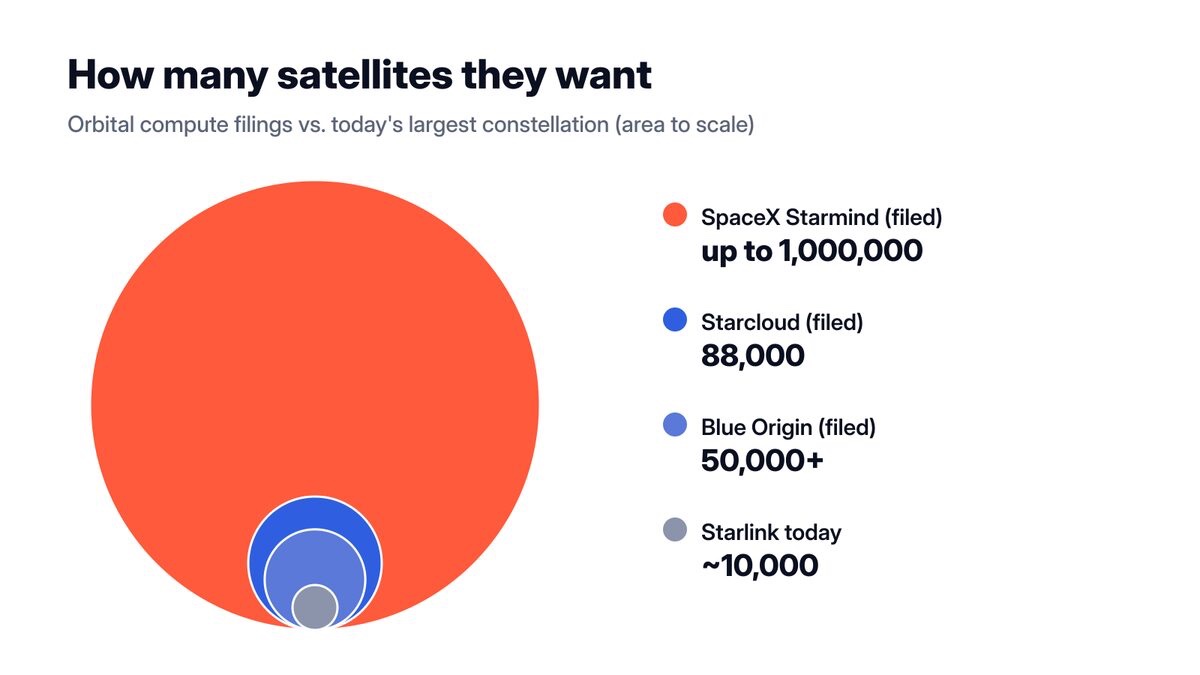
In June, Elon Musk confirmed a name for something SpaceX had been describing in regulatory paperwork since January: Starmind, a constellation of satellites that would do the job of an AI data centre from orbit. The filing to the US Federal Communications Commission asks for room for up to one million of them. For comparison, the whole Starlink network, the biggest constellation ever built, is a little over 10,000.
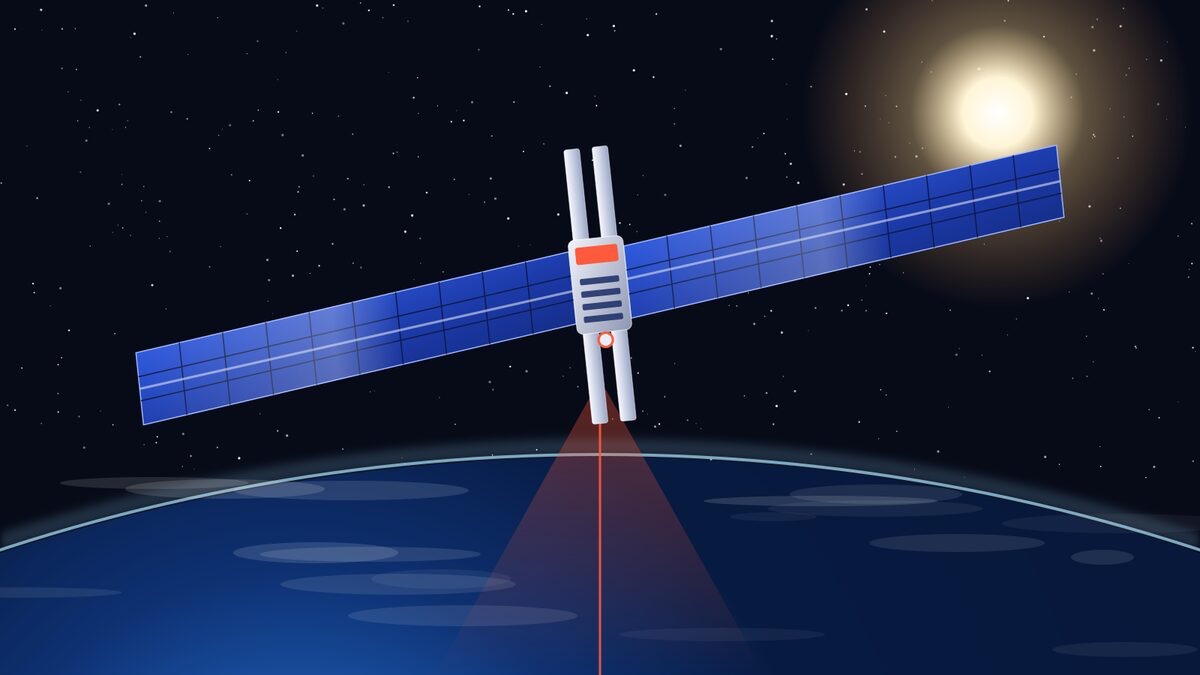
It is easy to file this under "Musk being Musk". I think that would uube a mistake. The plan may well not work as advertised, but the reasons behind it are real, and they touch anyone who pays an electricity bill or works for a company buying AI.
The problem on the ground
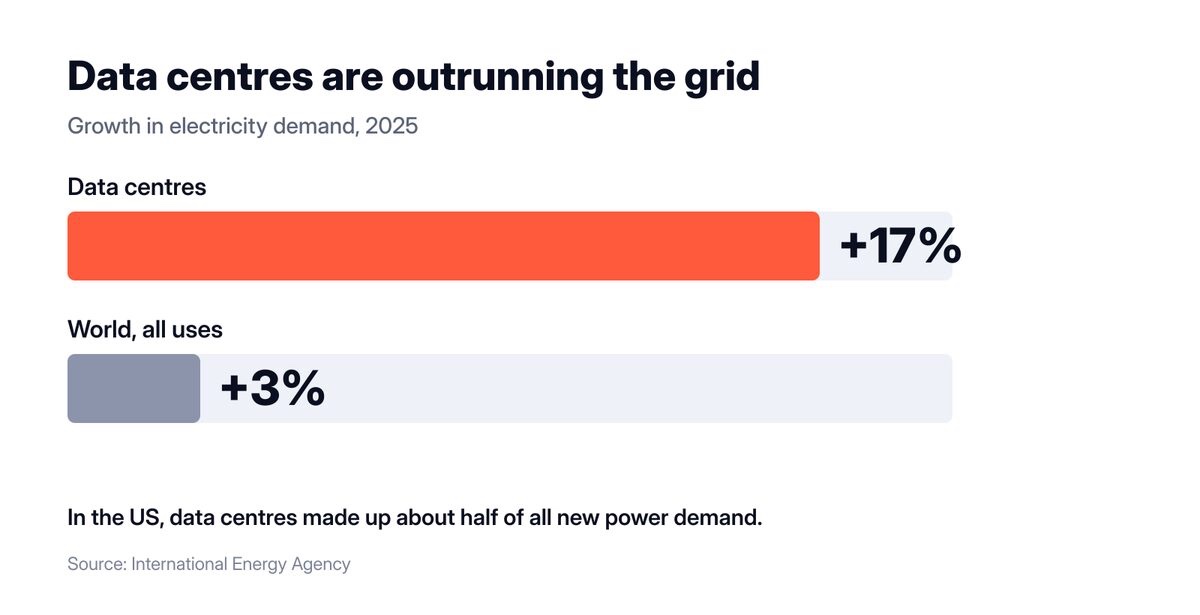
Start with the boring part: power. The International Energy Agency says electricity demand from data centres grew 17% in 2025, against about 3% for the world as a whole. In the United States, data centres made up roughly half of all growth in power demand last year. A typical data centre already uses as much electricity as 100,000 homes, and the biggest campuses now being built will use 20 times that.
Grids were not planned for this. Projects are queuing for connections from Virginia to Finland. To fill the gap, US developers had plans for about 180 gigawatts of new gas-fired plants as of August, which is close to the EU's entire gas capacity. In the US, local opposition blocked or delayed at least 16 data centre projects last year, worth about $64 billion in total, over power demand, water use and property values. In many places, a permit, a grid connection and enough cooling water are now harder to get than the chips.
So the question SpaceX is asking is fair: what if you could skip all three?
What SpaceX is actually proposing
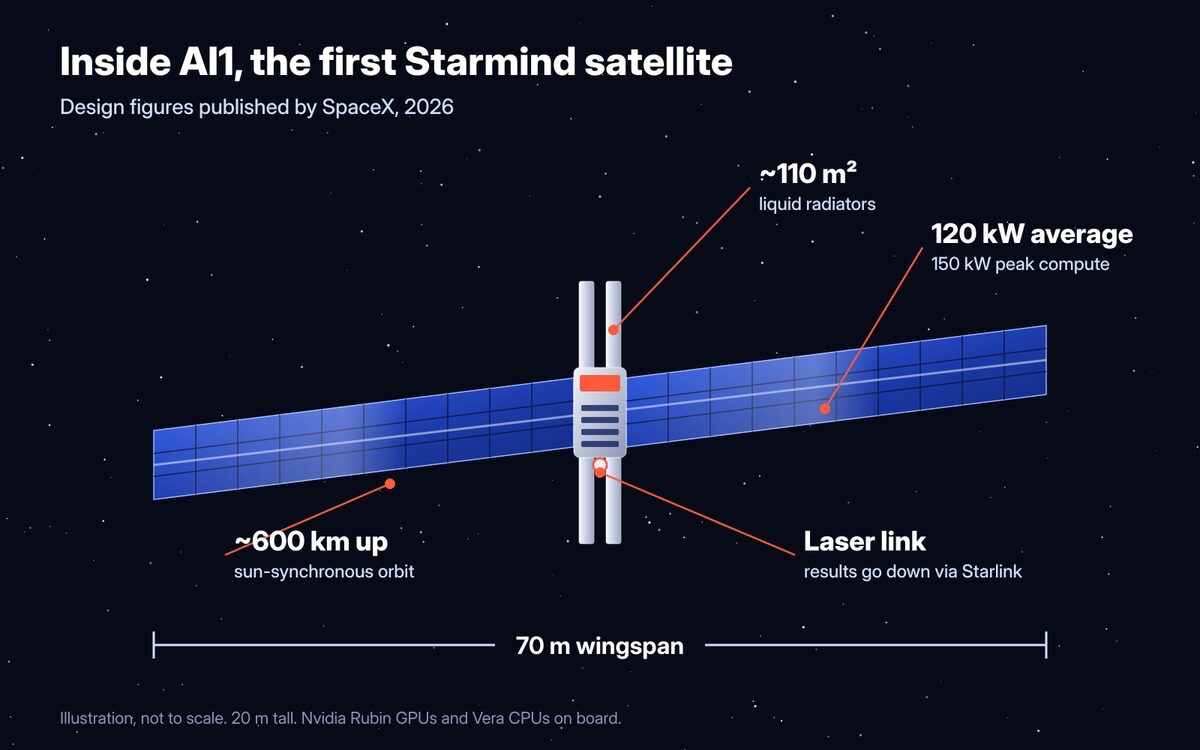
The first Starmind satellite is called AI1, and it is not small. SpaceX's published figures put it at 20 metres tall with a 70-metre wingspan once its solar arrays unfold. It is meant to average about 120 kilowatts of computing power and peak at 150, roughly what a modern server rack draws on Earth. The heat goes out through about 110 square metres of liquid radiators.
In August, SpaceX said Nvidia would co-design the compute payload: Rubin GPUs and Vera CPUs, adapted from the same family of hardware that fills ground data centres. The satellites would sit around 600 km up, in a sun-synchronous orbit where the panels see sunlight almost all the time, and they would send results down through laser links into Starlink. Prototypes are due in early 2027, with a factory called Gigasat meant to start volume production after that. Only a rocket like Starship can lift something this big, which is the other half of the logic: SpaceX owns the truck.
The pitch fits on one line. In orbit, the sun never sets, there is no grid to wait for, nobody needs a zoning permit, and you do not pour drinking water into cooling towers. Musk has said he expects space to be the cheapest place to run AI within a few years.
Why the physics argues back
Here is where engineers start shaking their heads. Space is cold, but it is a vacuum, and a vacuum is a terrible place to get rid of heat. On Earth, fans and water carry heat away. In orbit the only way out is radiation, which is slow. Nearly every watt a GPU uses ends up as heat, so a satellite running 120 kW needs a large radiator, and a million of them need an unthinkable amount.
Radiation of the other kind is a problem too. Cosmic rays flip bits in memory and wear chips out faster. Solar storms are worse: in February 2022, a fairly mild geomagnetic storm knocked 38 new Starlink satellites out of orbit. Then there is repair. When a GPU fails in a ground data centre, a technician swaps it the same afternoon. When one fails at 600 km, it stays failed.
Bandwidth matters as well. Starlink's laser links are fast for a satellite, but they are nothing like the cables between GPUs inside one building. That makes orbit poorly suited to training giant models, which needs thousands of chips talking constantly. It is better suited to inference, answering requests with a model that is already trained, which is what SpaceX says AI1 will do.
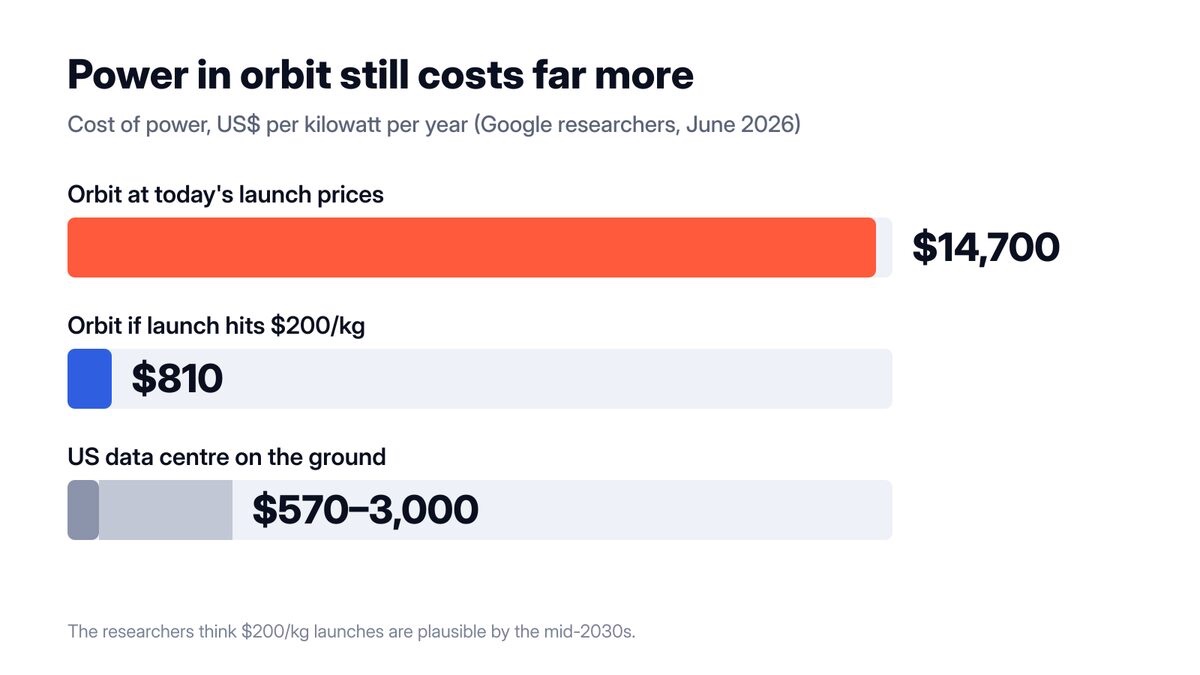
And then money. The consultancy Wood Mackenzie estimates a 1-gigawatt data centre in orbit would cost about $170 billion, more than three times the same capacity on the ground, with launch and the satellites themselves making up around 60% of the bill. Google's own researchers, in a June paper, put orbital power at about $14,700 per kilowatt per year today, compared with $570 to $3,000 for a US data centre. Their numbers only become competitive if launch costs fall to about $200 per kilogram, which they think could happen by the mid-2030s.
Who else is trying, and why it matters to you
The idea has company. Starcloud, a startup from Redmond, Washington, put an Nvidia H100 in orbit in November 2025 on a 60-kilogram satellite and trained a small language model on Shakespeare up there. It has since filed for 88,000 satellites. Google's Project Suncatcher plans two prototype satellites carrying its TPU chips by early 2027. Blue Origin has asked for permission for more than 50,000. When several of the richest companies in the world reach the same strange idea at the same time, the idea is telling you something about the pressure on the ground.
Most of us will never touch a Starmind satellite. But we will feel the forces behind it. AI is turning into an energy business. The price of the tools at work, the speed at which a company can roll out a new model, even the electricity bill at home in some regions, now depend on how fast power and grid capacity can be added. Starmind is one answer to that pressure. Others are small nuclear reactors, data centres built next to solar farms in deserts, and simply making chips and models more efficient.
My take
My own view is that Starmind is less a data centre than a bet on launch costs, with an AI badge on it. If Starship really does bring the price of a kilogram to orbit down by ten times, a lot of strange things become cheap, and orbital compute is one of them. If it does not, AI1 will be an impressive demo and a footnote. What I would watch is not the satellite count in the FCC filing but two plainer numbers: the cost per kilogram on Starship flights in 2027, and whether anyone besides SpaceX's own xAI pays to run work up there. I also suspect the first real customers will be things already in space, such as Earth-observation satellites that want to process images before sending them down. Chatbots on Earth come later, if at all. And the part I find most useful for the rest of us is the uncomfortable mirror it holds up: if moving servers into orbit sounds reasonable to serious people, our grids, permits and water planning on the ground are further behind than we admit. Fixing those is less exciting than a rocket, but it is the work most of us can actually influence.
Sources. SpaceX: Starmind · Notebookcheck: AI1 satellite specs and cooling · Interesting Engineering: SpaceX and Nvidia AI1 payload · The New Stack: why space is a hard place to cool a data center · TechTarget: when orbital AI data centers become business reality · IEA: data centre electricity use surged in 2025 · Fortune: US data center demand and local opposition · Quartz: the orbital data center race. Illustrations and charts drawn for this article.
分類於 科技
每週一封信,收到 NeatRead 的精選文章
每週一封,不需要密碼,隨時可以取消訂閱。
或使用電子郵件繼續
使用電子郵件時,我們會寄登入連結給你。
留言
還沒有留言。來開啟話題吧。
登入後即可留言。只需要電子郵件,不用密碼。