Why the ASI ban went viral
Listen to this post · 7 min
Read aloud by a synthetic voice.
The year's loudest AI debate, read as a launch that found its market and a requirement that would fail review.
On Thursday morning, my team's group chat had nothing to do with work. Someone posted a screenshot of a US congresswoman saying a pause on advanced AI and a ban on superintelligence should be her party's top priority. Within an hour a designer, two engineers and our finance lead were arguing about something none of us can define. That was when I knew the "ASI ban" had left the policy niche and become a mass-market product.
Here's how I read the story: as a launch that found product–market fit, and as a requirement that would fail any decent review.
First, what actually happened
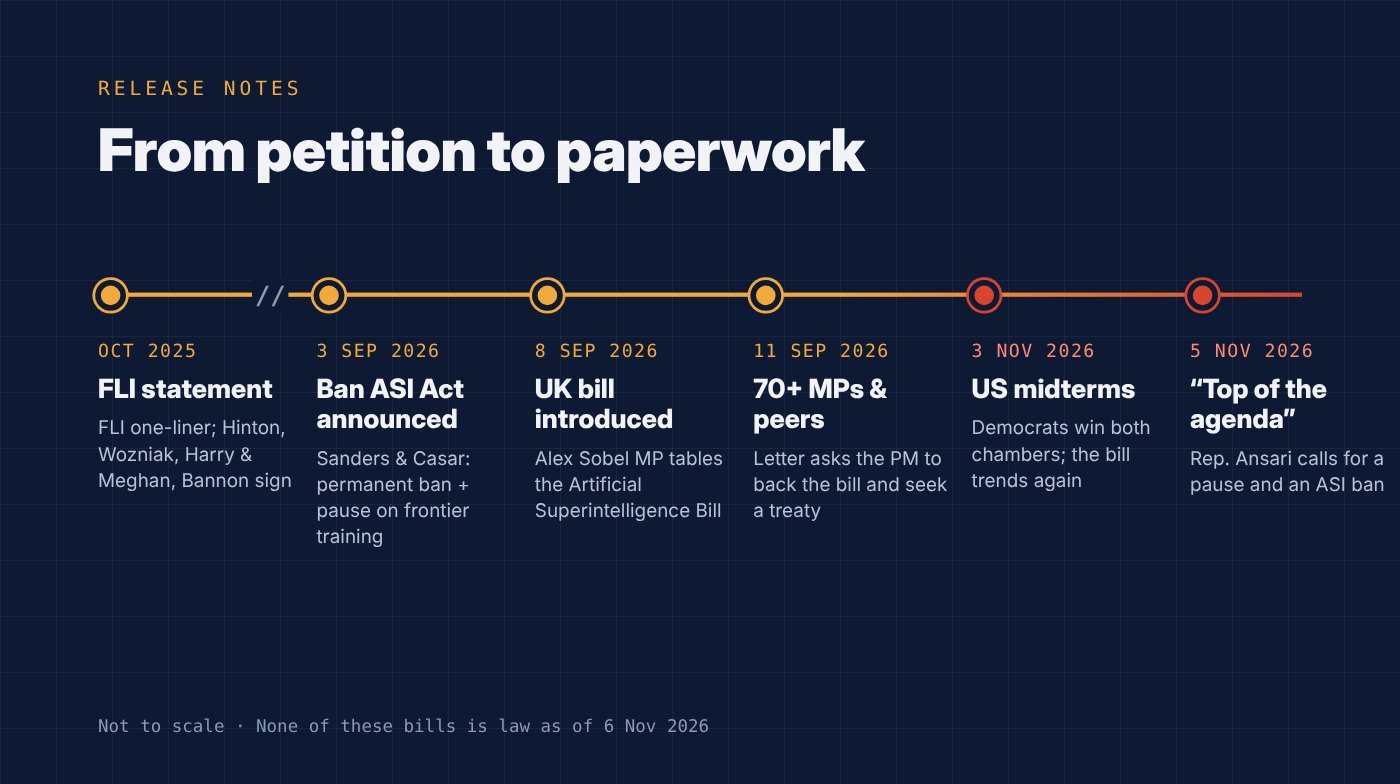
In October 2025 the Future of Life Institute published a one-sentence statement calling for a prohibition on developing superintelligence until there is broad scientific consensus that it can be done safely, plus strong public buy-in. The signers ranged from Geoffrey Hinton and Yoshua Bengio to Steve Wozniak, Richard Branson, Prince Harry, Meghan Markle and Steve Bannon.
Then 2026 turned the petition into paperwork. On 3 September, Senator Bernie Sanders and Representative Greg Casar announced the Ban Artificial Superintelligence Act. Five days later in London, Labour MP Alex Sobel introduced the Artificial Superintelligence Bill, and more than 70 MPs and peers wrote to the prime minister backing it. On 3 November the US midterms handed Democrats both chambers of Congress, and the bill came back into everyone's feed with a very different chance of moving. None of these bills is law yet. Virality doesn't wait for law.
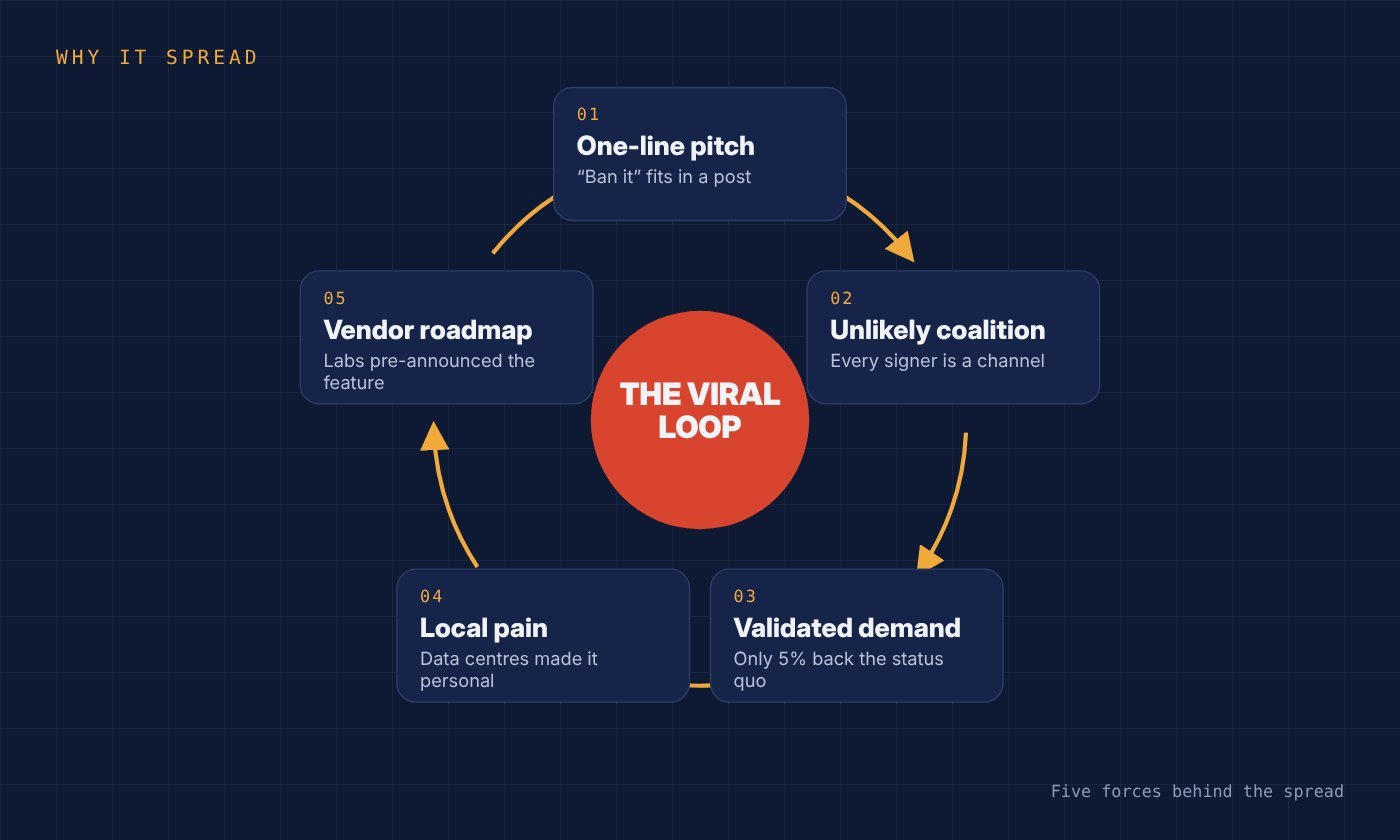
Why it spread: five launch lessons
1. The pitch fits in one sentence. Most AI policy is a 400-page framework nobody shares. This is one line with one verb: ban it. Simple asks travel. Every product that spreads has a one-liner, and "stop building the thing that could out-think all of us" is about as sticky as they come.
2. The launch partners were strangers. A Nobel laureate, a royal couple, a populist strategist and a pop star rarely share a press release. Each signer was a distribution channel into a different audience, and the oddness of the line-up was itself the hook. Nobody could dismiss it as the usual suspects.
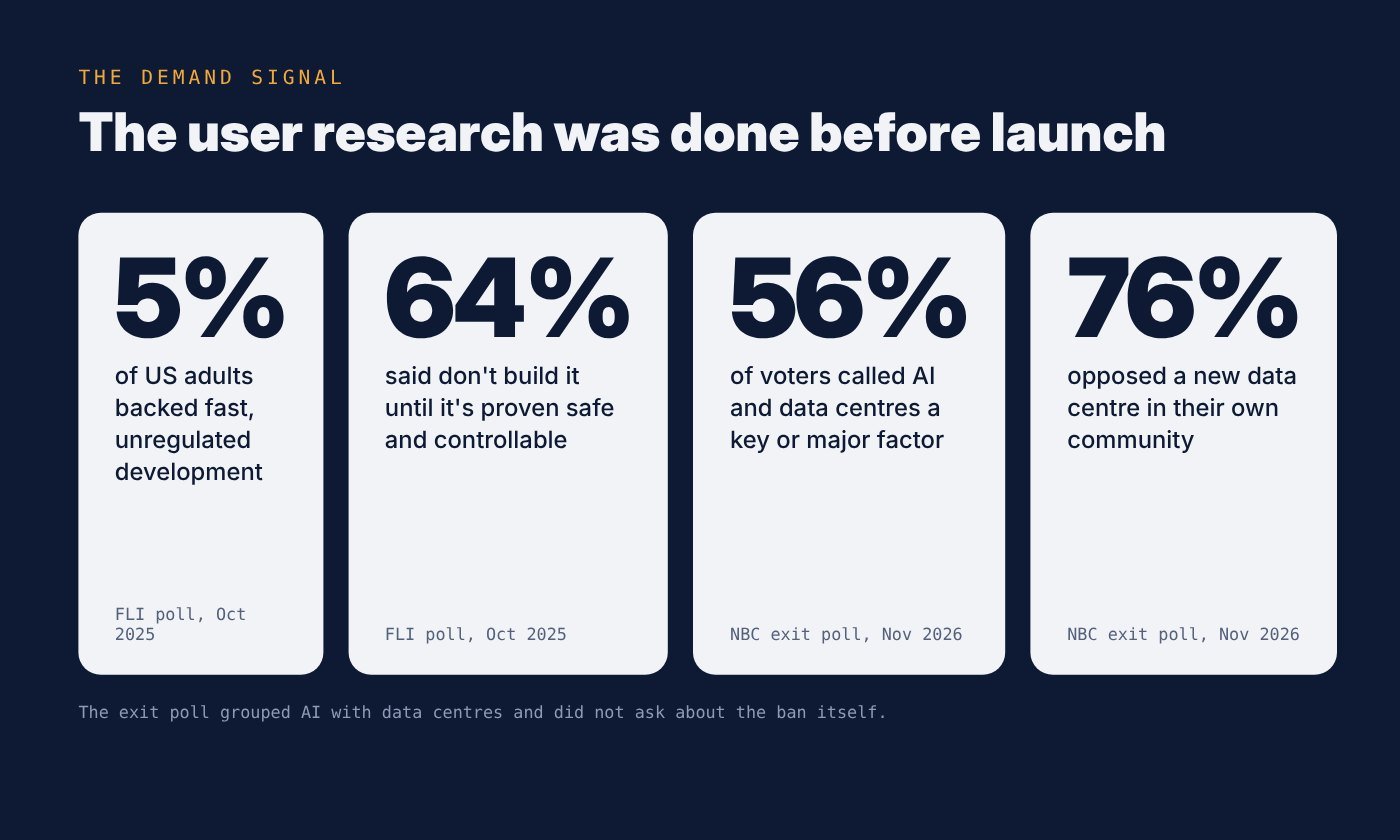
3. The user research was done before launch. FLI released a poll alongside the statement. Only 5% of US adults backed fast, unregulated development, and 64% said superintelligence shouldn't be built until it's proven safe and controllable. In product terms, demand was validated before the first post. People weren't being persuaded. They were being handed a name for a feeling they already had.
4. An abstract fear got a local face. Superintelligence is hard to picture. A data centre down the road, using water and pushing up power bills, is not. In NBC's 2026 exit poll, 56% of voters called AI and data centres a key or major factor in their vote, and 76% opposed a new data centre in their own community. That poll didn't ask about the ban. But it shows how a distant risk got bundled with a nearby annoyance, and that bundle is what turns a niche issue mainstream.
5. The vendors announced the roadmap themselves. Tech leaders have said publicly that superintelligence is "in sight" or likely by around 2030. When a company pre-announces a feature, customers react to the feature, not to the current release. The labs created the anxiety the ban campaign is now collecting.
Why this ticket goes back
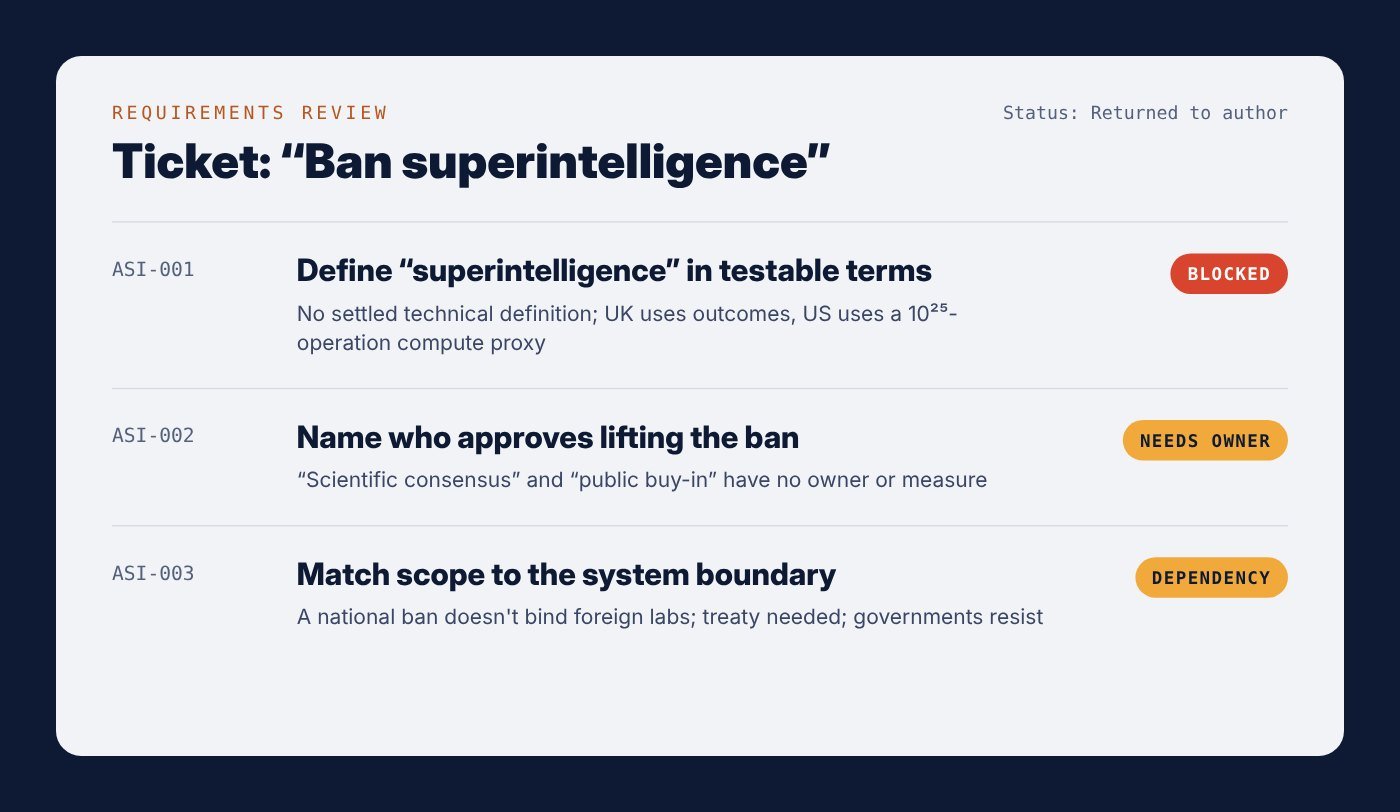
Going viral and writing a good specification are different skills. If this landed on my desk as a ticket, I'd return it with three comments.
No testable definition. Superintelligence has no settled technical definition, so a ban is hard to draw a line around and harder to prosecute. The drafters know this. The UK bill defines it by outcome, the way Britain's Chemical Weapons Act defines toxic chemicals by their effects. The US bill leans on a proxy, pausing systems trained with at least 10²⁵ operations. A proxy is measurable, which I like. But any analyst knows what happens when a metric becomes a target: teams optimise to land just under it.
No named approver. The original statement says the ban lifts once there is scientific consensus and public buy-in. Who signs that off, and how is consensus measured? A requirement without an accountable owner and acceptance criteria becomes either a permanent blocker or a rubber stamp.
Scope doesn't match the system boundary. A national ban doesn't bind labs in other countries. That's why the UK bill asks the government to pursue an international agreement, and why Sanders has urged a US–China treaty. Meanwhile governments are pushing back. The UK government has signalled it isn't interested in blanket prohibitions, and a US executive order from June 2026 forbids mandatory licensing or pre-clearance for AI development. Dependencies outside your control are the classic way projects slip.
My opinion, plainly
The ASI ban went viral because it's the first AI debate that gives ordinary people a vote-shaped button. For three years AI has mostly been done to working people: tools shipped, jobs reshaped, data centres built, with little asking. "Ban it" is crude, but it's a lever, and people grab levers.
That doesn't settle whether the ban is good policy, and I'd be wary of anyone who calls it obviously right or obviously silly. Supporters make a serious case: once a system outruns human oversight there's no second release to fix it, so you set a hard line early, as the world did with chemical weapons. Critics make a serious case too: a ban you can't define invites loopholes, may push research toward places with less oversight, and could freeze useful progress in medicine and science while competitors carry on.
I'd call the ban an MVP for an idea that isn't finished. Its real job right now isn't to become law. It's to force a question onto the roadmap: who decides how far frontier AI goes, on what evidence, and with whose consent.
What working people can do this week
- Separate the two policies. A permanent ASI ban and a temporary pause on frontier training are different instruments. Neither switches off the assistant in your inbox tomorrow.
- Map your AI dependencies. List which workflows lean on frontier models, and from which vendors. If a pause or licensing regime ever arrives, you'll know your exposure in an afternoon instead of a quarter.
- Write down where humans stay in the loop. Regulators in several countries are converging on oversight. Teams that already document who reviews AI output will adapt fastest.
- Watch the definitions, not the headlines. The number that matters is the threshold, whether it ends up measured in compute, capability or outcomes. That's where the line for your industry gets drawn.
- Talk about it at work. If your designers, engineers and finance team are already arguing about it, good. Products and policies both get better when the people affected show up early.
The ban may never pass. The question it raised will outlast it.
Comments
No comments yet. Start the conversation.
Sign in to comment. It takes an email address, no password.