Why Did Canva Fire Staff? A Deep Dive into the Business Model
Listen to this post · 7 min
Read aloud by a synthetic voice.
A design giant with 265 million users is cutting deep while revenue still grows. The reason sits in how it makes money.
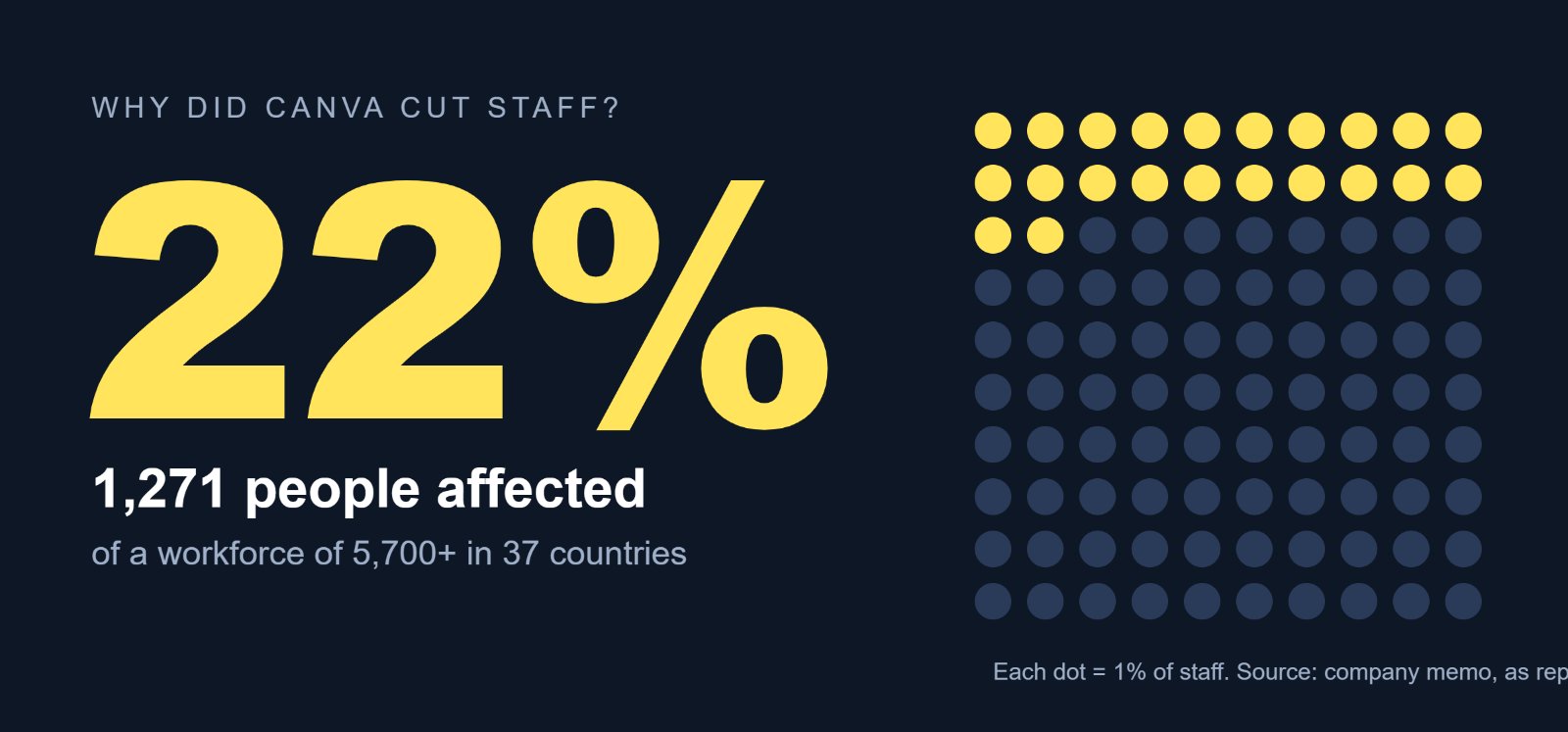
Canva told its staff this week that a restructuring will affect 1,271 people, about 22% of the company. Some will lose their jobs. Others will see their roles change or be asked to move to a central hub. The company has more than 5,700 employees in 37 countries, and CEO Melanie Perkins called it the hardest moment in Canva’s thirteen-year history.
The obvious headline is that AI took the jobs. Perkins did not say that, and the numbers point to something more useful. This is a story about unit economics, which is a fancy way of asking what it costs to serve one more customer. If you work for any company that sells software, it is worth understanding.
The machine that made Canva rich
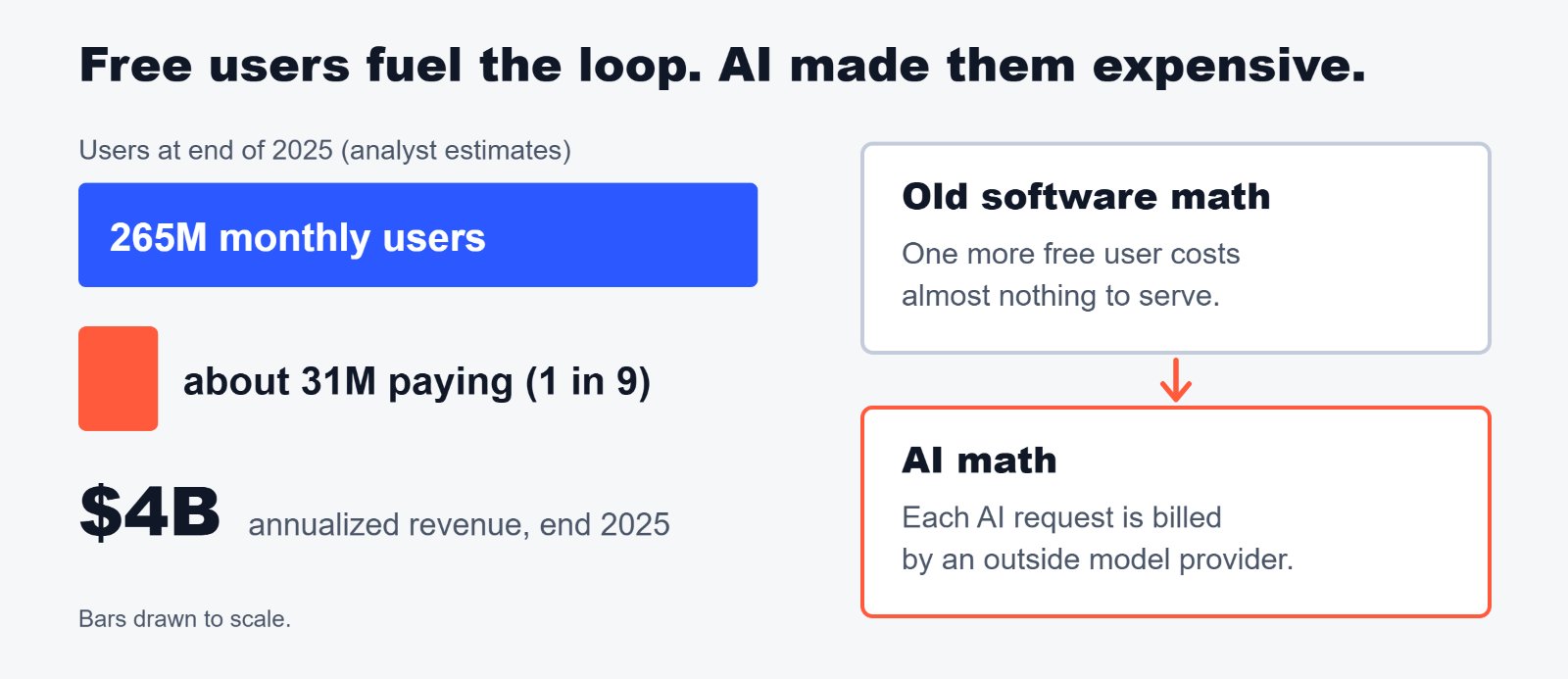
Canva runs on a simple loop. Anyone can start for free. A slice of those people hit a limit, want brand kits, team sharing or more features, and upgrade. Some teams grow into enterprise contracts. Analysts estimate Canva ended 2025 with about 265 million monthly users and roughly 31 million paying subscribers, around one in nine. Those are third-party estimates, not audited figures.
The loop works because a free user is cheap. Serving a template, a font and a few megabytes of storage costs almost nothing, so every free user is closer to marketing than to expense. By the end of 2025, annualized revenue had reached about $4 billion, up from roughly $3.3 billion that August and more than $2.5 billion a year earlier.
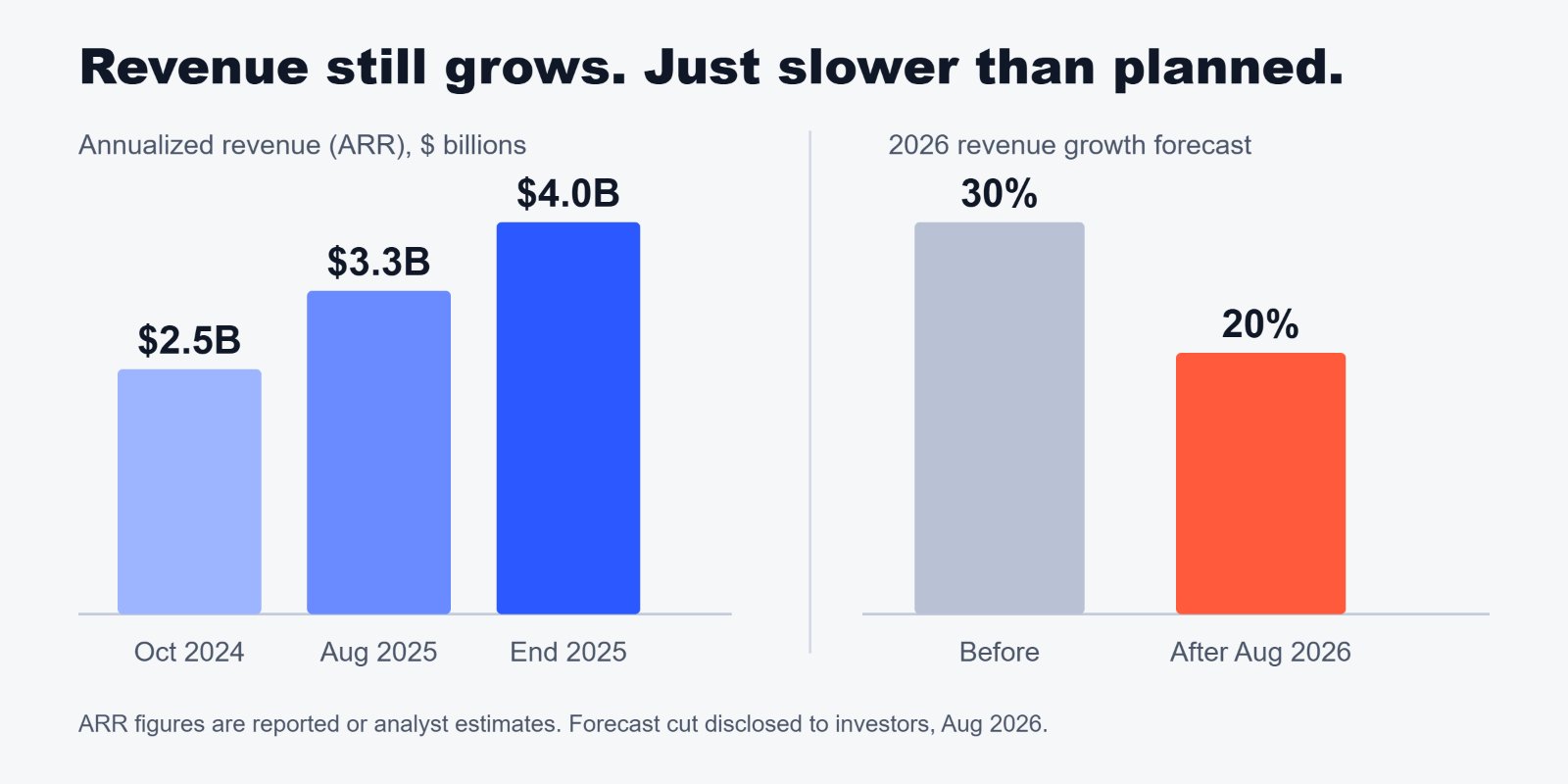
Even now, revenue is not collapsing. In the June quarter it grew 25% year on year to $921.9 million. But Perkins told staff that growth slowed for the first time in a decade, and for a company once priced like a rocket, that matters.
Then AI changed the cost line
Here is the twist. Classic software has near-zero marginal cost. Generative AI breaks that rule. Each image generated or document drafted calls a large model, and someone pays for that compute, usually the model provider charging Canva per use. The more people love the feature, the bigger the bill. Free users, the engine of the old loop, suddenly cost real money. Picture a bakery that always handed out cheap bread, then started making every roll to order with a chef it rents by the minute.
Canva said as much in August. It cut its 2026 revenue growth forecast from 30% to 20%. Perkins explained that the average cost of serving an AI task was too high and that the company had leaned too heavily on frontier models from outside providers. Demand was not the problem. She said interest in the new AI features beat expectations. So Canva slowed some launches to rebuild the plumbing behind them, including its own foundation model, Craft.
That is a deliberate trade: slower growth now, better margins later. It also explains why investors got nervous. The last priced transaction put Canva at $42 billion, and reports say some backers have since marked it down toward $35 billion. Those are paper marks, not a sale, but they show how the market is repricing design software.
There is a second bet inside the first. If Craft can handle most requests more cheaply than rented frontier models, Canva’s costs fall and it gets something new to sell. Co-founder Cliff Obrecht has suggested that opening the model to outside developers could become another revenue line. The company has also reorganized its product around AI under a plan it calls Canva 2.0. In other words, it is trying to turn its biggest cost into an asset.
The squeeze from the other side
Canva is also fighting for the front door. Image tools from OpenAI and Google, and chat assistants in general, let people make a graphic without ever opening a design app. When design becomes a feature inside someone else’s product, a destination business has to work harder for every visit. Canva’s answer is to go deeper into AI and into enterprise teams, which is exactly the expensive direction. Cost pressure from one side, competition from the other.
Why the org chart is part of the fix
This is where the layoffs come in. Perkins said the company’s structure made it hard for teams to own work that crossed departments. The plan merges product, growth and platform teams into one unit, removes layers of management and combines roles that overlap. Sydney becomes the main base for more product teams, and from January 2027 most hybrid staff are expected in the office two to three days a week.
Read plainly, a company built to add features and markets quickly is rebuilding its engine. Fewer layers means faster decisions. Fewer overlapping roles means a lower payroll. A tougher location policy also works as a quiet filter, because some people will not or cannot relocate. Perkins did not link the cuts to AI, and Canva has not said which teams or countries are hit hardest.
Canva is not alone. Dropbox, Squarespace and SUSE have announced cuts in recent weeks, and the pattern is familiar: investors want profit over growth at any cost. In my reading, AI spending now competes with payroll for the same budget. What makes Canva’s case clear is that the strain shows up in the cost of serving customers, not only in one weak quarter.
How Canva is treating the people leaving
In my read, the package is generous by industry standards. It includes at least six months’ salary with statutory entitlements, 12 months of healthcare where Canva already offers it, no vesting cliff for people who joined in the past year, and $10,000 grants for departing staff who want to start something, with no equity taken. Timing of individual meetings will vary by local law across its 37 countries. Canva will be judged on how this is carried out, not on how it is written.
What working people can take from this
- Ask what it costs your company to serve one more customer. If AI features raise that number, someone will eventually want savings elsewhere.
- Middle layers and overlapping roles go first when growth slows. Make your work easy to name and easy to measure.
- Location policy is a lever. A relocation or office rule can reshape a team without a single announced cut.
- AI can change your job through the budget before it changes it through automation. Watch the cost line, not only the product demo.
This looks like a reset, not a collapse. But it shows how the economics of AI land on real teams in every office, including those of companies that are still growing. What we do not know yet is which teams are affected and whether more cuts follow. An all-hands meeting is scheduled for November 10.
Sources
People Matters: Canva layoffs, 22% of employees to exit
ITP.net: Canva announces layoffs as restructuring affects 22 per cent
Startup Daily: Canva wipes $10 billion from its valuation
TechCrunch: Canva gets to $4B in revenue
Comments
No comments yet. Start the conversation.
Sign in to comment. It takes an email address, no password.