Monday Brief No. 6 Week of Nov 2
Monday Brief — November 2

Listen to this post · 8 min
Read aloud by a synthetic voice.
Intel fell 28.6% on Friday. That's not a typo. It's the stock's worst single session since 1974, erased in about eight trading hours after the company told Wall Street to expect fourth-quarter revenue of $15 billion to $16 billion, roughly 9% below what analysts were modeling. CFO David Zinsner said the slump in PC demand would continue "at least through the first half" of next year, even as Intel's data-center and AI revenue grew 78% year over year. One stock, two directions, and a market that chose to punish the weaker half.
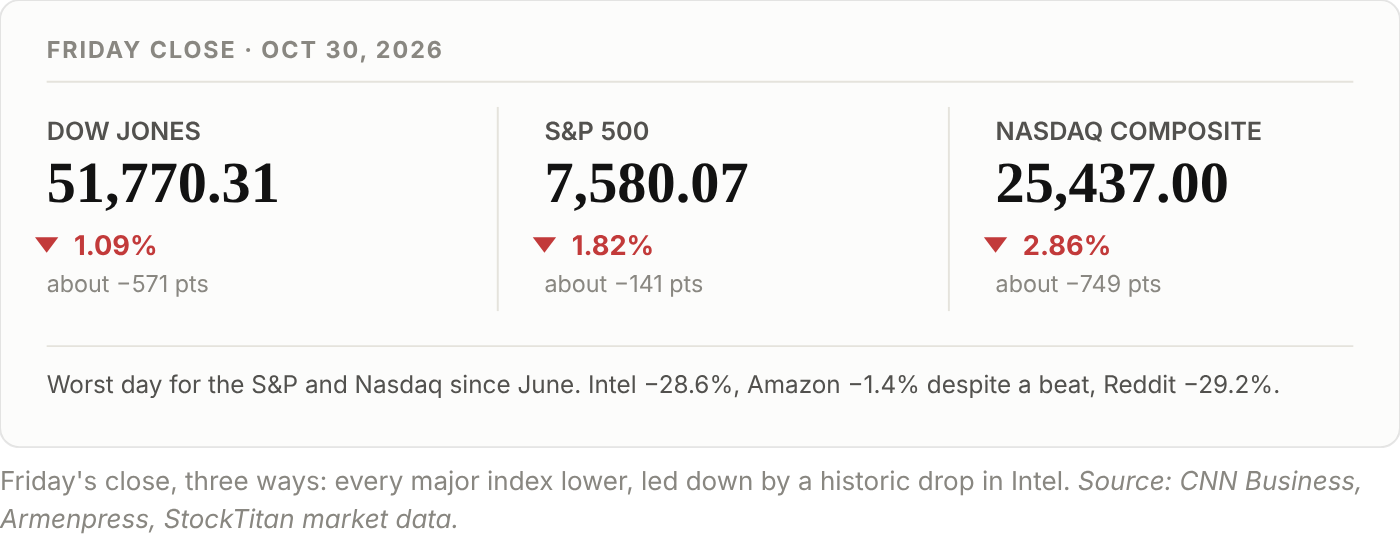
By the closing bell the rest of the tape wasn't much prettier. The S&P 500 finished at 7,580.07, down 1.82%. The Nasdaq Composite closed at 25,437, down 2.86%, its worst day since June and enough to make October the index's worst month since March 2025. The Dow fared best, relatively, down 1.09% to 51,770.31. Amazon actually beat on both revenue and AWS growth, up 12% and 39% respectively, and still fell on the day, because trailing twelve-month free cash flow is now negative $42.4 billion and investors are doing arithmetic on what all that AI infrastructure spending is supposed to buy. Roblox dropped 18% on a soft holiday-quarter bookings forecast. Reddit lost 29% with no single clean explanation offered.
A few stocks had the opposite week: Grid Dynamics jumped 41% on a strong earnings beat, CareDx gained 22% after raising its full-year forecast. The losers' column told its own story too. Alphatec fell 38% on weaker biologics sales even with revenue still up 13% year over year, and Arbor Realty dropped 29% after posting an $85 million quarterly loss and suspending its dividend. Chipmakers and PC names slid in sympathy with Intel all session, and CNN's closely watched semiconductor index fell 7.2%. None of this was sector rotation. It was a gut check on the AI trade, delivered three trading days before the busiest week left in the quarter.
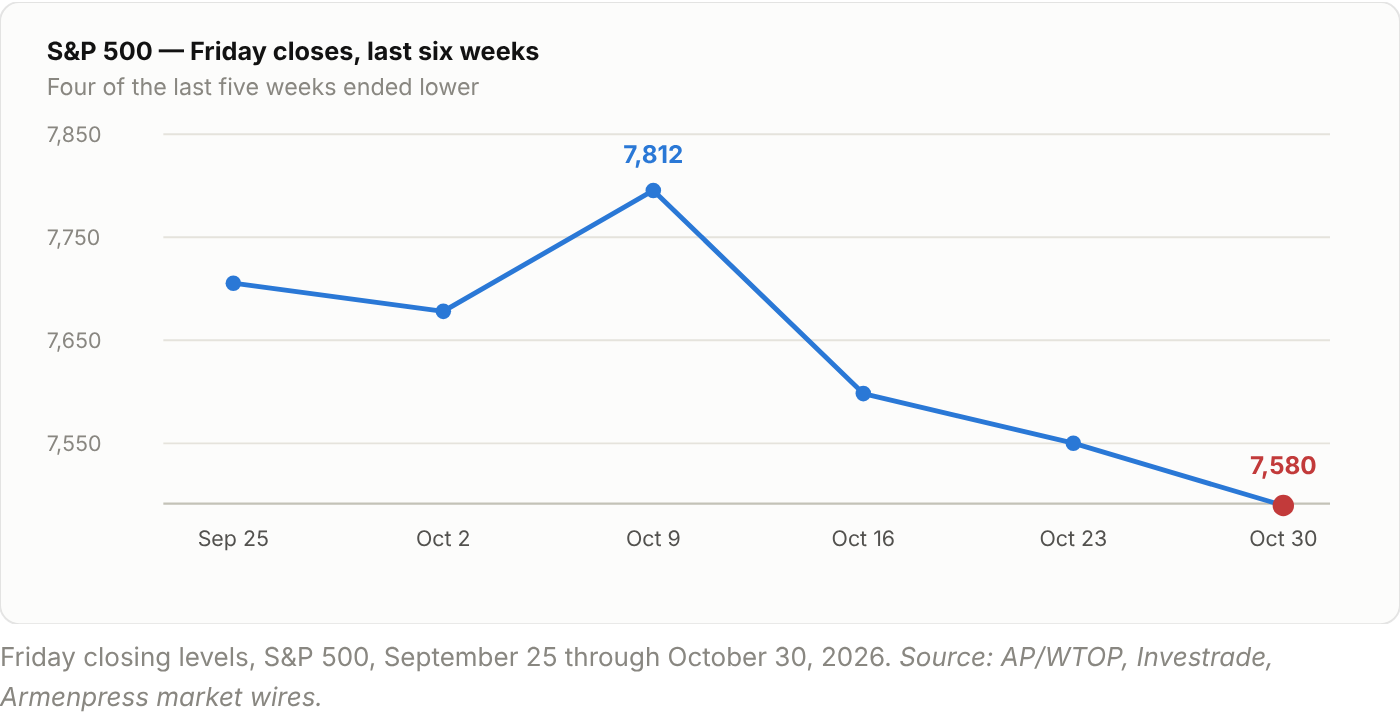
Zoom out past one bad Friday and the pattern looks worse: the S&P 500 has closed lower in four of the last five weeks, sliding from 7,811 on October 9 to 7,580 now.
That's the setup heading into a week carrying more scheduled risk than any other week left in 2026.
The week that decides where December goes
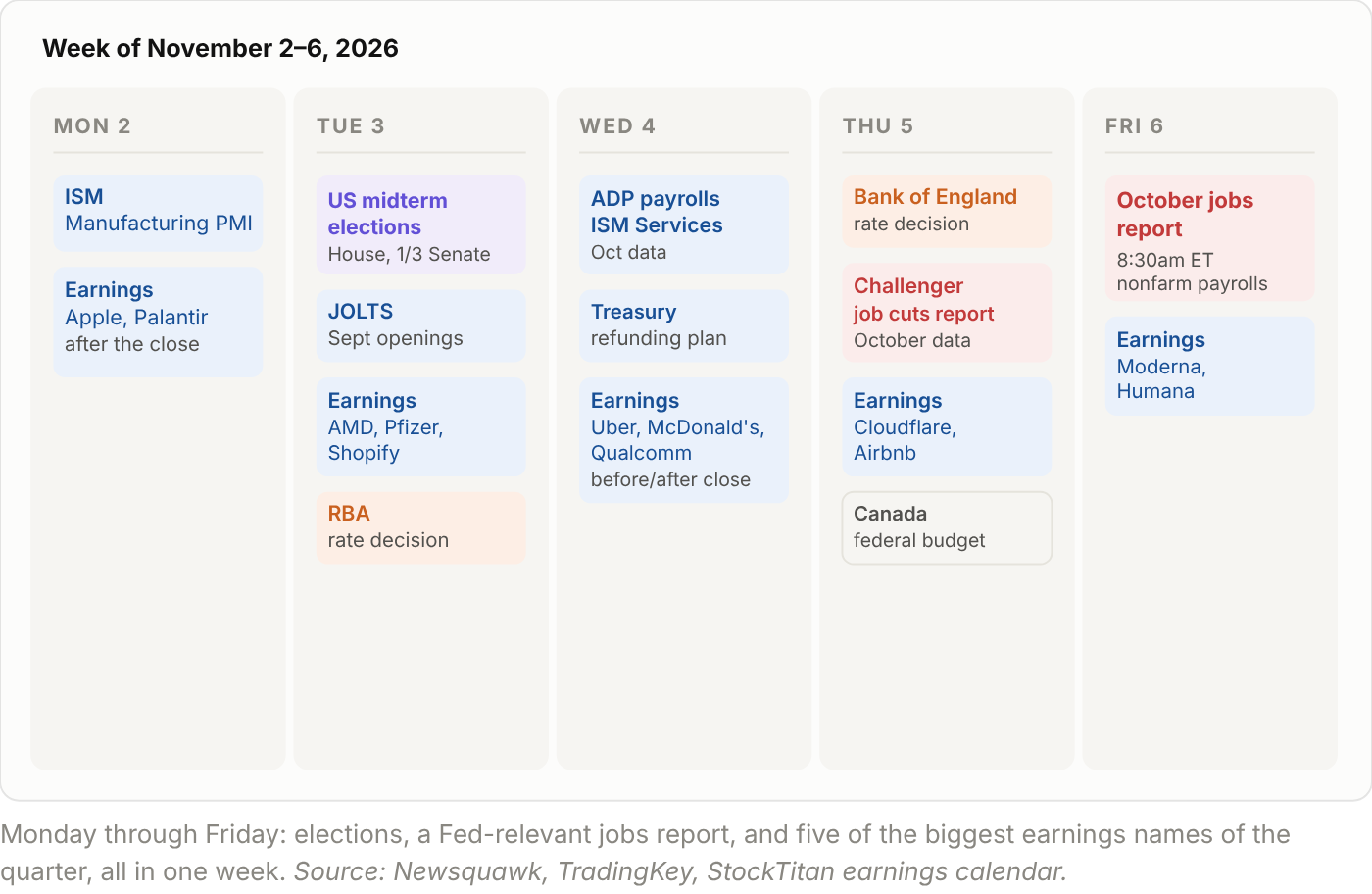
Monday opens with Apple and Palantir, both reporting after the close. Apple's own guidance called for revenue up 9% to 11% year over year and iPhone sales up in the mid-teens, with services roughly flat and gross margin at 47% to 48%. After Friday, none of that gets taken on faith; investors will want to see iPhone 18 Pro demand and services growth actually show up in the print. Palantir reports the same evening, with analysts watching whether government and commercial contract growth, and its remaining performance obligations, can keep justifying a valuation that has outrun most of the index.
Tuesday is the big one on two fronts simultaneously. Americans vote in the 2026 midterms, deciding all 435 House seats, roughly a third of the Senate, and governorships in most states, while AMD, Pfizer and Shopify report earnings and the Reserve Bank of Australia announces its rate decision. AMD's consensus estimate calls for earnings of $1.68 a share, nearly double last year's 97 cents, a sign of how much the AI buildout has already been priced in. Whichever party ends up controlling Congress will shape tax and spending fights for the next two years and could shift the regulatory outlook for energy, healthcare and tech. If races are tight, don't expect a final answer by Wednesday morning.
Before any of that, Tuesday morning also brings September's JOLTS report, the job-openings data the Fed watches almost as closely as payrolls themselves, since a cooling in openings tends to show up in hiring numbers a month or two later. Wednesday brings the Treasury's quarterly refunding announcement alongside October's ISM services data and ADP's private-payrolls estimate, both read as a preview of Friday. Uber, McDonald's and Qualcomm report. Thursday adds the Bank of England's rate decision, Canada's federal budget, Challenger's October layoffs report, and earnings from Cloudflare and Airbnb. Friday is the one everyone's actually circling: October's nonfarm payrolls report, the first full jobs read since the Fed held rates at 3.75% to 4.00% in October, with two officials dissenting because they wanted a hike rather than a pause. A soft number revives December rate-cut bets. A strong one kills them.
Whose job is actually at risk
Amazon has now announced roughly 30,000 corporate job cuts since October 2025: 14,000 last fall, another 16,000 in January, and a smaller October round that hit customer service, selling-partner support and retail engineering in the US, UK and India. CEO Andy Jassy has tied the cuts explicitly to flattening management layers and leaning harder on AI, even as the company's total headcount is still up 3% year over year and 2026 capital spending is running near $220 billion.
The wider picture is actually calmer than Amazon's headlines suggest. Challenger, Gray & Christmas's running tally of announced job cuts is down 39% through September compared with the same point in 2025, 573,195 versus 946,426. Monthly totals have been choppy rather than climbing in a straight line: 33,429 in July, a jump to 52,881 in August, back down to 43,281 in September. October's figure lands Thursday, with forecasters penciling in around 51,000, and Tuesday's JOLTS report will hint at whether hiring demand is quietly firming or still sliding underneath the headline cut totals.
What's actually happening is a split, not an across-the-board slowdown, and Intel's own numbers from Friday show it in miniature: AI and data-center revenue up 78%, personal-computing revenue down 5%, with the weak half expected to stay weak into mid-2027. The job market isn't shrinking evenly. It's shrinking in some lanes, customer service, retail support, PC-adjacent manufacturing, and expanding in others, cloud infrastructure, chip design, anything touching AI deployment. Which lane you're standing in matters more right now than any single headline total, and it's worth asking plainly whether your own role sits closer to the shrinking half or the growing one.
What else is different this week
Clocks fell back across the US and most of Canada overnight into Sunday, so Monday's 9 a.m. will feel like 10. If you've got early calls booked with colleagues in the UK or continental Europe, double check the time; their clocks don't move until late March.
Tuesday is a public holiday across the state of Victoria, Australia, for the Melbourne Cup, closing offices and schools there even though the exchange itself stays open nationally. In the US, plenty of employers quietly offer flexible hours or outright time off on Election Day without any federal mandate requiring it, so it's worth checking before booking anything early Tuesday.
One thing to actually do: block ninety minutes on Monday morning, before Apple's earnings call pulls everyone's attention sideways, and finish the task you've been bumping to tomorrow for a week. The rest of this week is going to be reactive by design: an election you can't control, a jobs number nobody can predict with confidence. Get the thing you can actually control out of the way first.
Sources: StockTitan, market close Oct 30, 2026 · Armenpress, US stocks close Oct 30, 2026 · TradingKey, week-ahead preview · StockTitan earnings calendar, week of Nov 2 · Newsquawk weekly economic calendar · Beinsure, Amazon layoffs tracker · Trading Economics, Challenger job cuts · Thrive in Markets, weekend recaps · Investrade, market review Oct 23, 2026 · Public Holidays Australia, Melbourne Cup Day
Filed under MarketTechnology
Comments
No comments yet. Start the conversation.
Sign in to comment. It takes an email address, no password.