Global Weekly No. 6 Week of Oct 12
Global Weekly — Business, AI & New Products (Oct 15, 2026)

Listen to this post · 9 min
Read aloud by a synthetic voice.
Three numbers rhymed this week, and not in a good way for anyone budgeting a product launch. The first is $92 billion — what Broadcom is lining up to finance so Anthropic and OpenAI can keep buying its chips. The second is 117% — how much the price of the memory those chips need jumped in about a week, according to Korea Economic Daily figures. The third is $299 — what Apple now charges for a countertop screen that recognizes your face and reads your group chat for dinner ideas. The AI buildout stopped being a line item on a handful of corporate balance sheets a while ago. This week it showed up on bank trading floors, inside merger filings, and on the shelf where your old smart speaker used to sit.
Business
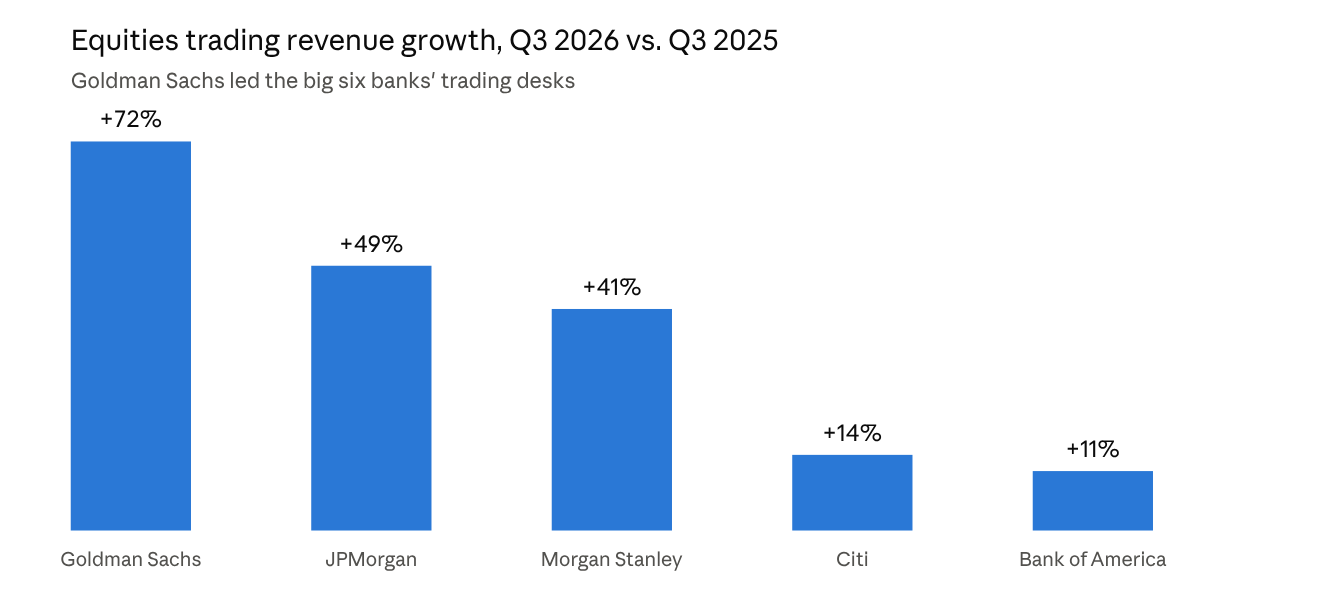
Six of the biggest U.S. banks — JPMorganChase, Bank of America, Citi, Wells Fargo, Morgan Stanley and Goldman Sachs — posted a combined $43.5 billion in third-quarter profit on roughly $165 billion of revenue, and the standout line wasn't lending. It was trading. Goldman's equities desk brought in $6.4 billion, up 72% from a year earlier; JPMorgan's rose 49% to $5 billion; Morgan Stanley's climbed 41% to $5.8 billion. Jamie Dimon struck a cautious note anyway, telling analysts that "in line with our hierarchy, we reduced share repurchases this quarter." Citi's Jane Fraser called the quarter "disciplined and consistent execution" and said the bank now expects to beat its own return target for the year.
The backdrop for all that trading activity is a stock market that keeps setting records almost in spite of itself. The S&P 500 touched an intraday high of 7,844.52 on October 6 and has barely budged off it since, carried by tech-earnings optimism and bets that the Fed has room to keep easing. The Fed's own meeting isn't until October 27–28, so for two more weeks the market gets to keep guessing.
Washington and Beijing, meanwhile, found something to agree on. A three-day Trump-Xi summit in Washington produced a deal lowering tariffs on $30 billion of goods — American farm products, seafood, lumber, cosmetics and medical devices headed to China; Chinese small appliances, toys and car seats headed here — funneled through a new U.S.-China Board of Trade. The fine print is still missing; trade representative Jamieson Greer told CNBC that "a lot more details" were coming. Given that tariffs on Chinese goods hit 145% as recently as last year, a $30 billion carve-out counts as progress, if a modest one. China's own trade surplus is nearing a record, with exports growing at a double-digit pace in September.
Dealmakers had a busy week too, and AI anxiety shaped both of the week's notable transactions. Thoma Bravo's Proofpoint agreed to buy the data-security firm Varonis for $6.3 billion in cash, a 52% premium to Varonis's price in June, with executives on both sides framing the deal explicitly around securing the data that AI systems touch. "As AI becomes embedded across the enterprise, the data it can access determines both its value and its risk," said Proofpoint's chief executive, Sumit Dhawan. Separately, Bumble agreed to go private in a $1.3 billion deal with Ithaca Holdings after revenue fell 15% and its paying-user base shrank to 3.2 million — a rough landing for a company that went public in 2021 at a $14 billion valuation, and a bet that it can rebuild around AI-driven matchmaking away from the quarterly scrutiny of public markets.
AI
If the banks had a good week, the model labs had a loud one. Google took Gemini 4 Argon fully public on October 13, after a limited release to cybersecurity partners in September; it prices at $2 per million input tokens and $10 per million output tokens until the end of November, then doubles. Anthropic's Claude Haiku 5.5 landed October 7 at $0.10 and $0.50 per million tokens for shorter prompts, a 90% cut from the prior Haiku generation. OpenAI pushed GPT-6 into ChatGPT the same week with what it calls Intelligent UI, which draws charts, forms and buttons directly inside a chat window. Meta's Superintelligence Lab shipped its first frontier model, Muse Wonder, on October 12, and Mistral opened a preview of a roughly 1.05-trillion-parameter model called Large 4, with open weights promised by month's end. Four labs, four releases, one week — that is simply the pace now.
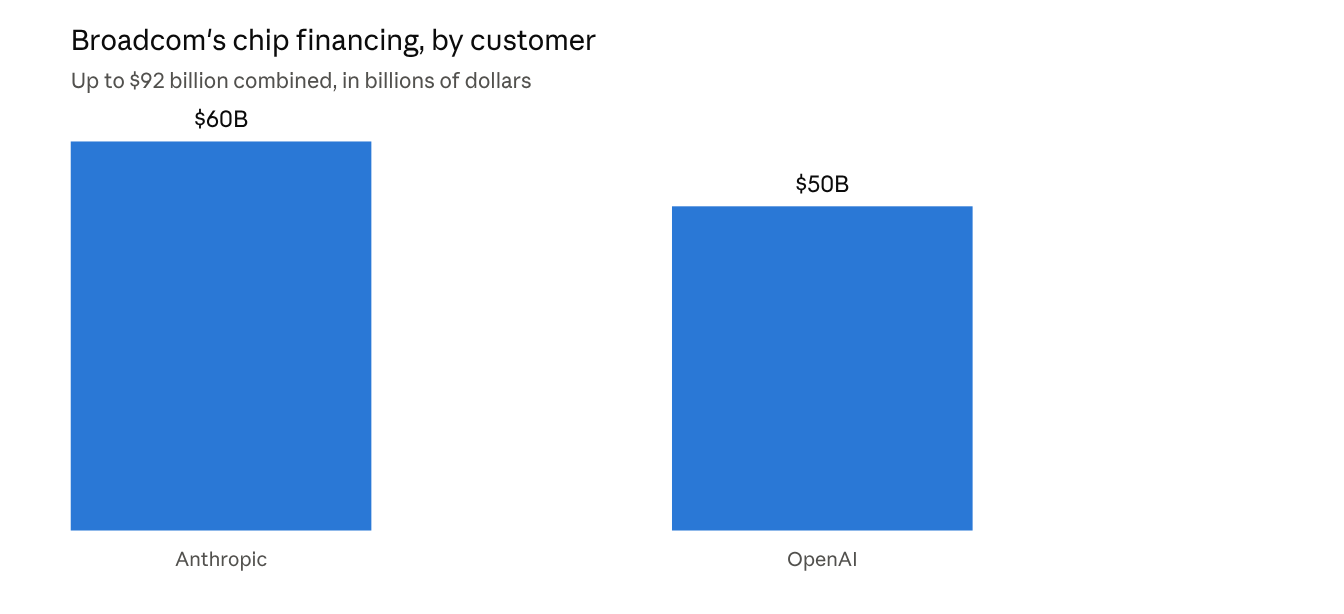
The money behind all of it is the bigger story. Broadcom is arranging financing worth up to $92 billion so its two largest customers can keep buying its chips: $42 billion of Broadcom-guaranteed senior debt plus an $18 billion junior tranche for Anthropic, which is racing toward 10 gigawatts of TPU-based capacity by 2028, and talks toward $50 billion for OpenAI's own Jalapeño accelerators. Chief executive Hock Tan has compared the arrangement to Nvidia's separate $500 billion financing scheme for OpenAI's data centers, announced earlier this year. In effect, the chipmakers are co-signing loans against hardware that, unlike a general-purpose GPU, has a narrower resale market if a lender ever actually had to repossess it.
All of that compute needs memory, and memory is where the bill is landing hardest. Contract prices for HBM4, the high-bandwidth memory packed onto accelerators from Nvidia and AMD, jumped roughly 117% in about a week, according to figures reported by Korea Economic Daily; a 36-gigabyte stack running near $600 this year is projected to cost around $1,300 in 2027. Samsung, SK hynix and Micron have all reportedly cleared qualification to supply Nvidia's coming Vera Rubin platform, and AMD signed a three-year memory pact with Samsung on October 7. Because HBM and ordinary consumer DRAM come off the same production lines, the squeeze is already showing up well outside the data center: smartphone shipments fell about 20% to a 14-year low last quarter, and PC shipments dropped 20.1%, with memory cited as a direct cause.
New Products
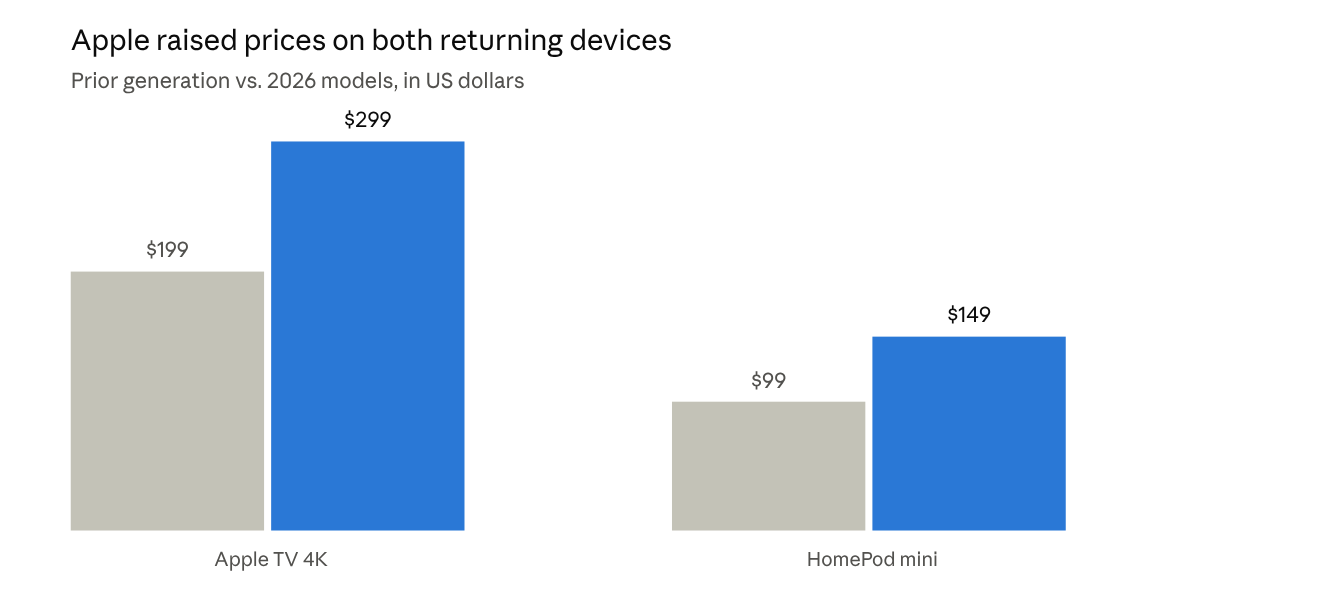
Which brings the story home — literally. Apple's "Welcome Home" event on October 13 introduced three products built around Siri AI, and all three cost more than their predecessors. HomeView, a new $299 countertop or wall-mounted display running Apple's A18 chip, ships November 13; it recognizes up to six faces and can pull dinner ideas out of a family text thread using Apple Intelligence running on nearby iPhones. Apple TV 4K returns at $299, up from $199 a few years ago, with an A19 chip Apple says is 50% faster and hands-free Siri AI support. HomePod mini 2 is $149, up from its original $99, running the Apple Watch's S10 chip and adding an LED ring that pulses in time with whatever's playing.
Apple hasn't said component costs are driving the increases, and the new chips genuinely do more than the old ones. But the timing is hard to ignore: these launches land in the same month that memory contract prices are spiking across the industry, and a company that can absorb a cost increase quietly chose not to. Counterpoint Research frames the real contest here as a race for the kitchen counter before Google or Amazon lock households into a rival smart-home system first. Early reviews, including from Tom's Guide, say Siri AI finally feels competent again, though reviewers still reach for ChatGPT for some tasks.
The quieter product news this week happened in developer tools rather than on store shelves: Claude Code, GitHub Copilot and Codex CLI all shipped updates built around the newest cheap small models, a reminder that for every consumer gadget unveiled this month, there's a less visible wave of software retooling itself around the same underlying price drops.
What to watch
The Fed meets October 27–28, and after a unanimous rate increase in September, officials now sound divided on how much urgency the moment calls for — expect that meeting to set the tone for whether the S&P's record run continues. Watch for the U.S.-China Board of Trade to publish actual tariff rates, promised for the Monday after the summit. Watch too whether Proofpoint-Varonis and the Bumble buyout draw copycat take-private bids in software and consumer tech. And watch memory: Mistral's promised open-weights release and new chip announcements from the OCP Global Summit will say more about how much worse, or how much better, the 2027 memory squeeze actually gets.
References
- Broadcom Is Backing Anthropic and OpenAI With $92 Billion — The Motley Fool, Oct 13, 2026
- Wall Street Q3 2026: Six Banks, $43.5bn Profit, Equities Up 72% — Global Brands Magazine
- US, China strike deal to lower tariffs on $30B in goods after Trump-Xi Washington summit — Fox News
- The S&P 500 Just Hit a Record High — The Motley Fool, Oct 14, 2026
- Bumble agrees to a $1.3B acquisition deal as online dating faces a reset — TechCrunch
- Proofpoint to Acquire Varonis in a $6.3 Billion Transaction — Proofpoint press release
- Haiku 5.5, Muse Wonder, Open Racks: Oct 6–14 — AM Datalakehouse
- HBM4 Shortage: Price Jumps 117% as AMD Chases Supply — Tech Insider
- Apple HomeView event live coverage — Tom's Guide
Filed under MarketStrategyTechnology
Comments
No comments yet. Start the conversation.
Sign in to comment. It takes an email address, no password.