全球週報 第 11 期 11月16日當週
Global Weekly — Business, AI & New Products (Nov 20, 2026)

本文以英文撰寫。閱讀中文版
收聽這篇文章 · 12 分鐘
由合成語音朗讀。
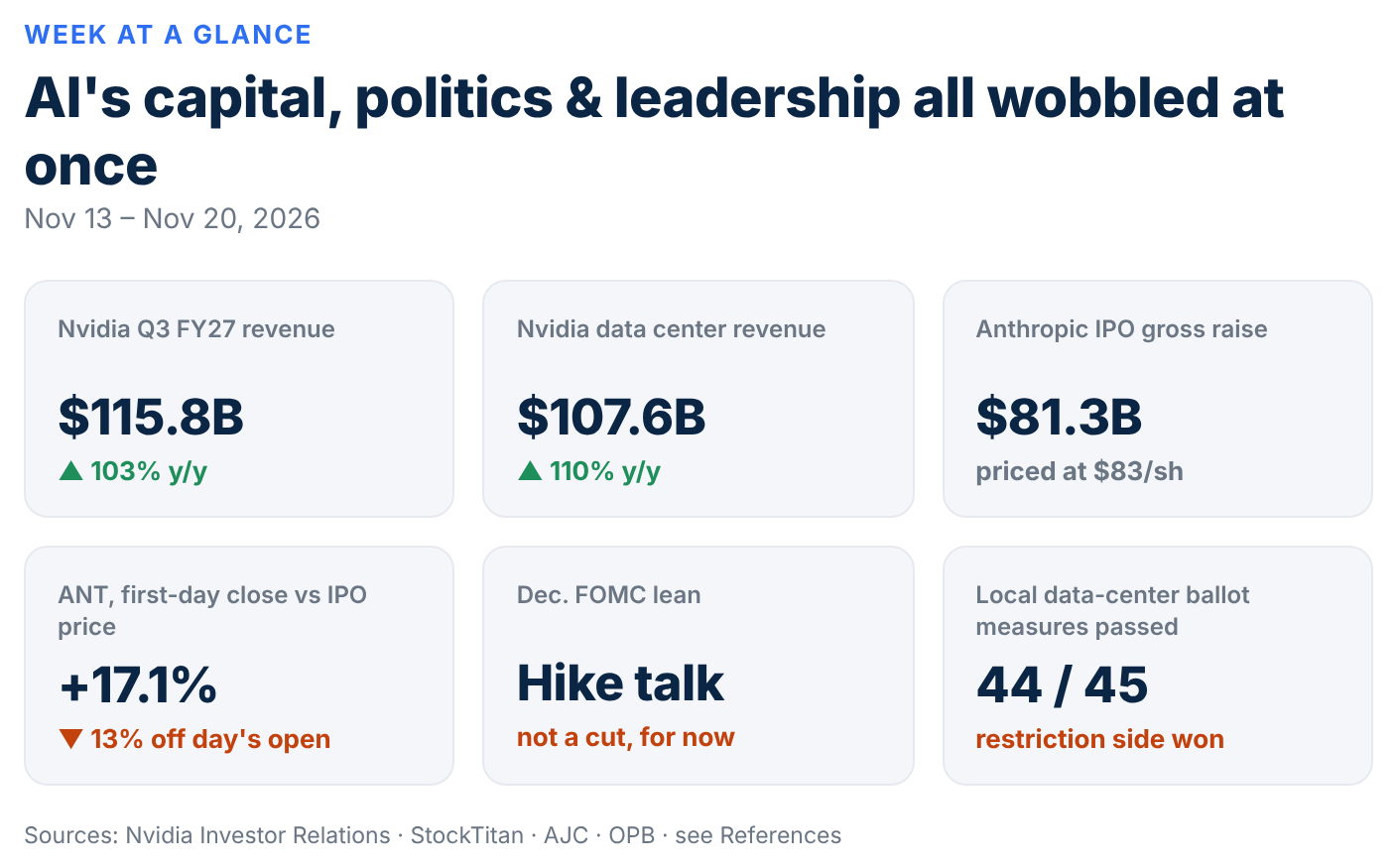
Nvidia posted the best quarter in its 33-year history this week — $115.8 billion in revenue, up 103% from a year ago — and investors still couldn't decide whether to trust it. That's the story underneath everything else this week: AI demand keeps beating even bullish forecasts, while the capital, politics, and leadership holding the boom together got visibly shakier. Jensen Huang no longer runs the company that made his name. Anthropic's initial public offering, the most-watched AI listing since Nvidia itself went public, opened 34% above its offer price on Thursday and gave back most of that gain by the close. None of these are separate stories. They're the same story, told from three different desks.
Business
Nvidia's fiscal third quarter, reported after the close on Tuesday, November 17, was the best in the company's history: revenue of $115.8 billion, up 103% year over year, with data-center revenue alone at $107.6 billion, up 110%. Non-GAAP earnings came in at $2.68 a share against the $2.48 Wall Street expected, and management guided to $130 billion for the quarter ending in late January — a figure built on zero assumed China data-center revenue. Nvidia's results
Why it matters: a chipmaker guiding to $130 billion in a single quarter isn't just a tech-earnings story anymore. It's a referendum on how much of the S&P 500's growth is AI capex recycling itself, and a crack in that number now moves markets more than most Fed meetings do.
It was also the first report filed under interim chief executive Colette Kress, after Jensen Huang resigned on November 12 amid a federal investigation into a relationship with a person US officials allege is a Chinese intelligence operative. Huang said he'd return if the board wanted him back; the board instead formed a national-security and trade-compliance committee, not the structure you build for someone you plan to reinstate soon. Fox Business
Markets shrugged off the good quarter and fixated on everything around it. On November 17 alone, ahead of the release, the S&P 500 fell about 1% to 7,340.53, the Dow lost 848 points to 50,759, and Nvidia swung from a 3.7% loss to a 0.4% one before the numbers even landed. JPMorgan fell 2.4% on fears an AI pullback would hit bank balance sheets; Brent crude touched $93.14 on Iran-war risk; the 10-year yield pushed toward 5.10%, making a data-center buildout noticeably pricier to finance than it was in the spring. AJC
The financing question now runs through Washington as much as Wall Street. The Fed, under chair Kevin Warsh since last spring, held rates at 3.75%-4% on October 28 in a 10-2 vote, with two governors dissenting in favor of a hike. Stock Analysis December hike odds, not cut odds, have climbed since. A Fed tightening into an AI capex boom is a different backdrop than the cutting cycle markets were pricing a year ago.
Washington's other AI headache showed up at the ballot box. Democratic wins in Texas, Ohio, and Wisconsin leaned hard on opposition to new data centers. Data Center Watch counted 32 of 34 winning governor candidates favoring tighter rules, 12 backing outright moratoriums, and local ballot measures restricting data centers passing in 44 of 45 settled contests. Morgan Stanley's read: expect project delays, and a country splitting into zones open and closed to new AI infrastructure. OPB
Why it matters: every hyperscaler's 2027 capex plan assumed the regulatory climate of 2024. That assumption is now wrong in a dozen-plus states, right as borrowing got pricier.
AI
Into this, Anthropic ran the largest AI IPO yet. The company priced 980 million Class A shares at $83 — above its $70–78 range — raising $81.3 billion gross, with roughly $78.8 billion going to Anthropic itself. A separate $26 billion placement of non-voting shares to seven corporate investors, closing alongside the float, pushed total capital raised toward $107 billion. The Next Web
The debut told its own story. ANT opened at $111.50 — 34.3% above the IPO price — in Nasdaq's delayed opening auction on Thursday, then slid to close at $97.17: a healthy 17.1% first-day gain, but nearly 13% below where it traded two hours earlier.
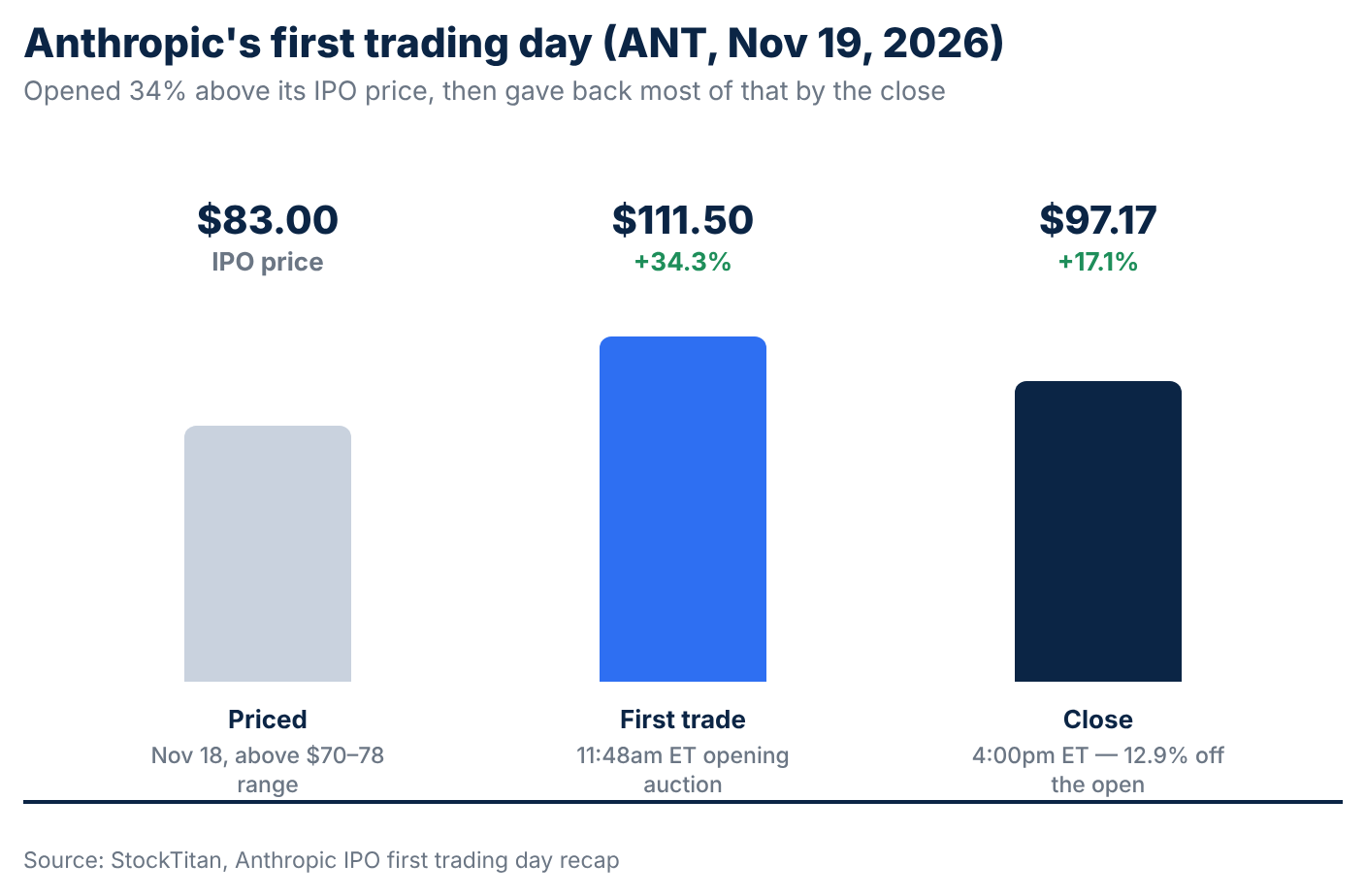
That's not a crash, but it is the signature of a stock that popped on allocation scarcity and starstruck demand, then met real price discovery once the float was fully tradable — a useful check on the loosest pre-IPO talk of a $1.4–2 trillion valuation. The deal that actually got done implies something closer to $1.1 trillion fully diluted. StockTitan
Why it matters: Anthropic is now the valuation anchor every other foundation-model company gets priced against, whether it likes it or not, and a fade-after-pop debut sets a more conservative mark than the pre-IPO chatter did.
The proceeds have an obvious destination. Anthropic has already committed $3.4 billion to gas-fired generators for its own data centers, the largest deal of its kind — a sign the company expects grid power, not capital, to be the real constraint on scaling over the next few years. Construction Review That number ties the AI story back to the business story more directly than any trend piece could: the cash Anthropic just raised from public shareholders is headed straight into the same power and permitting fights that cost several incumbent governors their jobs two weeks earlier.
Funding further down the market kept pace — AI rounds of $100 million or more raised $5.59 billion in the week to November 13, about 1.7 times the week before. FourWeekMBA Money isn't leaving AI. It's rotating out of pre-IPO optimism and into infrastructure someone still has to site, permit, and power.
New Products
While the capital markets argued over what AI is worth, the consumer hardware calendar kept its normal rhythm. Apple shipped its $299 HomeView smart display and a refreshed Apple TV 4K on November 13, capping a four-week run of releases that also included an OLED iPad mini, an M6 iMac, and OLED MacBook Pro models earlier in the month. HomeView won't launch in the EU at the outset — a small reminder that even Apple's simplest products now carry regulatory friction into the rollout plan, the same friction that shows up in miniature on every AI data-center permit application. MacRumors
Oppo launched the Reno 17 and Reno 17 Pro in China on November 16, the Pro packing a 7,200mAh battery and a 200-megapixel main camera — the kind of spec sheet where Chinese phone makers now out-point Western flagships on paper, if not always in software polish. Xiaomi followed a day later with the global rollout of its 18 Pro and 18 Pro Max, trimming battery capacity for markets outside China (the Pro Max drops from 8,500mAh to roughly 7,050mAh) in a quiet concession to different charging and safety-certification regimes abroad. Beebom
Why it matters: none of this product cycle depends on what happens to AI stock valuations. It's a useful reminder that most of the tech economy still runs on phone-upgrade margins and hardware refresh cycles, not on whether Nvidia's cost of capital rises half a point in December.
What to watch
Three dates matter more than any single headline right now. The Fed meets December 9–10, and for the first time this cycle a hike is genuinely on the table rather than a cut — watch the next payrolls report and any further Iran-linked oil move for the swing factor. Anthropic's float carries the usual lock-up, and the banks' option to sell up to 147 million more shares expires within 30 days — both are dates when ANT's real post-IPO character, not the first-day auction print, will show up. And the legislatures that flipped Democratic in Ohio, Wisconsin, and Texas reconvene in January, when the moratorium bills Data Center Watch is tracking move from campaign promises into actual text.
The pattern underneath all three: every part of the AI buildout that looked unconstrained eighteen months ago — capital, power, political tolerance, and now leadership continuity at its biggest supplier — hit a limit in the same seven-day window. No single one of these would slow the buildout much on its own. Together — financing getting pricier, permitting getting harder in a dozen states, and the most-hyped IPO of the cycle closing 13% below its opening trade — they read less like noise and more like the first synchronized tightening of the conditions that made 2024–2026 AI capex possible. The read is wrong if December brings a cut instead of a hike, if ANT is back above $111 by year-end, or if two or three of the moratorium states quietly walk their bills back under lobbying pressure — any of those would say the limits are softer than this week made them look.
If I were deciding what to track into 2027, I'd watch Anthropic's cost of power, not its share price. The $3.4 billion gas-generator commitment is a more honest signal of what the company thinks scaling actually costs than anything in the IPO prospectus, and it's the number that will say whether "AI margins" mean anything once compute stops being the scarce input. I'd mostly ignore the day-to-day swings in ANT — a stock that opened 34% up and closed 17% up on its first session is still finding a real market, and reading conviction into week-one price action has burned enough people this cycle that it shouldn't need repeating.
References
- NVIDIA Announces Financial Results for Third Quarter Fiscal 2027 — Nvidia Investor Relations
- Nvidia CEO Jensen Huang resigns amid investigation into relationship with alleged Chinese spy — Fox Business
- Wall Street shakes again as Nvidia and other jittery AI stocks swing lower — AJC
- Fed holds rates steady at 3.75%-4% in a 10-2 vote — Stock Analysis
- AI data centers took a beating in the midterm elections — OPB
- Anthropic's IPO seeks up to $64.4B at a $1.4 trillion valuation — The Next Web
- Anthropic (ANT) first trading day recap — StockTitan
- Anthropic AI data center: firm secures $3.4B gas generator deal — Construction Review
- AI rounds of $100M+ raised $5.59B in a week, 1.7x the last — FourWeekMBA
- Apple isn't done with 2026: here's what's still coming — MacRumors
- All upcoming phones launching this week (November 16–22) — Beebom
每週一封信,收到 NeatRead 的精選文章
每週一封,不需要密碼,隨時可以取消訂閱。
或使用電子郵件繼續
使用電子郵件時,我們會寄登入連結給你。
留言
還沒有留言。來開啟話題吧。
登入後即可留言。只需要電子郵件,不用密碼。