The 42.195 km Question
Listen to this post · 8 min
Read aloud by a synthetic voice.
Where the marathon came from, why companies spend millions to put their name on one, and why so many people with jobs, kids and deadlines keep signing up to run it.
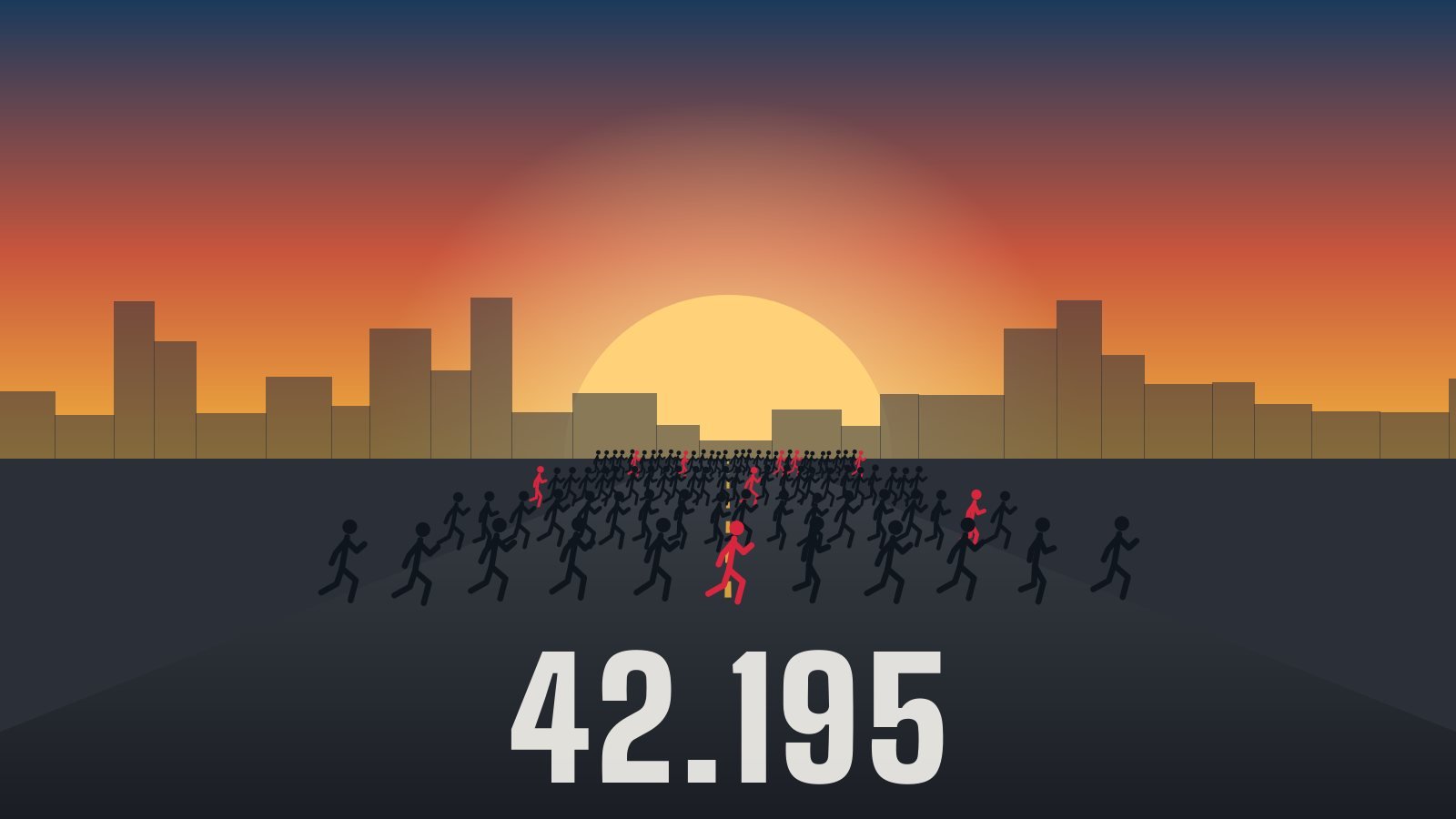
Today, 1 November, more than 50,000 people will gather on Staten Island for the New York City Marathon. Most of them have office jobs. Many have spent four months getting up before sunrise to run in the dark. They paid an entry fee for the privilege, and most of them had to win a lottery just to be allowed to pay it.
If you have never run one, that can sound a little mad. If you have, it probably sounds like the best weekend of the year. Either way, it raises three fair questions: where did this race come from, why do cities and companies fight to host it, and why do ordinary people get so hooked?
A myth, a poem and a royal nursery
The story most of us know goes like this. In 490 BC, the Athenian army beat the invading Persians on the plain of Marathon, about 40 km from Athens. A messenger ran the whole way back to the city, announced the victory, and dropped dead.
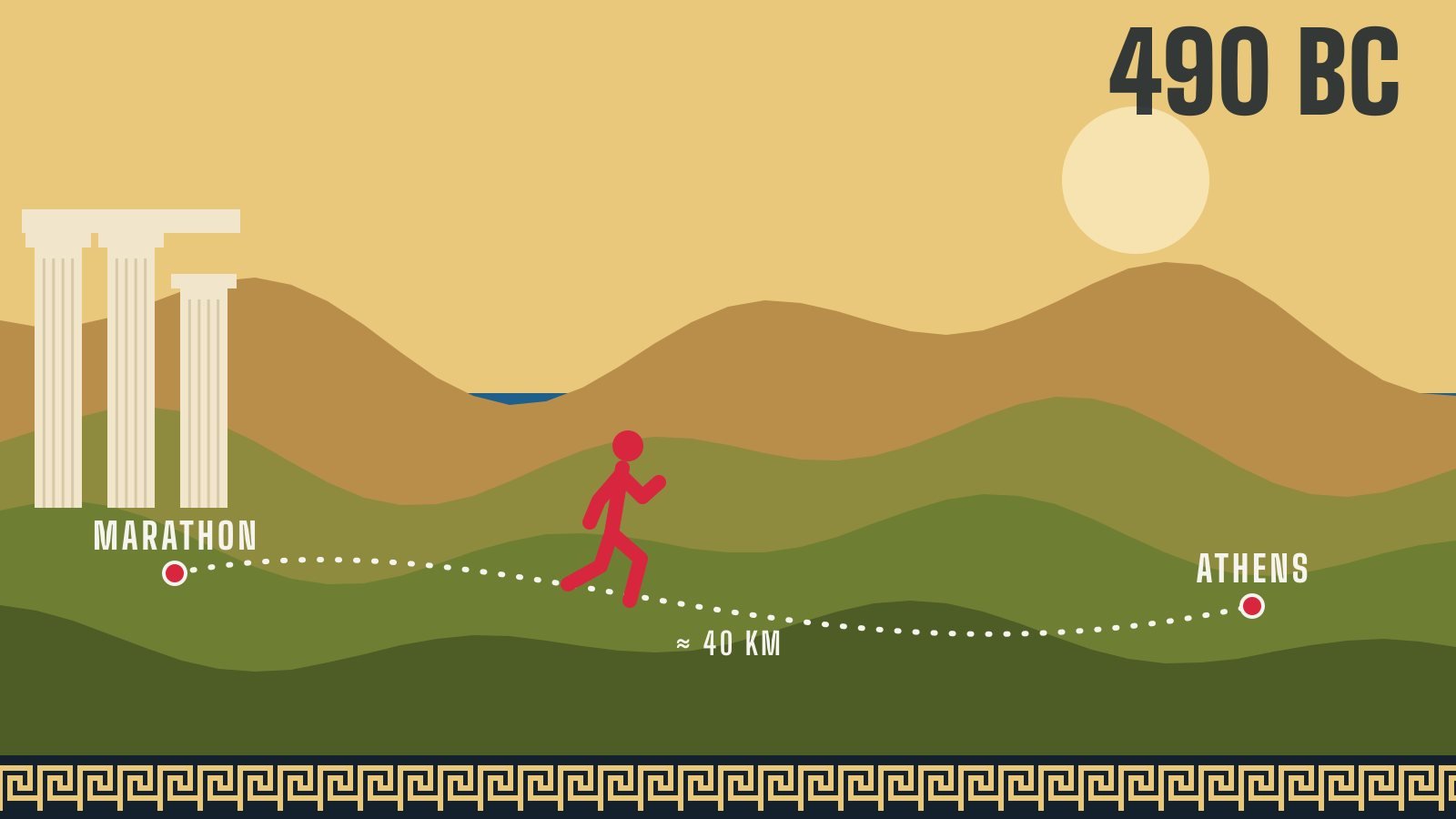
It is a great story. It is also probably wrong. Herodotus, the historian who wrote closest to the battle, tells a different one. In his version a professional runner named Pheidippides ran from Athens to Sparta, roughly 240 km, to ask for help before the fighting began, and arrived the next day. The dying messenger only shows up in writers several centuries later, such as Plutarch and Lucian.
The legend got its big break in 1879, when Robert Browning published a poem called Pheidippides. When the modern Olympics were revived in Athens in 1896, the French scholar Michel Bréal suggested a race from Marathon to the stadium to honour the story. A Greek water carrier named Spyridon Louis won it in just under three hours and became a national hero overnight. Boston held its first marathon the next year, and it has been a fixture of the city ever since.
The odd distance came later. At the 1908 London Olympics, the course was laid out to start at Windsor Castle, where the royal children could watch from the grounds, and to finish in front of the royal box in the stadium. That came to 26 miles and 385 yards, or 42.195 km. The sport's governing body made it the official standard in 1921.
So the modern marathon is a race built on a myth and measured to suit a royal family. In April this year, Kenya's Sabastian Sawe won the London Marathon in 1:59:30, the first time anyone has broken two hours in a record-eligible race. He took 65 seconds off the record set by the late Kelvin Kiptum in 2023.
The business case: an ad that people pay to be in
Start with the host city. New York Road Runners, the nonprofit that organises the New York race, commissioned a study of the 2024 edition. It found the marathon generated $692 million in economic impact, with 55,642 finishers, at that point the largest marathon ever held. Out-of-town runners and their families spent $178 million on hotels and $109 million on food and drink. Mastercard's card data showed spending at small businesses along the route jumping close to 40% above normal on race day. Boston estimates its marathon weekend is worth more than $509 million in local and state activity.
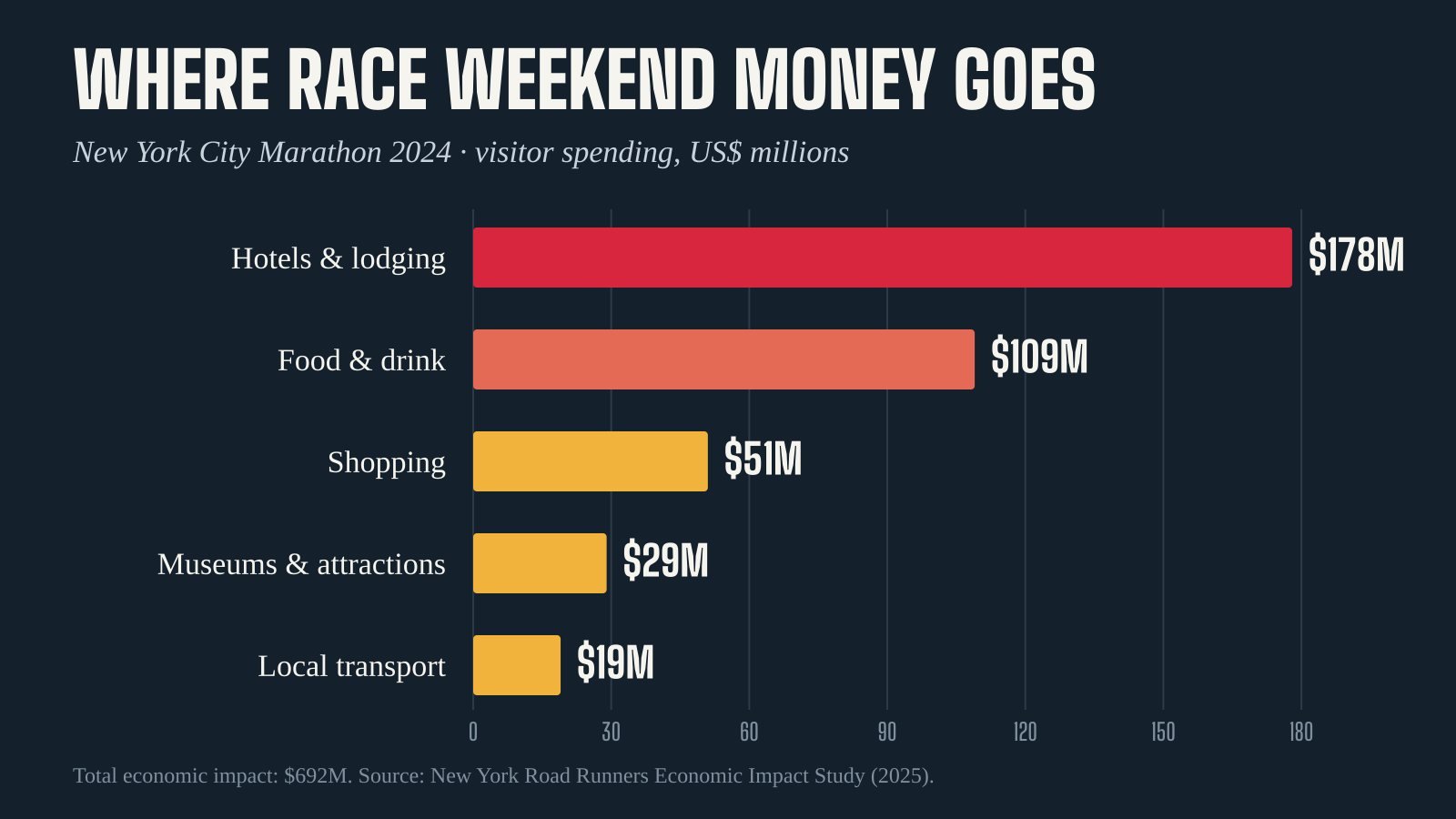
Think about what a city gets here. It is something like hosting a Super Bowl every year, except the players pay to take part, fly in with their families, and spend months training in local parks first.
For sponsors, the maths looks different but is just as appealing. Look at who runs marathons. Survey research shows runners skew younger, wealthier and better educated than the general population. Brand Finance found that about 14% of marathon runners worldwide work in C-suite roles. If you sell IT services, banking or insurance to large companies, a start line is a crowd of your customers in shorts.
That explains why the big title sponsors read like a list of business-to-business firms rather than sports brands. Tata Consultancy Services, the Indian IT company, sponsors 14 marathons in 11 countries, including New York, London and Sydney. Its own research found 67% of marathon runners would consider working with TCS, compared with 27% of non-runners. Bank of America has had its name on Chicago since 2008. Abbott, the healthcare company, sponsors the whole World Marathon Majors series and uses it to show off its glucose-monitoring biosensor.
There is also less noise. A football stadium has dozens of logos competing for 90 minutes of attention. A marathon gives one sponsor a whole city for a morning, plus months of training content in the official app, the live tracking and every finish-line photo.
Then there is the goodwill money can't easily buy. The 2025 London Marathon raised £87.3 million for charity, and the race has raised more than £1 billion since it began in 1981. No billboard makes people feel that way about a brand.
Why runners can't stop
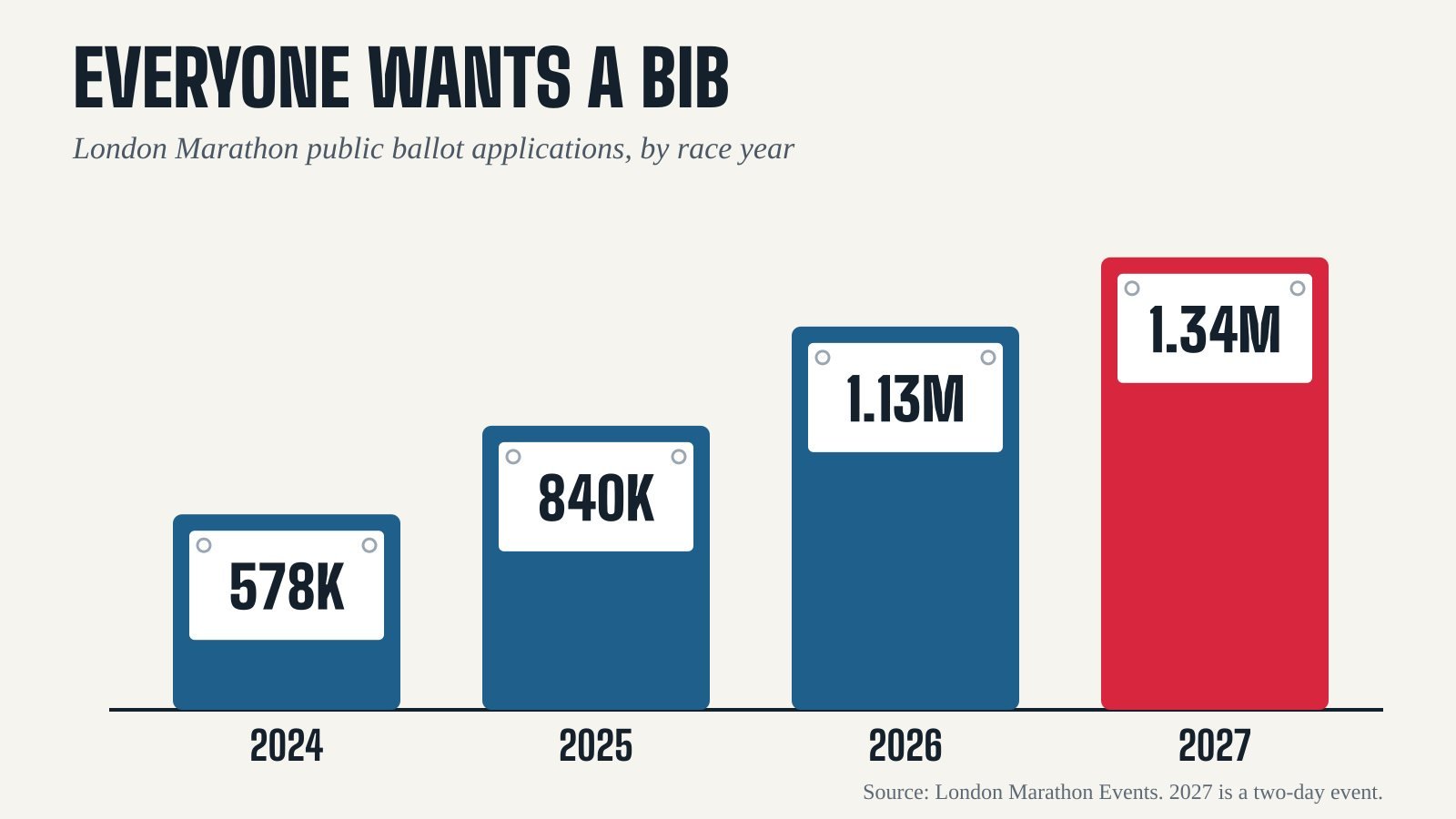
The demand numbers look like a concert presale. More than 1.13 million people applied for the 2026 London Marathon ballot. For the 2027 race, which will run over two days, the figure rose to 1,338,544. New York's 2026 drawing drew more than 240,000 applications, and only about 1% got in. The crowd is getting younger too: runners under 30 made up 24% of New York's 2025 finishers, up from 17% in 2022.
Ask people who have run one why they keep coming back, and the same reasons come up.
It is a finish line in a life without many. Most office work never really ends. Projects roll into next quarter, and the inbox refills overnight. A marathon has a date, a distance and a clock. You cross the line or you don't. For people whose effort usually disappears into a slide deck, that clarity is addictive.
The training is the real product. A typical plan runs 16 to 20 weeks. The long run creeps from 10 km to 32 km, and a watch records every step. That steady, visible progress is rare in adult life, and race day becomes the receipt for it.
It is hard in a safe way. Modern life seldom asks us to suffer on purpose. Around kilometre 32 to 35, many runners hit "the wall", when the body's stored fuel runs low and every step becomes a negotiation. Getting through it changes your sense of what you can handle, including on Monday morning at work.
The people. Running clubs have become a social life for many young professionals. Charity runners carry other people's stories with them. And somewhere around the halfway mark, a stranger will read the name on your bib and shout it like you are family.
The collecting. Finish all the World Marathon Majors and you earn a special medal. That list grew to seven when Sydney joined, and Cape Town is set to become the eighth in 2027. Few hobbies come with such a clear checklist.
Same road, same day as the legends. You will never play at Wimbledon on finals day. But you can line up in London on the same morning, on the same course, as the fastest marathoner in history.
The quiet lesson for the rest of us
The marathon began as a messenger with an urgent job to do. Today it is a business with clear economics and a very human hook. You don't have to run one to borrow the idea: pick a date, break a big goal into weekly blocks, track your progress, find people to do it with, and let the finish be only part of the reward.
Then, maybe, enter the ballot. The odds are about one in a hundred, and that is part of the fun.
Sources: New York Road Runners Economic Impact Study (2025); Mastercard Economics Institute; Brand Finance; Elevent; Fortune; Marketing Brew; London Marathon Events; World Athletics; Marathon Handbook; Herodotus, Histories, Book 6.
Comments
No comments yet. Start the conversation.
Sign in to comment. It takes an email address, no password.