Monday Brief No. 2 Week of Sep 28
Monday Brief-2026-Sep-28

Listen to this post · 7 min
Read aloud by a synthetic voice.
The 10-year Treasury yield hit 5.225% on Friday, the highest since 2007, and the stock market shrugged it off completely. The S&P 500 closed the week up 0.51%, the Nasdaq gained 1.21% over five sessions, and the Dow pushed past 51,800 for the first time ever. Bond traders are pricing in a Federal Reserve that stays cautious longer than anyone in the stock market wants to admit. Stock traders, meanwhile, are pricing in Akamai signing an $11.6 billion cloud deal with Anthropic and jumping 15% in a single session. Both stories are true at once, and that split is worth watching more closely than either headline by itself.
This week should start to settle which side has it right. Five macro data points land in five straight days, and a fresh round of earnings arrives from companies people actually buy things from.
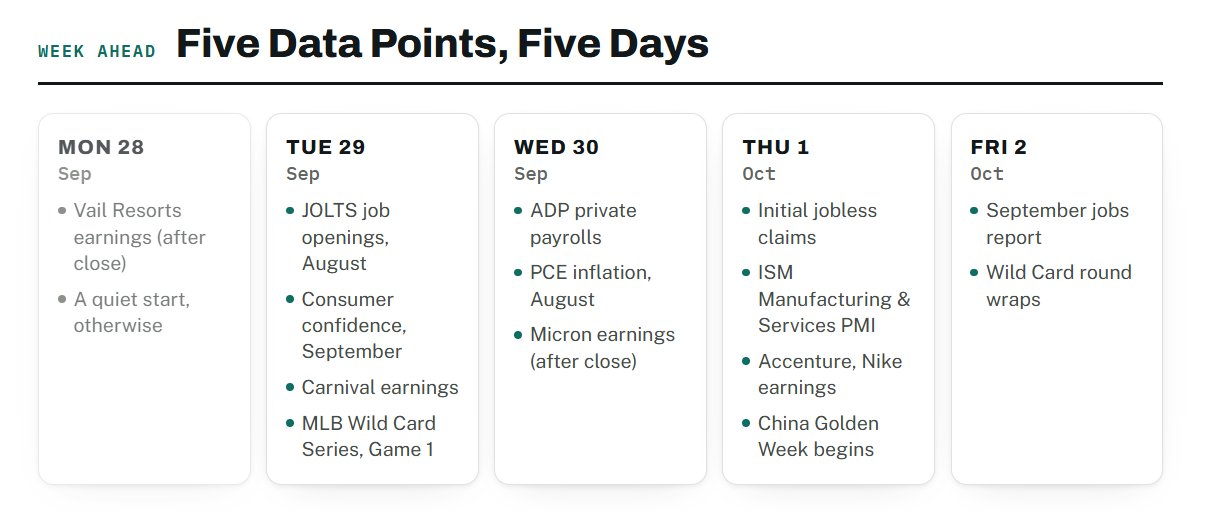
Tuesday opens with JOLTS job openings for August and the Conference Board's consumer confidence read for September, the first real test of whether hiring is actually cooling or just being talked about that way. Wednesday brings the ADP private payrolls report and the Fed's favorite inflation gauge, the PCE price index, in the same morning. Thursday stacks initial jobless claims against both ISM manufacturing and ISM services. Friday closes it out with the September jobs report, the number that either confirms a slowdown or embarrasses everyone who's been calling one since spring.
None of this lands near an actual Fed decision. The next FOMC meeting isn't until October 28, so Jerome Powell gets a full month to sit with whatever this week produces before he has to say a word about it publicly. Washington isn't adding competing drama either. The stopgap funding bill signed earlier this month keeps the government open through December 11, so there's no shutdown fight fighting for headline space until the holidays are already underway.
Earnings fill the gaps between data points. Carnival reports Tuesday and will say something real about how much people still want to spend on vacations. Micron reports Wednesday afternoon, and given how the entire memory chip market has repriced around AI data center demand this year, its numbers will move more than just its own stock. Nike reports Thursday after the close in its first real test of whether tariffs and a soft China market have finally caught up with it. Accenture also reports Thursday morning, and its commentary on enterprise AI spending tends to drag the whole consulting and IT-services trade with it.
Baseball fans get something too. All four MLB Wild Card series start Tuesday, single win-or-go-home games that will thin the playoff field to eight teams by Thursday night.
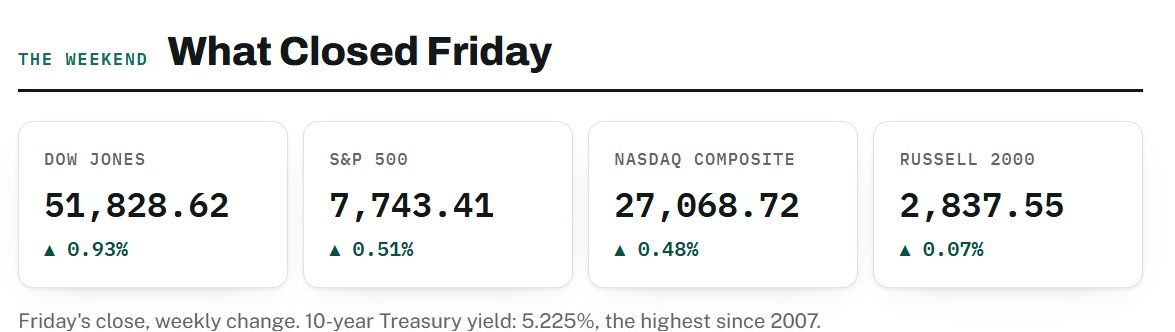
Friday's rally had one clear author. Akamai jumped 15.3% after announcing that $11.6 billion cloud services agreement with Anthropic, the kind of number that turns a content-delivery company into an AI infrastructure story overnight. People Inc., the publisher, rose 10.3% on chatter about a potential MGM Resorts takeover. Not everyone had a good week: Twilio fell 4.4% after an HSBC downgrade, and Zscaler dropped nearly 4% on a leadership change investors didn't love.
The bigger story sat in bonds, not stocks. Wall Street hasn't lived with a 10-year yield above 5.2% in almost two decades, and it happened alongside easing oil prices and unresolved, still-developing talk of a U.S.-China trade framework and an Iran ceasefire. The Russell 2000, more sensitive to borrowing costs than its megacap cousins, could barely move, up just 0.07% on the week. Markets shrugged anyway. Call that confidence or call it complacency; this week's data should start to tell us which one it actually is.
Away from markets, a nor'easter battered the New York and New Jersey coast all weekend, with gusts up to 81 mph recorded in Montauk and up to three feet of coastal flooding along the Jersey Shore and Long Island. The storm pushed the Yankees' Sunday start time up two hours and wiped out the Global Citizen Festival and New York City's Iron Man triathlon entirely. It was weakening as of Sunday night, but commuters in the region should still expect standing water and delays into Monday morning.
Work & Money Entry-Level Jobs, Still Shrinking
A Stanford study led by economist Erik Brynjolfsson, built on ADP payroll data covering millions of workers, found that entry-level jobs in software development, accounting, and administrative work have dropped 13% over three years, concentrated almost entirely among workers age 22 to 25. Experienced people in the same roles kept their jobs or absorbed the extra work. The uncomfortable read is that AI isn't mainly cutting headcount, it's cutting the bottom rung specifically, which happens to be the rung people used to climb on to become senior. If a 23-year-old can't get the junior developer job that used to teach the trade, nobody has a good answer yet for where the next generation of senior developers is supposed to come from.
That lines up with what Challenger, Gray & Christmas found in its August report. U.S. employers announced 52,881 job cuts last month, down 38% from a year earlier and one of the mildest Augusts in years.
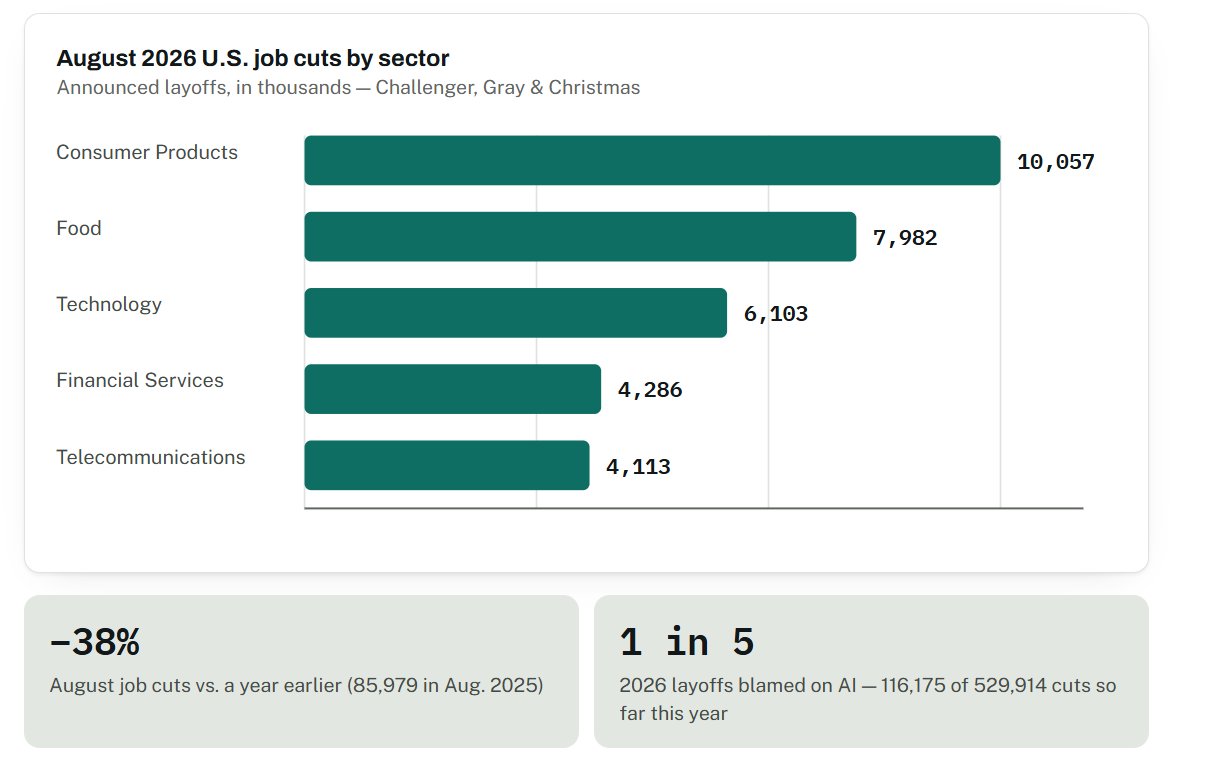
AI actually fell to the fourth most-cited layoff reason in August, its lowest monthly total since December, as plain old restructuring reclaimed the top spot. Don't read that as a trend reversing. AI is still the single biggest reason cited for job cuts this year overall.
93% of employed workers say their pay still isn't keeping pace with prices — a number that's barely moved in three years.
Meanwhile NBCUniversal told corporate staff they're due back in the office four days a week starting in January, matching parent company Comcast's own policy, and offered holdouts a buyout conversation instead of a fight. That pay figure above comes from Monster's latest cost-of-living survey, and it has barely budged in three years running. Whatever's happening in the layoffs numbers, it isn't translating into raises big enough for people to actually feel.
Plan Around It What Scrambles Your Week
China shuts down almost entirely from Thursday through the following Wednesday for Golden Week, the National Day holiday. Factories, ports, and government offices go quiet for seven straight days, and mainland stock markets close right along with them. If your supply chain, your shipment, or your job depends on anything moving through China, plan around it now instead of Thursday morning. There's no U.S. market holiday this week, so Wall Street trades a full five days. New York-area commuters should build in extra time Monday while the region finishes drying out from the weekend's storm.
Before You Go
Five economic reports in five days sounds like noise, but only one number matters for your own week: whatever you're waiting to hear back on. Chase it down before Wednesday, before everyone's attention shifts to Friday's jobs number instead. Ship the thing that's been sitting in your drafts folder since last month. It only gets harder to finish once the news cycle picks a new obsession, and next Monday there will be a new one.
References
- TheStreet — Friday's close, sector moves, single-stock winners and losers
- Challenger, Gray & Christmas — August 2026 job cuts report
- Kiplinger — earnings calendar, week of Sept. 28
- Letters to a Young Investor — weekly economic calendar
- FedRateCalc — 2026 FOMC meeting schedule
- FedTools — government funding bill status
- CBS Sports — 2026 MLB postseason schedule
- LyrikTrip — China Golden Week 2026 dates
- CBS News New York — weekend nor'easter live updates
- Yahoo News — Stanford study on AI and entry-level jobs
- Yahoo News — NBCUniversal return-to-office mandate
Filed under MarketStrategyTechnology
Comments
No comments yet. Start the conversation.
Sign in to comment. It takes an email address, no password.