Monday Brief No. 1 Week of Sep 14
Monday Brief-2026-Sep-21
Listen to this post · 7 min
Read aloud by a synthetic voice.
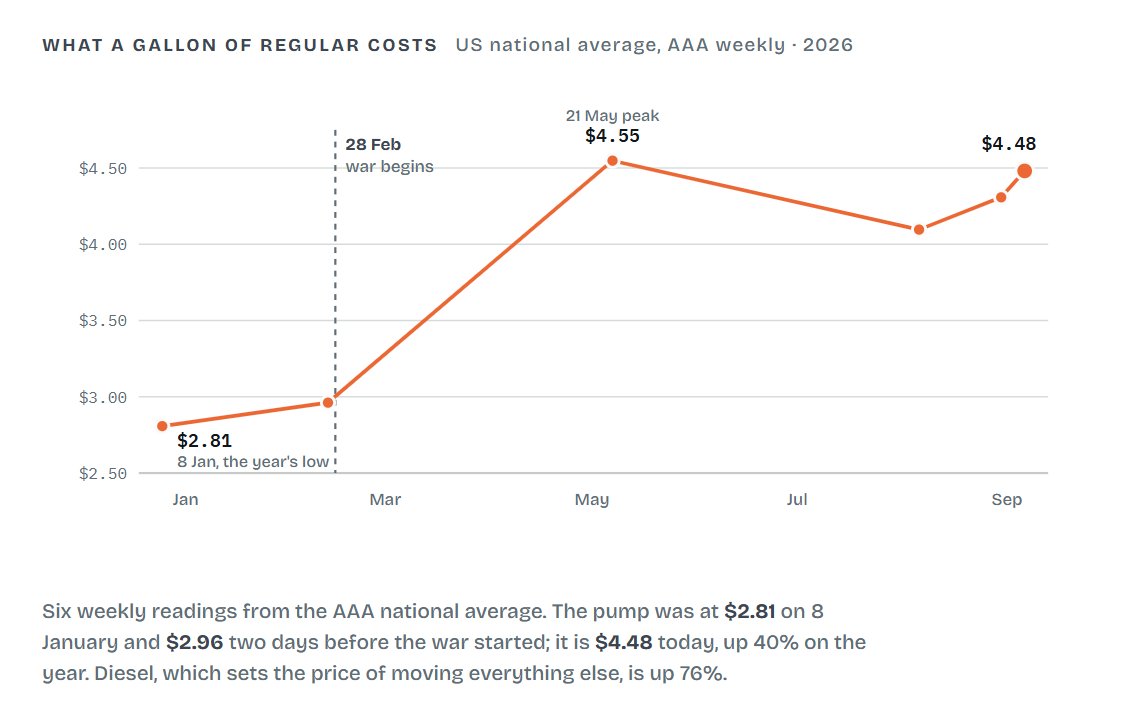
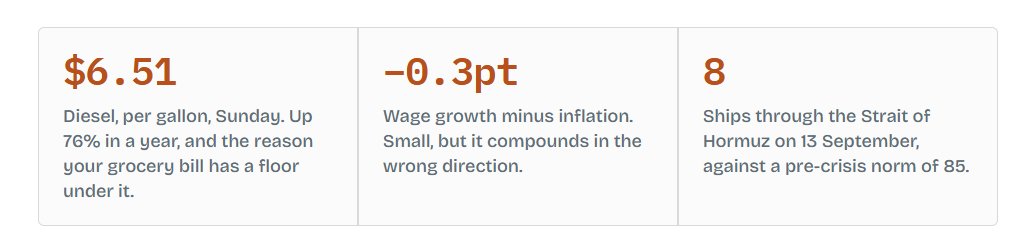
Diesel cost $6.51 a gallon on Sunday. A year ago it was $3.70.
That one line on a truck-stop sign explains most of what follows: why the Federal Reserve raised interest rates on Wednesday for the first time since 2023, why a strip of water off the coast of Oman is the most consequential place on earth right now, and why the raise you negotiated in January is quietly worth less than the number on the letter.
Kevin Warsh is not bluffing
The Fed lifted the funds rate to 3.75%–4.00% on 16 September. Twelve votes for, none against. “Inflation is too high and has been for too long,” the chair said — the kind of sentence a central banker delivers when he plans to do it again.
He does. Sixteen of the nineteen officials on the committee pencilled in at least one more hike before New Year. The median projection for end-2026 moved to 4.1% from 3.8% in June, and the part that made no headlines: the Fed's own forecast does not have inflation back at 2% until 2029.
Stocks gave up about 1% during the press conference and finished the day at six-week lows. The two-year Treasury ended the week at 4.756%, a 52-week high. The ten-year sits at almost exactly 5.00%. If you are shopping for a mortgage, refinancing anything, or sitting on cash in a savings account you stopped checking in 2023, those two numbers matter to you more this week than the S&P does.
There is something awkward buried in the data. August core CPI — everything except food and energy — ran at 2.4% a year, the lowest reading since March 2021. Headline was 3.4%. The whole gap is fuel. Gasoline is up 27.4% over twelve months and contributed more than a third of August's monthly increase by itself. Rates do not refloat tankers. Warsh is raising the price of money to contain the second-round effects of a war, which is defensible and extremely blunt at the same time.
Thursday eats the week
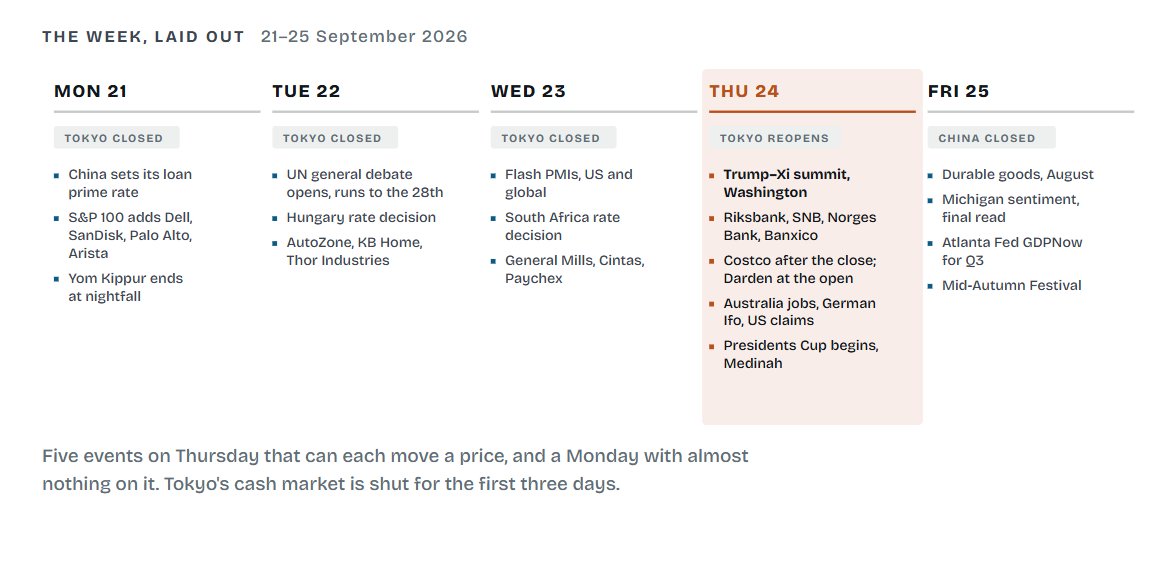
Almost everything worth watching lands on the 24th, and the calendar was not arranged by anyone who cares about your Thursday.
Xi Jinping arrives in Washington. It is the second Trump–Xi meeting of 2026 and the first on American soil, and the realistic aim is keeping the Busan truce alive past its November expiry, plus movement on rare-earth export licences and roughly $30bn of goods still disputed across about ten categories. Beijing has already threatened to walk over a possible Taiwan arms sale. A joint statement is the good outcome. No new tariffs is the base case.
Four central banks decide the same day: the Riksbank, the Swiss National Bank, Norges Bank and Banxico. Australia's August jobs report and the German Ifo land in the morning. Costco reports after the close, where the number to read is not the $6.53 a share the street wants but the membership renewal rate, which is the cleanest read on household stress that retail produces. Darden reports at the open and tells you the same thing from the restaurant side.
Around it: China's loan prime rate today, flash PMIs everywhere Wednesday, US durable goods and the final Michigan sentiment print Friday. The UN General Assembly's general debate opens Tuesday and runs to the 28th, with Iran's nuclear programme expected at the centre of the American address. And the Presidents Cup starts Thursday at Medinah, Brandt Snedeker's Americans against Geoff Ogilvy's internationals, Scottie Scheffler leading the home side.
How Friday ended, and a goodbye
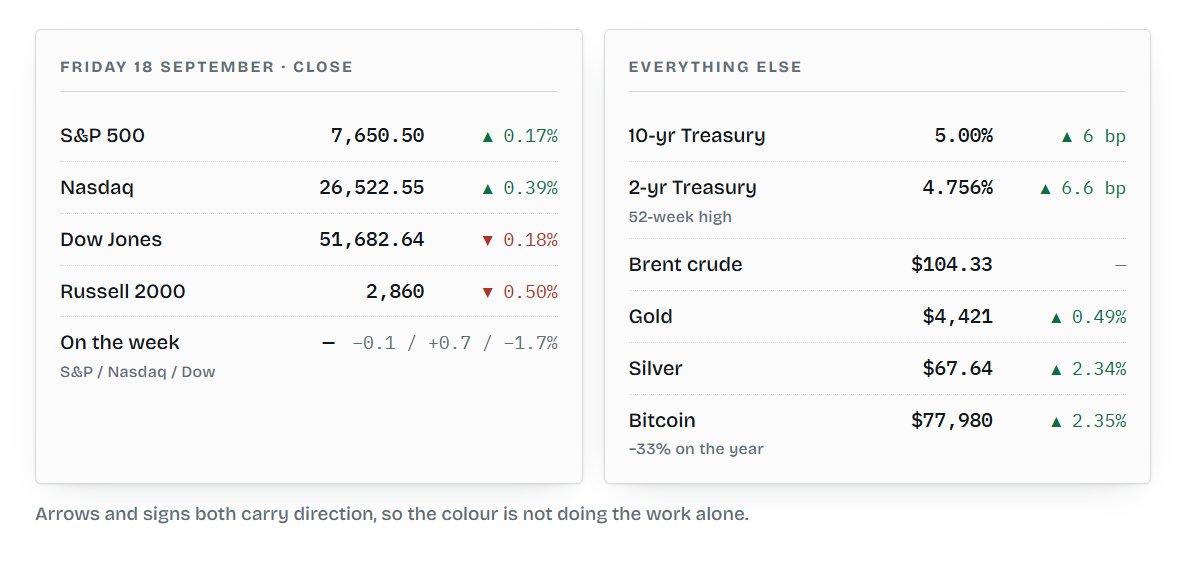
A flat tape hiding a lot. The S&P finished the week down a tenth of a percent, the Dow down 1.7%, and investors pulled $31.44bn out of US equity funds in five sessions. Gold at $4,421 and silver at $67.64 are the honest read on how people feel.
Warren Buffett stepped down as chairman of Berkshire Hathaway on Friday, at 96. “Father Time always wins,” he wrote. Greg Abel keeps the chief executive job he took earlier this year and Howard Buffett takes the chair: “Greg runs the company; Howard will guard its culture.” The stock barely moved, which is exactly the compliment a decade of succession planning was built to earn.
Over the weekend, Ukraine sent more than a thousand drones at Russia, its largest attack of the war, hitting the Moscow Oil Refinery and killing two people in the surrounding region on the final day of Russia's Duma election. Houthi forces fired on Riyadh's jet-fuel infrastructure on Saturday. In football, Manchester City beat Sunderland 5–3 to stay perfect under Enzo Maresca, Brighton put three past Arsenal, and Atlético beat a ten-man Real Madrid in the derby. JJ Spaun won at Wentworth by two.
Your raise is smaller than it looks
Average hourly earnings rose 3.1% over the past year. Inflation ran 3.4%. That subtraction is the most useful arithmetic in this brief: the typical worker is going backwards, slowly, and will keep going backwards for as long as Brent costs $104.
The strange part is that the labour market is otherwise fine. August payrolls came in at 162,000 against an expected 56,000. Unemployment held at 4.1%. Announced job cuts through August total 529,914, down 41% from the same stretch of 2025, and August alone was the lightest August since 2022. Announced hiring plans are up 37%.
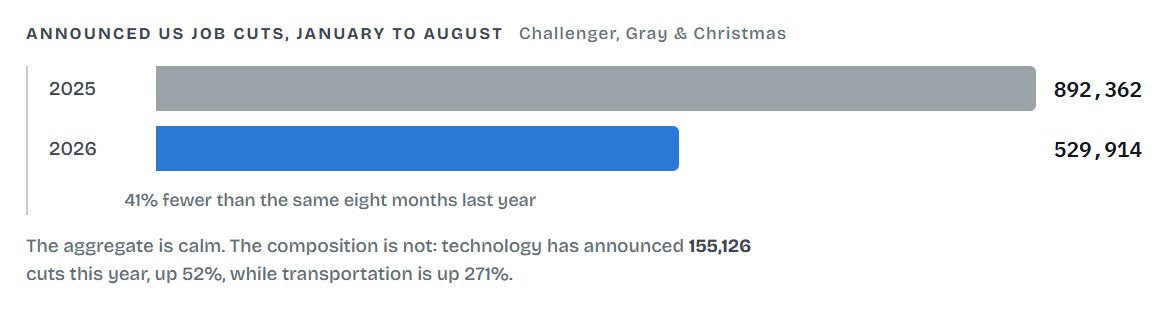
Look underneath and the composition is doing something. The information sector shed 23,000 jobs in August while restaurants added 59,000 — that is a labour market rearranging itself, not growing. Artificial intelligence remains the single most-cited reason for cuts in 2026 at 116,175, though August's AI-attributed figure of 3,462 was the lowest monthly total since December 2025. Worth holding onto the next time someone tells you the displacement is accelerating in a straight line.
On the office question, the drift is still toward the building. Fidelity and TikTok have both gone to five days. EY now wants twelve days a month and checks the badge data. Airbus went the other way entirely: it scrapped a four-day mandate in August after roughly 40% of its workforce walked out, and reverted to two. That is the clearest signal of the year about where leverage actually sits. It sits with people willing to coordinate.
Three days without Tokyo
Japan's cash equity market is shut Monday, Tuesday and Wednesday for Respect for the Aged Day, a bridge holiday and the Autumn Equinox. Derivatives keep trading; shares do not. Expect thin Asian-hours liquidity through midweek, and expect anything that breaks over there to get priced all at once when Tokyo reopens Thursday.
China's markets close Friday for the Mid-Autumn Festival. Yom Kippur runs until nightfall tonight. And if you have anything scheduled in midtown Manhattan this week, the General Assembly is in session through the 28th — move the meeting or leave an extra forty minutes, because the motorcades will not move for you.
Compiled Monday 21 September 2026. Figures as of Friday's close and Sunday's AAA reading. Sources: CNBC and Schwab on the FOMC; TheStreet and Investrade on Friday's close; AAA and Finder on fuel; US Inflation Calculator on August CPI; Fox Business on payrolls; Challenger, Gray & Christmas on job cuts; Archie on return-to-office; Newsquawk and Kiplinger on the week ahead; WEF on the summit; Straits Daily Brief on Hormuz; Axios on Buffett; NPR on Moscow; GuruFocus on the Tokyo holidays.
Filed under Leisure
Comments1 comment
Such a cool newsletter
Sign in to comment. It takes an email address, no password.