One company sells most smart rings. The fight to change that is happening in court.
Listen to this post · 7 min
Read aloud by a synthetic voice.
Rings are the quiet part of the wearables boom. They are also the most tangled, and what you pay for one depends on lawyers as much as sensors.
If you sleep badly and work a lot, someone has probably tried to sell you a smart ring this year. A friend wears one. A colleague checks a recovery score before the Monday meeting. The pitch is easy to like: a band about the width of a wedding ring that tracks sleep, heart rate and stress, with no screen to buzz at you.
The market behind that pitch is odder than it looks. Roughly 4.3 million smart rings shipped worldwide in 2025, up about half on the year. Smartwatches shipped around 163 million. That is one ring for every 38 watches. In a category that small, one company can own most of it, and one does.
One brand, three rings in four
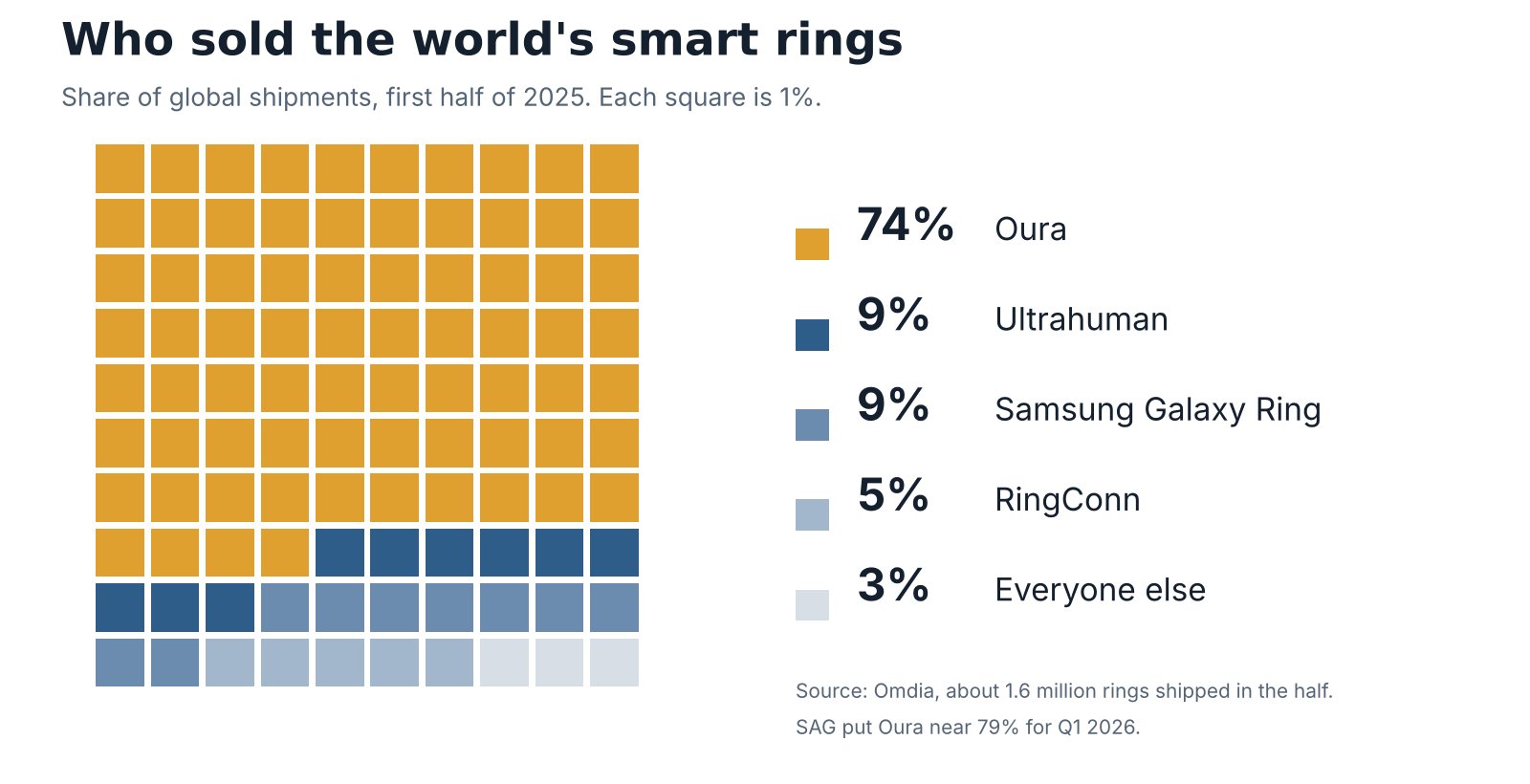
Oura, the Finnish company that started the category, shipped about 74 percent of rings sold in the first half of 2025, according to Omdia. Ultrahuman and Samsung each had around 9 percent, and RingConn about 5. A different tracker, SAG, put Oura near 79 percent for the first quarter of 2026. It also found that overall ring shipments grew only 3 percent that quarter, because Samsung and Ultrahuman were both having a rough few months.
Oura's own filing with US regulators, made in September, tells the same story from the inside. It sold 3.6 million rings in the twelve months to June 2026 and had 5 million paying members at the end of that month. The members are the real business. About 94 percent of ring buyers sign up for the membership, and 72 percent of them are women, a group that wrist wearables built around training have often missed.
Then came a stumble. Oura launched its stock market listing in September and postponed it on 29 September, citing market uncertainty. It says paid membership has since reached about 5.7 million. The ring business looks healthy. Investors were simply not in the mood that week.
A patent is doing the heavy lifting
Here is what makes this category different from phones or watches. Oura holds a patent on how a smart ring is built, and it has been using it.
In 2025 the US International Trade Commission found that Ultrahuman and RingConn infringed that patent. The import ban took effect on 21 October 2025. On the same day RingConn signed a licence and agreed to pay Oura a royalty, so it kept selling. Ultrahuman fought, lost its bids to pause the order, and was shut out of new US sales until it redesigned. In March 2026 US Customs ruled that its new Ring Pro, a one-piece titanium design, falls outside the order. Shipments began in May. The older Ring AIR is still barred.
Oura did not stop there. In November 2025 it filed a new case against Samsung, Reebok, Zepp Health (the company behind Amazfit) and a smaller brand called Nexxbase. Samsung answered with its own complaint a month later, asking the commission to block Oura's imports. Both cases are still open. Samsung's second-generation Galaxy Ring is now reported to be slipping to early 2027. Some observers link that to the dispute. Nobody outside the companies can confirm it.
For a buyer, the lesson is plain. Supply in this category is partly a legal question. A ring that is on sale today may not be next year, though rings people already own keep working.
What it costs, in several currencies
The second split is money. The Oura Ring 5 went on sale on 4 June from $399, with fancier finishes at $499. It is about 40 percent smaller than the Ring 4. Full features need a membership at $5.99 a month or $69.99 a year. Oura prices by region, so it is 999 yen a month in Japan, 5.99 euros in the euro area, 9.99 Australian dollars in Australia, and $6.99 across much of the rest of the world.
The rivals sell the opposite idea. RingConn's Gen 3 is around $349 with no subscription and a battery rated for up to 14 days. Samsung's Galaxy Ring has no subscription either. It lists at $399.99, is often discounted to $299.99, and works only with Android phones. Ultrahuman's rings skip the fee as well.
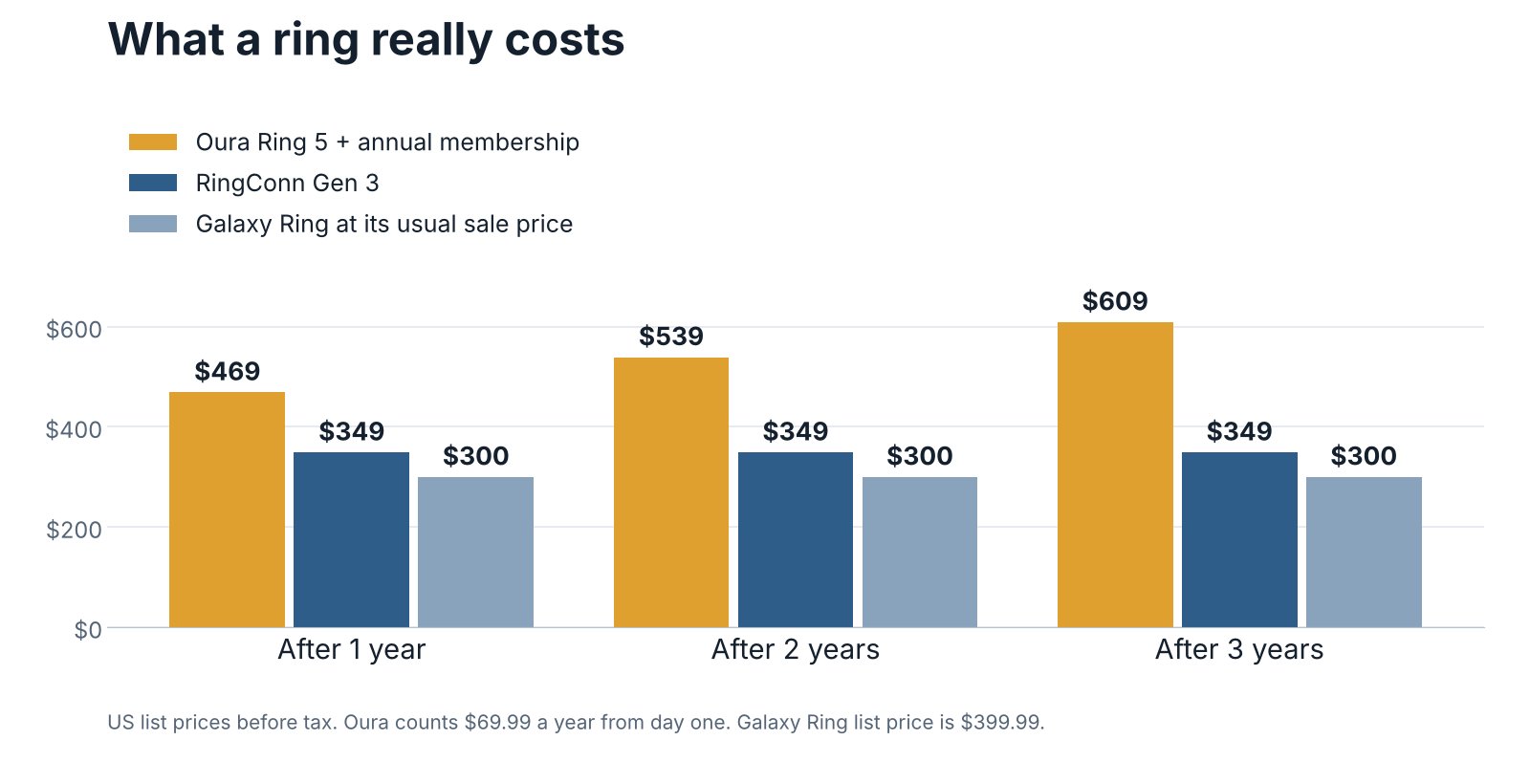
Do the sums and the picture is clear. After three years an Oura Ring 5 on the annual plan costs about $609. A RingConn is still $349, and a discounted Galaxy Ring is $300. Whether the premium is worth it depends on how much you value the app, which reviewers tend to rank as Oura's strongest card.
What a ring changes on a working day
Strip away the market talk and the reason people buy these is mundane. A ring does not light up in a meeting. It does not need charging every night, which matters on a business trip. Oura quotes six to nine days for the Ring 5, and Samsung about seven for the Galaxy Ring. Oura also argues that the finger gives a stronger signal than the wrist while you are lying still, which is why rings lean toward sleep and recovery.
New features push further. The Ring 5 adds Blood Pressure Signals, which look for long-term patterns, and a rolling 30-day view of breathing disturbances at night. Neither is a diagnosis, and some features are not yet available in every country because of local rules. Think of them as a reason to ask your doctor a better question, not as an answer.
A few rules of thumb for the rest of us:
- On an iPhone and happy to pay monthly: the Oura Ring 5 has the best app and the thinnest body.
- Allergic to subscriptions and often on the road: RingConn Gen 3 is the battery pick.
- On a Samsung phone: the Galaxy Ring fits neatly. On an iPhone, skip it.
- Able to wait: a second Galaxy Ring is rumoured for 2027, and Garmin may have something coming.
What to watch next
Samsung versus Oura is the big one. Either side could come out of the commission with an import ban against the other. Garmin is the wild card. In July it launched the Cirqa Smart Band, a screenless tracker at $199.99 with no subscription. A matching ring has since appeared in certification filings in several countries, but Garmin has announced nothing. Apple and WHOOP, for now, do not make rings. And Oura has set no new date for its stock market debut.
The short version for your wallet is simple. The ring is the easy part. Which one you can buy, and what it costs to keep using it, will be decided by who wins the next round of court cases.
Sources
- Sahha, The Smart Ring Market in 2026, 1 October 2026, citing Omdia, IDC, Oura's SEC filing and company releases
- Smart Analytics Global, Q1 2026 smart ring market
- T3, Oura Ring 5 review for pricing and features
- US ITC notice, Investigation 337-TA-1398
- Legal Clarity, Ultrahuman ring lawsuit timeline
- Vora, smart ring prices checked 3 October 2026
Filed under MarketTechnology
Comments
No comments yet. Start the conversation.
Sign in to comment. It takes an email address, no password.