The Quiet War for Your Reading Time: eReader Competition in 2026
Listen to this post · 7 min
Read aloud by a synthetic voice.
It's 10:40 pm, wherever you are. You've sent your last email, and you finally have twenty minutes that belong to you. Do you open a book, or does your phone open you?
That tiny moment is the real battlefield of the e-reader business. These devices are quiet, gray and a little old-fashioned, yet a global fight is going on over which one lands on your nightstand, and which bookstore gets your money for the next ten years.
This is a quick, honest map of that fight: who is winning, who is chipping away, and what it means if you are a busy person deciding what to buy. Short version: you have more good options than you think, and the biggest decision isn't the hardware. A note for readers outside the US: prices below are in US dollars unless stated, and what you can buy, borrow or ship varies a lot by country, so check your local stores.
Amazon owns the room
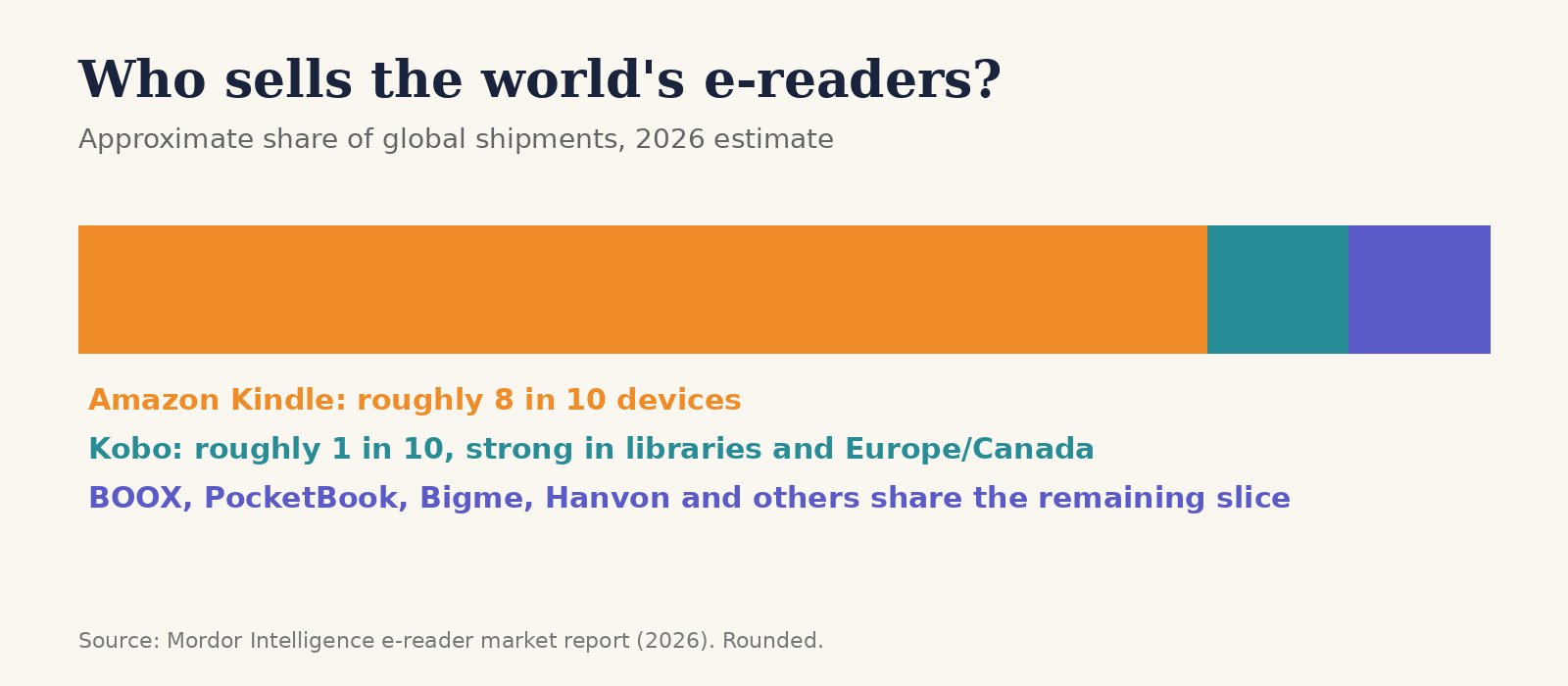
Start with the elephant. One market report puts the whole e-reader business at about $8.8 billion in 2026, growing roughly 6% a year, and estimates that Amazon ships around 80% of all devices worldwide. Kobo, owned by Rakuten, is second at about 10%. Everyone else fights over the last tenth.
Why is Kindle so hard to dislodge? Because the device is almost the side dish. The main course is the store: a vast catalog, one-tap buying, Audible, Kindle Unlimited. Most reviewers still name the Paperwhite (12th generation) as the safest pick for most people, with a warm light, waterproofing, USB-C and 16GB of storage.
If you already own a pile of Kindle books, that settles it. Leaving means leaving your library behind, and that lock-in is the wall every competitor keeps running into. (These are rounded figures from one analyst, so read them as the shape of the market, not gospel.)
Kobo, the polite rebel
Kobo's pitch is simple: your books should stay yours, in any country. Its devices read EPUB, the open format most libraries and independent shops use, and they plug straight into library borrowing through OverDrive and Libby. On a Kindle that still takes workarounds. Library lending depends on your country and your local library, so check that yours supports it before you buy.
The lineup climbs like a ladder. The Clara BW is the small, sharp, inexpensive one, and French retailers have recently listed it near 150 euros (roughly $175). The Clara Colour is $179.99. The Libra Colour, around $260, adds page-turn buttons, stylus notes and color, and reviewers keep calling it the best-differentiated rival to Amazon.
The honest trade-off is the store. It is smaller than Amazon's, and if you read new releases in English, Amazon's convenience is hard to beat. If you read in another language, check each store's catalog first. But if you borrow from a library, or you simply hate being locked in, Kobo is the grown-up alternative.
BOOX and the Android crowd
Then there is the rebel faction: BOOX (made by Onyx), Bigme, Meebook and friends. They run Android, which makes them less "e-reader" and more "paper-screen tablet." Install the Kindle app, the Kobo app, Libby, your read-later list and even work PDFs, all on one calm screen. The BOOX Go 7 costs about $250, and the color version about $270.
The catch is real: more menus, more fiddling, faster battery drain and uneven app polish. A plain Kindle or Kobo is better precisely because it does less. If your reading is scattered across five apps, BOOX is the cure. If it isn't, it's a hobby you didn't ask for. Note too that some BOOX and Bigme models are sold mainly in China, so check which version ships to your country.
Color and writing are where the fight is heating up. Kindle Colorsoft ($249.99), Kobo's color models and BOOX all offer it, but color suits comics, textbooks and magazines more than novels, because color text is less crisp than black and white. Large note-taking screens like the Kindle Scribe, Kobo Elipsa, reMarkable and BOOX Go 10.3 are quietly going after the paper notebook you carry to meetings.
What it means if your evenings are short
Three things matter more than any spec sheet.
First, friction. A reader you have to babysit ends up in a drawer. That is the quiet argument for the simple devices: they open a book in two taps and, with normal reading, run for weeks between charges.
Second, where your reading comes from. Count the books you already own digitally, check whether your local library lends through Libby, and think about whether you read work documents. Those three answers choose your ecosystem for you, and ecosystems are hard to leave.
Third, price. Entry-level color starts near $180, and the pricier everyday models sit around $250 to $270, about what a mid-range pair of headphones costs.
And one more thing, which no review table captures: an e-reader doesn't buzz. No feed, no pings, no little red numbers. For plenty of busy people, that is the real product: a screen that asks nothing back.
It looks different from Taipei, Paris and Warsaw
The global picture is messier than "Kindle versus the rest." Amazon, Kobo, PocketBook, Meebook and reMarkable sell in nearly every major country. A separate Chinese camp, including Hanvon, iFlytek, iReader, Huawei, BOOX and Bigme, grew up at home first, and some of their models never leave China.
Kobo is the strongest foreign challenger in Europe, Canada and parts of Asia-Pacific, largely thanks to partnerships with local booksellers. PocketBook, a European maker, does well in Central and Eastern Europe, where wide format and language support matter. In France, local brands such as Vivlio sit beside the big names, and Sony still has a foothold in Japan.
Here is the quiet twist: almost everyone buys their screens from the same place. E Ink Holdings has a near monopoly on the panels, so the real competition is software, bookstores and price, not the display.
The next skirmish looks small. PocketBook announced the Q in late August, a black-and-white reader shaped like a phone, due this autumn, and BOOX's mini Picco is being talked about too. Analysts expect steady, unglamorous growth, driven by replacements, students and devices that read and take notes.
So which one should you buy?
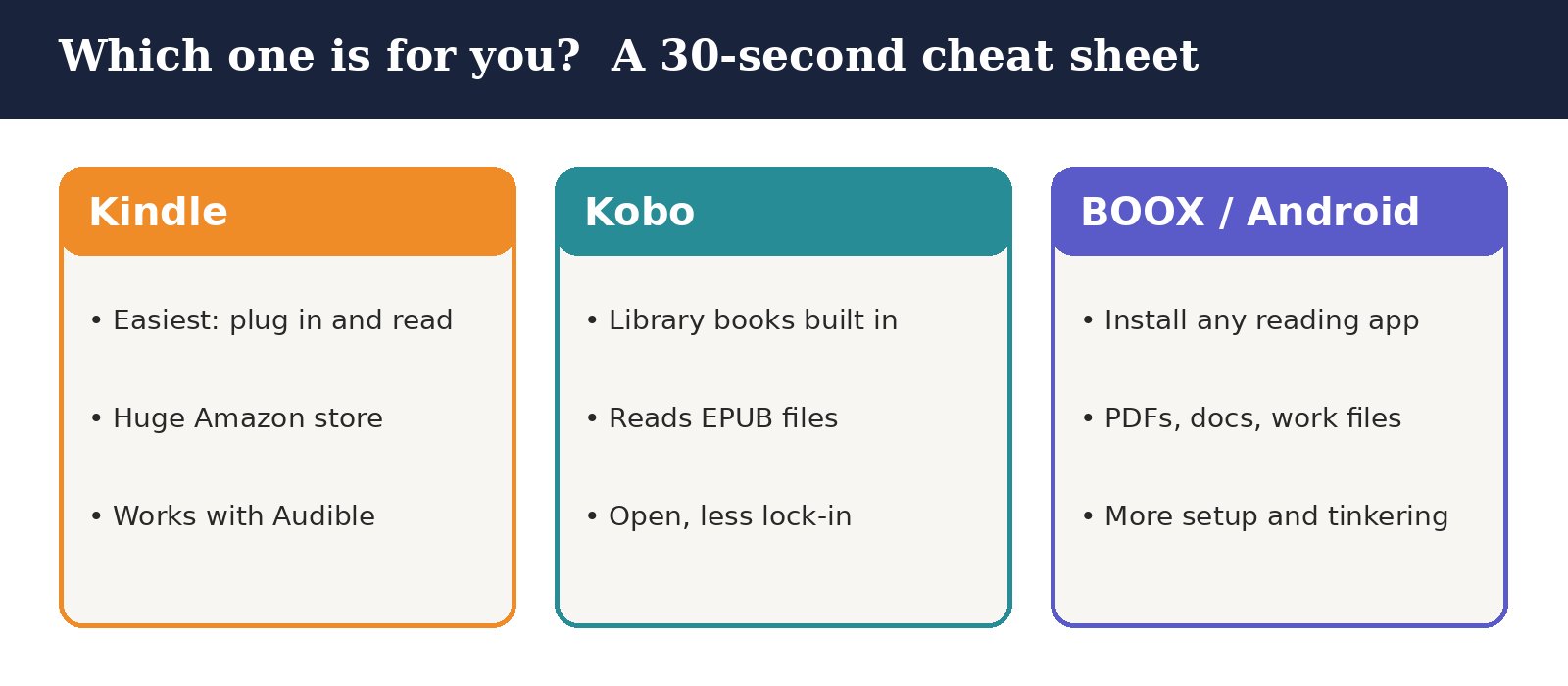
Pick the bookstore first and the hardware second. If you buy mostly from Amazon, get a Paperwhite and stop thinking. If you borrow from a library or own EPUB files, start with a Clara BW or a Libra Colour. If your reading and your work files live in many apps, try a BOOX Go 7. Want color? Buy it only if you read comics, textbooks or magazines.
The e-reader war is not really about screens. It's about who holds your library, and whether leaving ever feels easy. The best device is the one that makes it effortless to open a book at 10:40 pm.
Sources
- Best e-reader of 2026 compared
- E-reader market size and share (Mordor Intelligence)
- Best e-readers of 2026 (iTechGuides)
- Kindle alternatives in 2026 (eReaders Forum)
- Chinese vs global e-reader brands (Good e-Reader)
- Top 10 e-reader companies (Deep Market Insights)
- PocketBook Q and BOOX Picco news (Liseuses.net)
Filed under CraftMarketTechnology
Comments
No comments yet. Start the conversation.
Sign in to comment. It takes an email address, no password.