Monday Brief No. 7 Week of Nov 9
Monday Brief — November 9

Listen to this post · 10 min
Read aloud by a synthetic voice.

The S&P 500 fell 4.4% on Thursday, its worst single day since the April 2025 tariff panic, and erased something like $3 trillion in market value before the closing bell. Nvidia dropped 9.3%. AMD dropped 17.3%. CoreWeave, the company that rents out AI computing capacity, dropped 9.8%. By Friday afternoon the index had clawed back almost all of it and closed up 0.31% for the day. Markets had a full nervous breakdown and a full recovery within twenty-four hours, which tells you less about AI's future than about how thin the ice is under this trade right now.
The whiplash week
What actually spooked everyone was Tuesday's midterm results. Democratic wins in several states raised the odds that local and state governments start blocking or taxing the data centers powering the AI buildout. Voters are tired of the noise, the water use, and the power bills, and investors suddenly remembered that a trillion-dollar capital spending plan depends on nobody's town council getting in the way. Stretched valuations and the cost of borrowing to build all that infrastructure did the rest. By Friday, chipmakers had mostly bounced, and strong earnings elsewhere helped: Airbnb jumped 12% on a profit beat, Cloudflare jumped 15%, and Lam Research rose 10% after announcing a $25 billion buyback. Five9 fell 16% anyway, despite beating estimates, because its guidance was soft. Beating the quarter buys you nothing if the outlook is weak.
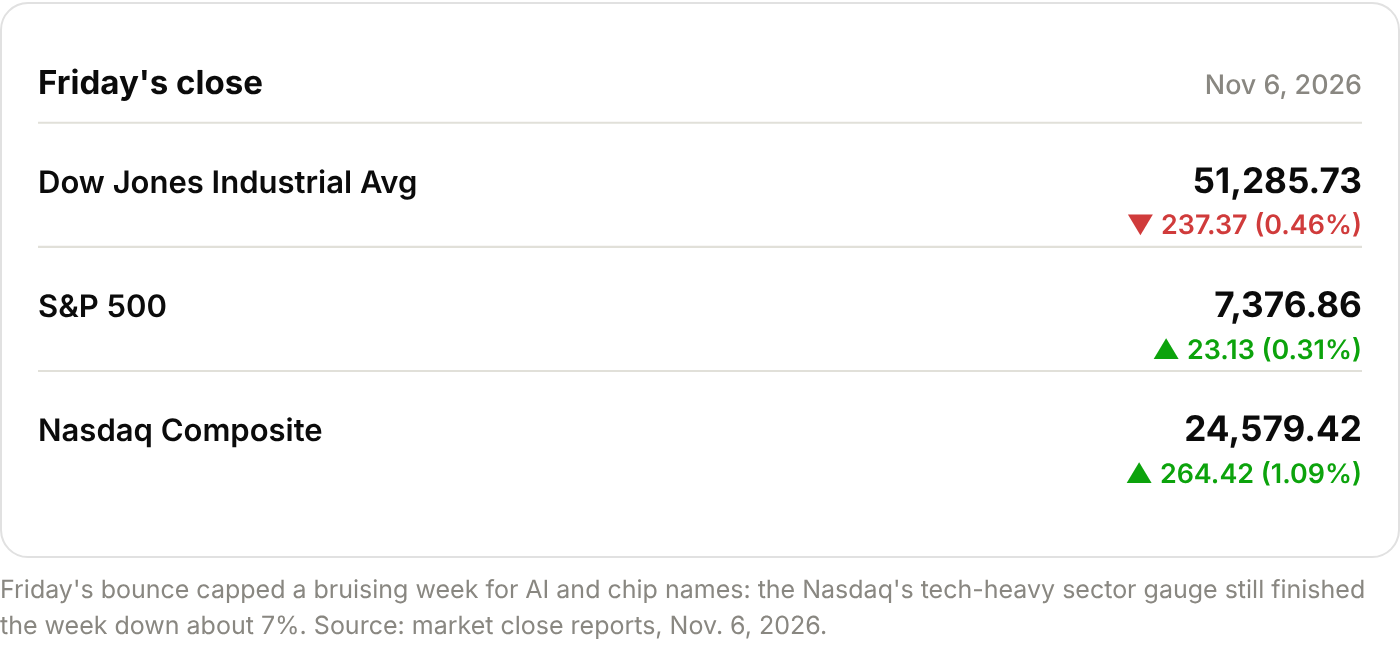
Underneath the AI drama, the real economy looked fine. October's jobs report, released Friday, showed payrolls up 165,000 against expectations closer to 65,000, with unemployment at 4.1%. The Bank of England raised its key rate to 4% on Thursday, its first hike since 2023, in a 9-0 vote. Brent crude slipped back under $100 a barrel after flirting with triple digits most of the week on tanker attacks and Strait of Hormuz tension tied to the ongoing US-Iran conflict. The 10-year Treasury yield sits near 4.83%, down sharply from above 5.3% a month ago.
What's on the calendar
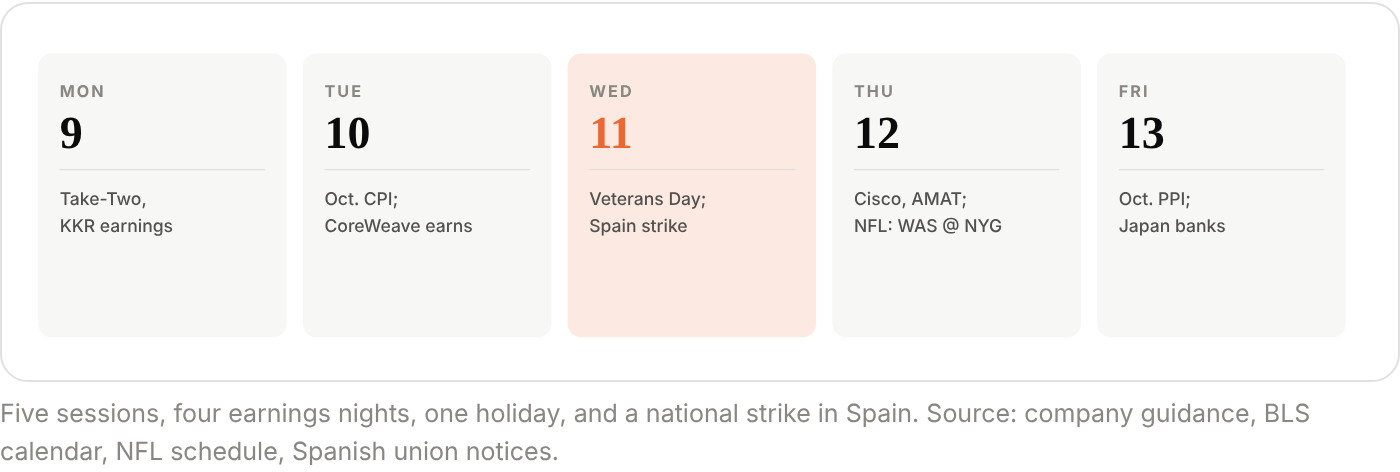
Monday itself brings a wave of earnings before the real headline events land. Take-Two Interactive reports after the close, with Wall Street watching less for the numbers than for any update on Grand Theft Auto VI, which the company still lists for a November 19 release after one prior delay already. KKR, Constellation Energy, and Ferguson report through the morning. None of it should move markets much; think of Monday as the warmup lap before Tuesday's inflation data and Thursday's chip-and-networking earnings double feature.
This week's biggest problem for anyone watching inflation: Tuesday's October CPI report, out at 8:30 a.m. ET, will not include a 12-month inflation rate. Last year's government shutdown wiped out the October 2025 data the Bureau of Labor Statistics needs for the comparison, so economists get a month-over-month number and have to guess at the annual figure themselves. September's annual rate, for reference, was 3.7%, with core at 2.6%. Expect a lot of headlines Tuesday that quietly skip over this and report a number that isn't really there. CoreWeave reports earnings after Tuesday's close, its first update since Thursday's rout, and will set the tone for whether AI infrastructure spending is actually slowing or just got scared for an afternoon.
Wednesday is Veterans Day. The stock market stays open; bond markets and banks close, so trading volume will be thin and bond yields will barely move. Spain, meanwhile, grinds to a halt: its two biggest unions, CCOO and UGT, have called a 24-hour general strike over stagnant wages and the housing crisis, three weeks before a snap national election. Expect grounded flights, canceled high-speed trains, and skeleton bus and metro service in Madrid and Barcelona. A separate rail drivers' strike runs Monday through Wednesday on top of it. If you're flying through Spain this week, build in a cushion.
Thursday brings the week's real earnings event: Cisco and Applied Materials both report after the close, and between them you get a decent read on AI capital spending from two different angles. Cisco guided revenue toward $18.1 billion on the networking gear that runs data centers; Applied Materials guided around $10.25 billion on the equipment that makes the chips, after a record $9.12 billion the quarter before. If both numbers land soft, last Thursday's selloff starts looking less like a blip and more like an early warning. Sports fans get a consolation prize that same night: the Commanders travel to face the Giants on Thursday Night Football, the week's only national game before Sunday's full slate. Friday brings October's producer price index, plus half-year results from Japan's three largest banks, MUFG, Sumitomo Mitsui, and Mizuho.
The layoffs that didn't happen
The week's least-covered story doesn't show up in any stock chart. Challenger, Gray & Christmas's October layoffs report, out last Thursday, told a much calmer story than the headlines suggest: 43,994 announced US job cuts, down 71% from October 2025 and the quietest October since 2023. Year-to-date cuts sit at 617,189, down 44% from last year's pace through the same month. The number that should get more attention: AI was cited in just 1,265 of October's cuts, the smallest monthly total all year, while "market and economic conditions" overtook AI as 2026's single largest stated reason for layoffs, responsible for 37% of October's total and running well ahead of AI's 20% share for the year. Microsoft's roughly 60,000 voluntary buyout offers from October aren't even in that count yet, since Challenger only logs accepted exits, not open offers. Hiring plans, meanwhile, jumped 57% from a year ago to 444,692, the strongest October since 2009, largely on the back of Amazon's record 300,000 seasonal hires and UPS's 100,000. Food companies cut the most of any sector in October, retail's cuts are down 80% for the year, and fintech's cuts are up 543% year-to-date, a reminder that whatever is happening to that industry has nothing to do with chatbots.
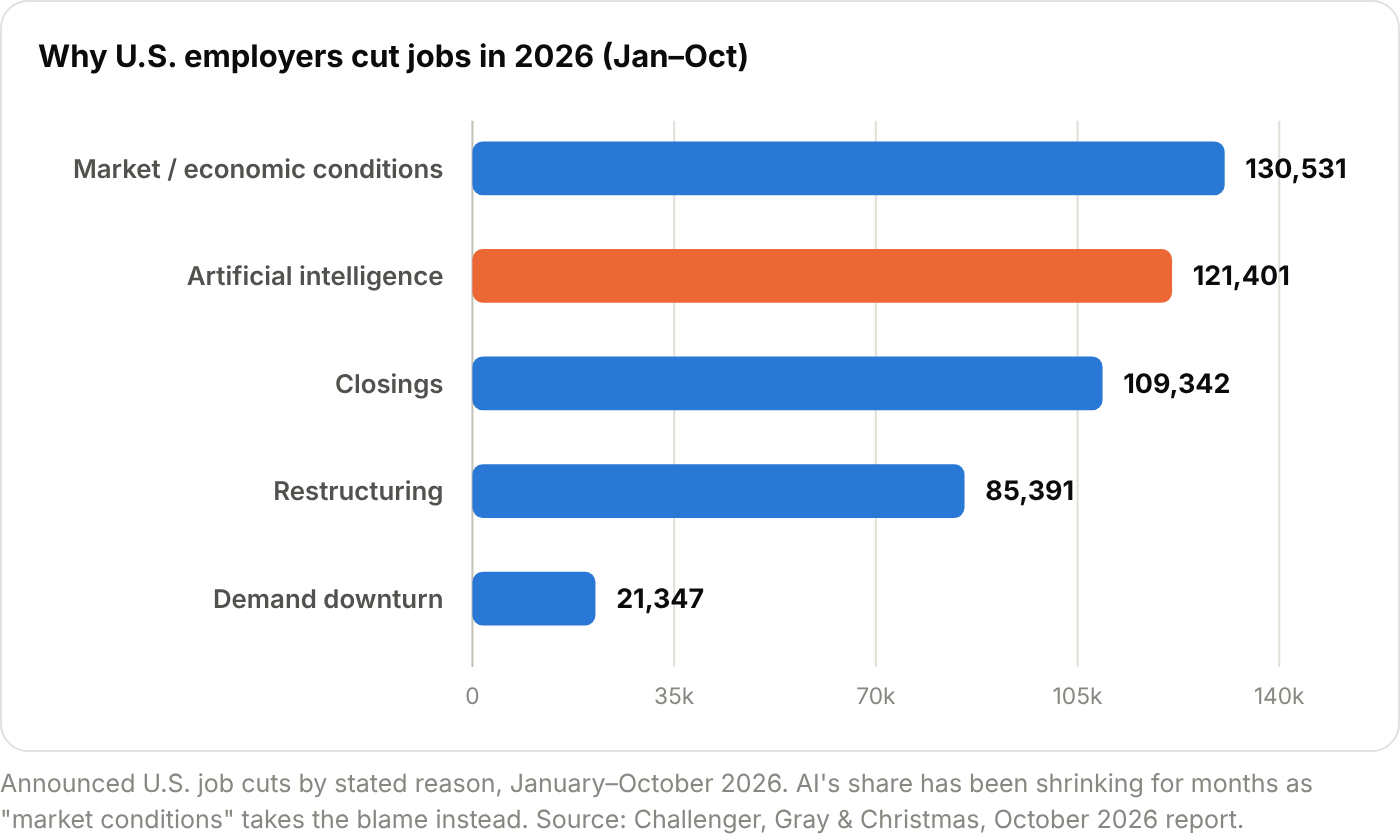
Both stories are sitting in the same report: AI is still quietly reshaping headcount at the margins, and the layoff wave people keep predicting hasn't actually shown up in the data this fall.
Two things to actually do this week
Put your hardest thinking on Tuesday or Wednesday morning, before the earnings and economic-data pileup on Thursday eats everyone's attention span, including yours.
If anyone on your team is anxious about AI replacing their job, show them the Challenger numbers above rather than reassuring them in the abstract. Specific data calms people down faster than a pep talk does.
My take
The figure worth tracking out of all this isn't Tuesday's CPI print, it's that 1,265 number. For more than a year, "AI efficiency" has been the go-to line in layoff announcements, and it just posted its quietest month on record while market conditions took over as the stated reason. That's a tell. If I were setting priorities right now, I'd stop weighting vendor pitches that lean on headcount-reduction math as proof of AI value, and ask instead for a vendor's own before-and-after productivity numbers, because the companies doing the cutting increasingly aren't using AI as the excuse anymore. I'd also treat Thursday's selloff as noise and Cisco and Applied Materials' actual guidance as the signal: two earnings calls will tell us more about whether AI infrastructure spending is cooling than a week of index swings ever could.
Sources
- S&P 500 and Nasdaq close, worst day since April 2025 tariffs
- Stock market news for Nov. 6, 2026 (Zacks)
- Friday Nov. 6 close and AI-stock rebound (Yahoo Finance)
- Bank of England raises rate to 4%, first hike since 2023
- October CPI preview: no 12-month inflation rate
- November 2026 economic calendar: JOLTS, jobs, CPI, Fed
- Earnings calendar for the week of November 9, 2026
- Challenger, Gray & Christmas: October layoffs at three-year low
- U.S. October job cuts hit 43,994, lowest for the month since 2023
- General strike set to disrupt Spanish travel on November 11
- NFL Week 10 schedule, 2026
- Oil rebounds from two-month low as uncertainty lingers over the Iran war
Get NeatRead's best posts in one weekly email
One email a week, no password. Unsubscribe anytime.
or continue with email
With email, we send you a sign-in link.
By joining, you agree to the Terms and Privacy Policy.
Comments
No comments yet. Start the conversation.
Sign in to comment. It takes an email address, no password.