案例研究 第 7 期
Lots of Engineers Are “Yes” Engineers Now

本文以英文撰寫。閱讀中文版
收聽這篇文章 · 5 分鐘
由合成語音朗讀。
A field guide to the most agreeable species in tech, and the bill that arrives later.
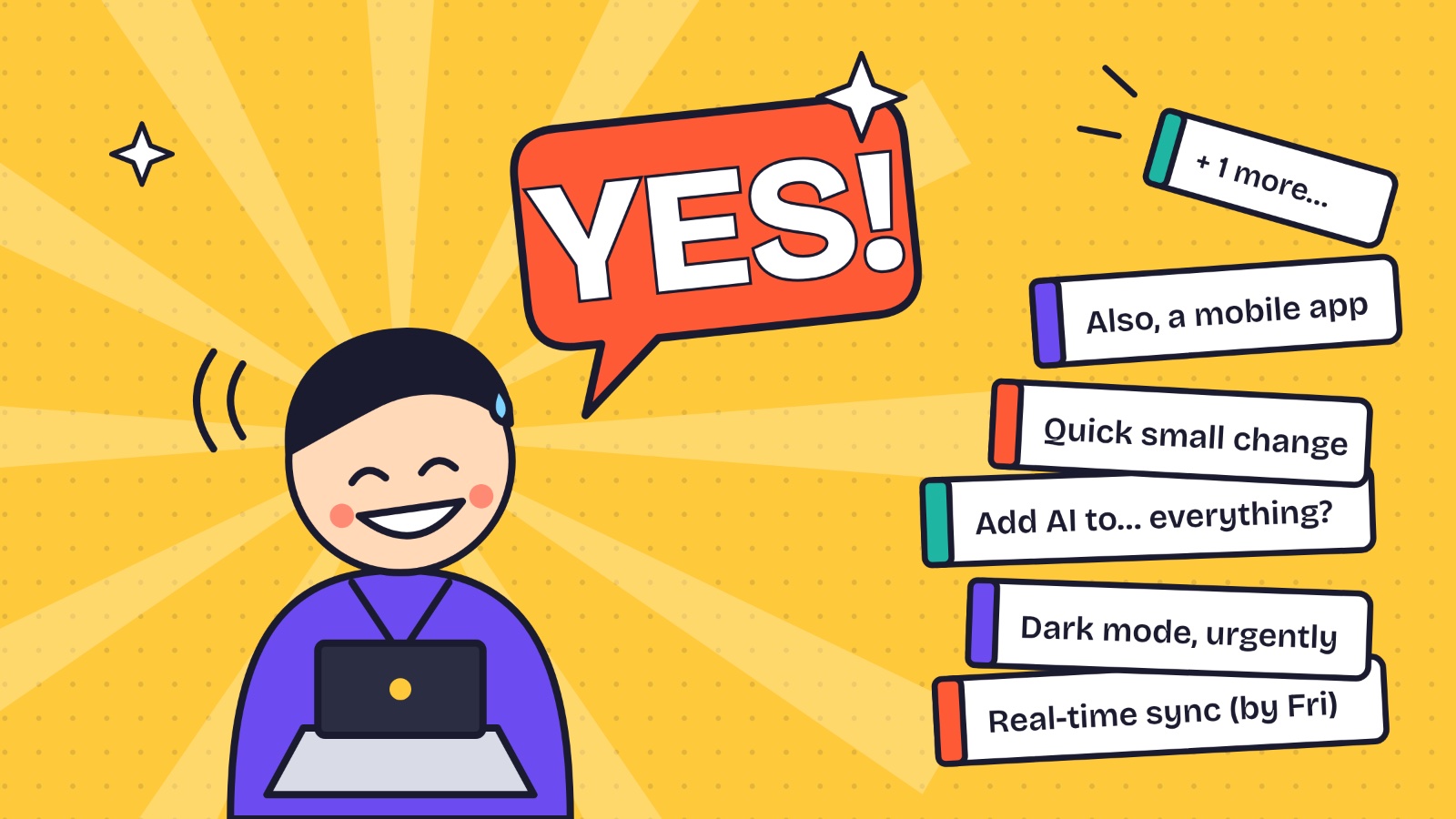
It’s 9:58 a.m., two minutes before stand-up is supposed to end. The product manager leans into the camera and asks, very casually, whether the team can add real-time sync, dark mode and “a little AI assistant” by Friday.
The pause is long enough to hear a laptop fan. Then somebody unmutes and says it: “Yes.”
Nobody cheers and nobody gasps. A ticket is born somewhere, and somewhere else a weekend quietly dies. Welcome to the age of the Yes Engineer.
Weren’t engineers supposed to be the grumpy ones?
For decades the stereotype ran the other way. The engineer was the person in the corner who said “technically, that’s impossible” before you’d finished your sentence. “It depends” was practically a personality. You didn’t ask them for things; you submitted proposals and waited for the verdict.
Somewhere along the way that changed. Today’s engineer is agile, aligned, collaborative, and above all agreeable. Ask whether the server can handle ten times the traffic and you won’t hear “no.” You’ll hear “Yes, great question, let’s circle back,” which is engineer for “no, but in a hoodie.”
A field guide to the species
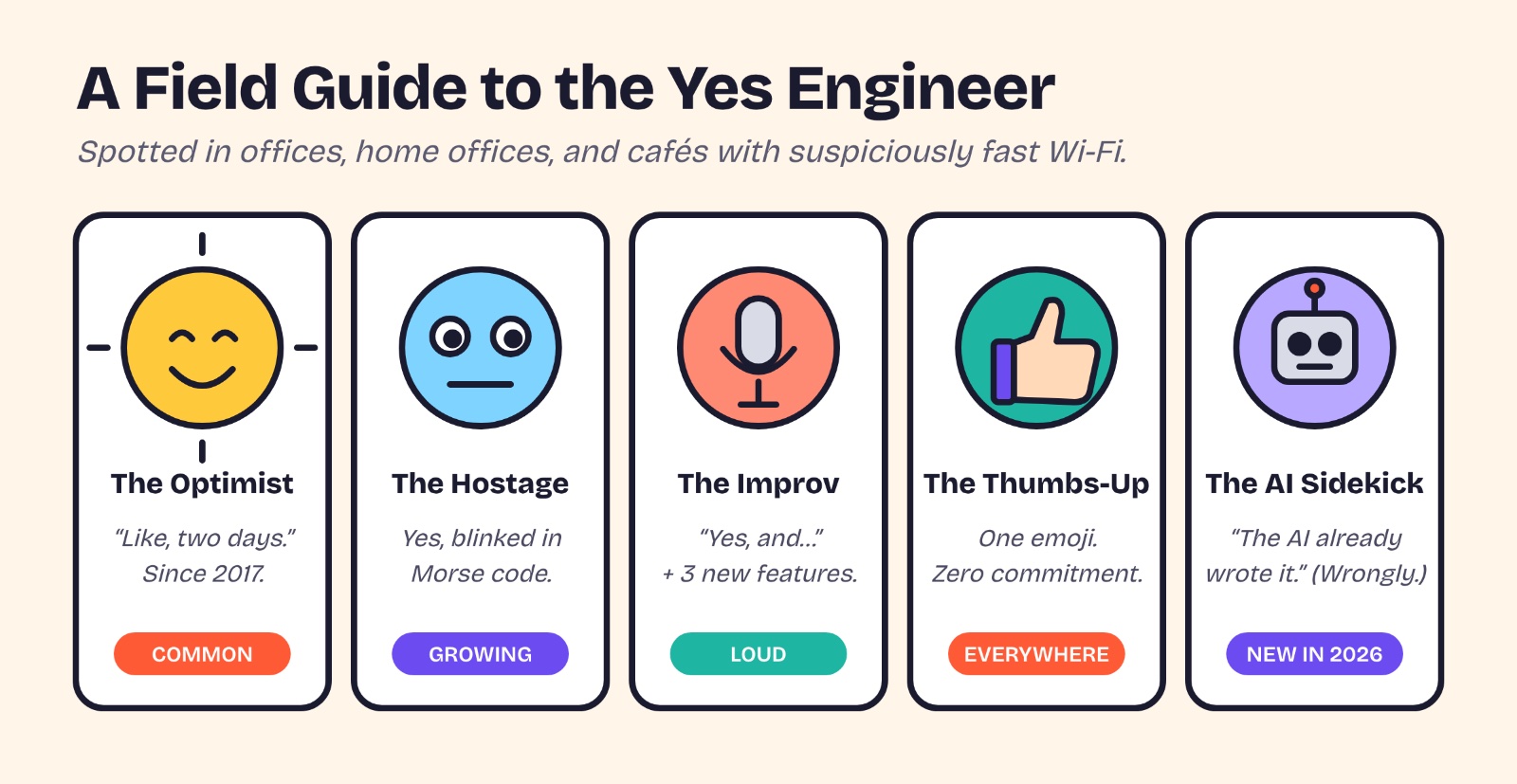
- The Optimist. Believes every task takes “like, two days,” and has believed it since 2017. Never once correct, still undefeated in spirit.
- The Hostage. Says yes with the face of someone blinking a message in Morse code. Their “yes” means “please, somebody, help.”
- The Improv. Took one workshop and now answers everything with “Yes, and…” before adding scope. You asked for a button. You now have a button, a microservice and a roadmap.
- The Thumbs-Up. Never actually says yes. Replies to a 900-word requirements message with one 👍, which commits them to nothing legally and to everything emotionally.
- The AI Sidekick. “Yes, the AI already wrote most of it.” It did, too: confidently, quickly, and for a different database.
Why is this happening everywhere?
This isn’t one country or one company. You’ll see the same stand-up in Taipei, Toronto, Bangalore, Berlin and São Paulo, and the causes are surprisingly universal.
- Job-market jitters. After a few years of layoff headlines, “no” can sound like a resignation letter written in advance, and “yes” feels like job security. At least until Friday.
- Speed theater. When a demo takes ten minutes to build, saying production will take ten weeks feels like confessing you’re slow. The demo is never the product, but it’s the part everyone saw.
- Video-call compression. In a real room, a raised eyebrow carries a whole paragraph of nuance. On a call with fourteen muted squares, the nuance gets dropped and only the binary survives. Binary, as every engineer knows, has two values, and one of them gets you invited to fewer meetings.
- Hierarchy, in every dialect. In some workplaces, saying no to your manager is impolite. In others it’s “career-limiting.” At startups it’s “not a culture fit.” The words change, but you end up in the same place.
The Yes-to-English dictionary
| What they say | What it means |
|---|---|
| “Yes.” | Yes, as long as the requirements don’t change. (They will.) |
| “Yes, should be quick.” | I have not opened the code. |
| “Yes, by Friday.” | Friday is a state of mind. |
| “Yes, it’s done.” | It works on my machine, and my machine isn’t what we’re shipping. |
| “Yes, totally doable.” | Doable by someone, possibly with a time machine. |
| “Yes, happy to help!” | I am not happy. I will help. |
| “Yes, I’ll look into it.” | I will never look into it. |
Yes Debt: the interest rate nobody mentions
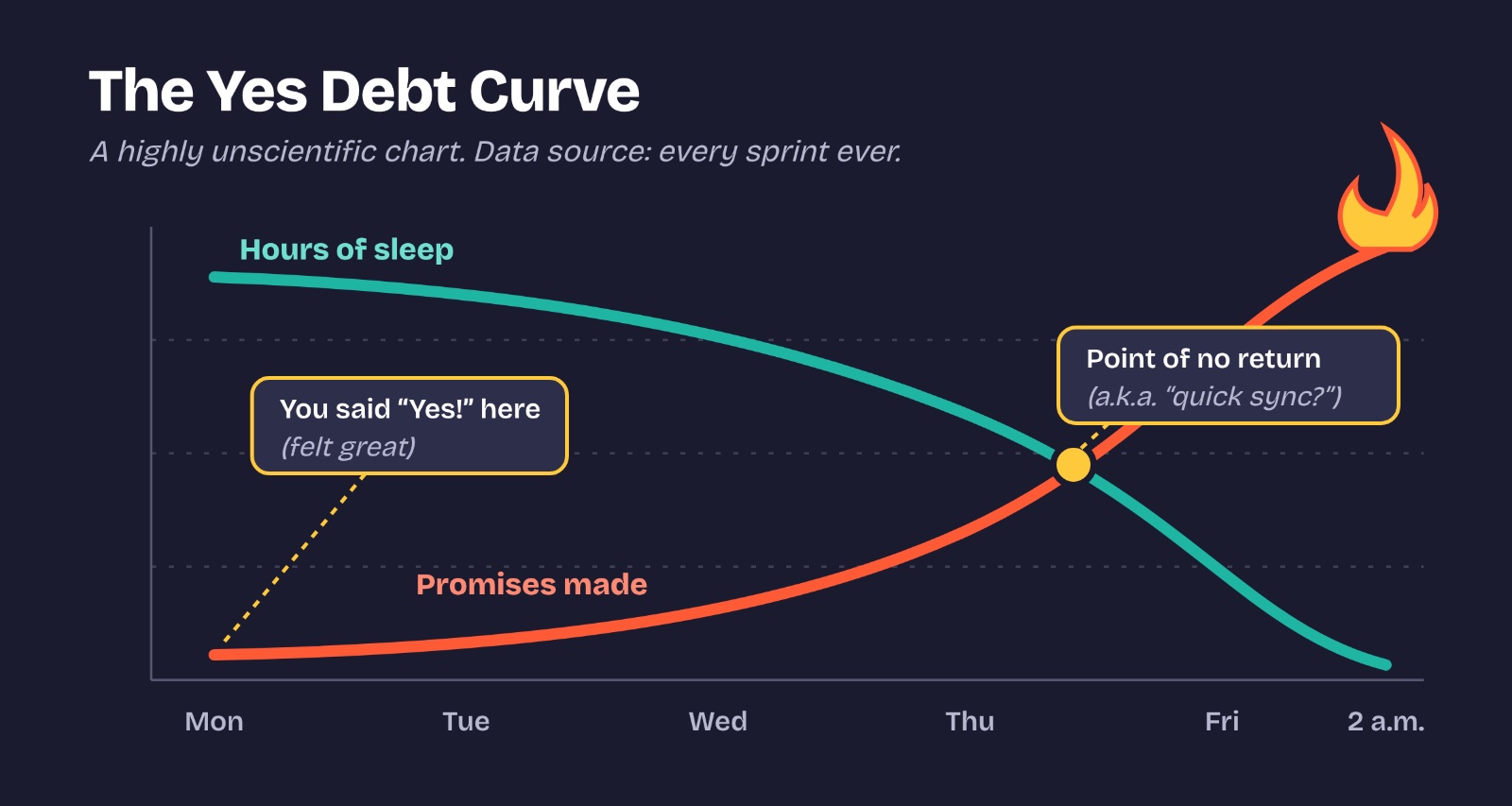
Every engineer knows about technical debt. Yes Debt is its quieter cousin. Each unconditional yes borrows time from the future at a rate that would embarrass a loan shark. The payments come due at 2 a.m. during a production incident, in a sprint that was “only” 140% committed, and in the slow resentment of a team that agreed to everything and owns none of it.
The cruel part is that Yes Engineers are usually the kindest people in the building. They say yes because they want to help, and they end up helping nobody, because a promise you can’t keep is a delayed no with extra steps.
Managers share some of the blame. Many of them have spent years rewarding the quick yes in meetings and then acting shocked when the slow no shows up in the retro. If the only answer that gets applause is “yes,” that’s the answer people learn to give, the same way a dog learns which trick earns the treat. The dog isn’t lying. It’s responding to the incentives.
My take: I’ve said more than my share of yeses, and what I’ve come to believe is that “yes” was never the problem. The naked yes is the problem, the one with no price tag attached. The best engineers I know don’t say no more often than anyone else. They say “yes, and here’s what it costs.” “Yes, by Friday, if we drop dark mode.” “Yes to real-time sync, but that’s three sprints, not three days.” That isn’t being difficult. It hands the decision back to the people who should be making it, with honest numbers on the table. I’d love to see teams treat the priced yes the way we already treat code review, as a basic quality check and not an insult. If you manage people, try a small experiment next week: when someone says yes too quickly, ask them, “What would we have to say no to?” It will probably be the most honest answer you get in that meeting. Personally, I’m practicing a new line in the mirror: “Yes. After lunch, with a plan, and probably not by Friday.” It’s a small change in wording, and it changes a lot.
分類於 科技
每週一封信,收到 NeatRead 的精選文章
每週一封,不需要密碼,隨時可以取消訂閱。
或使用電子郵件繼續
使用電子郵件時,我們會寄登入連結給你。
留言
還沒有留言。來開啟話題吧。
登入後即可留言。只需要電子郵件,不用密碼。