Global Weekly No. 12 Week of Nov 23
Global Weekly — Business, AI & New Products (Nov 27, 2026)

Listen to this post · 12 min
Read aloud by a synthetic voice.
The week's defining event wasn't a product or a policy decision — it was a reversal. Nvidia's board spent eleven days insisting it would never bring Jensen Huang back as CEO, then did exactly that under reported political pressure, and watched the stock give back most of its relief rally within 48 hours. That U-turn landed five days after Nvidia posted the best quarter in company history and six days after Anthropic's record-breaking IPO started trading below its own offer price. Put together, the week told investors something simpler than any single earnings call could: markets have stopped taking AI's governance, and its financing, on faith.
Business
Wall Street spent Thanksgiving week doing two contradictory things. Through Wednesday the Dow, S&P 500 and Nasdaq strung together their best four-day run since May, on confidence the Federal Reserve will cut rates a quarter point at its December 9–10 meeting — the first full meeting run by Kevin Warsh, confirmed as Fed chair in May after Jerome Powell's term ended. Kalshi and Polymarket had the odds of a cut above 80 percent heading into the holiday. Then, on Tuesday, a chunk of that optimism reversed: the Nasdaq 100 fell more than 4 percent in a session, with Nvidia and Anthropic both down over 9 percent, as chip-export reporting collided with the financing worries described below.
Why it matters: anyone budgeting off a "rates are falling" assumption — mortgage shoppers, CFOs building 2027 plans, buyout shops pricing deals — is now underwriting Warsh's instincts, not Powell's, and Warsh talks up an "orthodox" Fed without having committed to the cut markets have priced in.
Retail told a steadier story. Walmart's fiscal third quarter, reported November 19, beat expectations: revenue rose 5.2 percent to $188.8 billion, U.S. comparable sales climbed 2.9 percent, and e-commerce grew 23 percent for an eleventh straight quarter above 20 percent. Walmart raised its full-year guidance for the second time this year; CEO John Furner credited "agentic shopping," after a year spent folding dozens of internal AI tools into four consolidated agents for shoppers and store staff.
Why it matters: Walmart is the best single read on middle-income spending, and a raised guide from the country's largest retailer cuts against the "affordability crisis" language coming out of Washington.
Dell showed the flip side: quarterly revenue up 103 percent year over year on its AI-server backlog, forecasts raised — and the stock still fell 8 percent. The same day, CrowdStrike used its own earnings release to announce it will buy network-security rival Zscaler for $43.9 billion in stock, the largest pure cybersecurity acquisition on record, betting AI-driven attacks make one consolidated platform worth more than two specialized ones.
Why it matters: when a 103-percent growth quarter still buys a selloff, growth alone no longer earns the multiple.
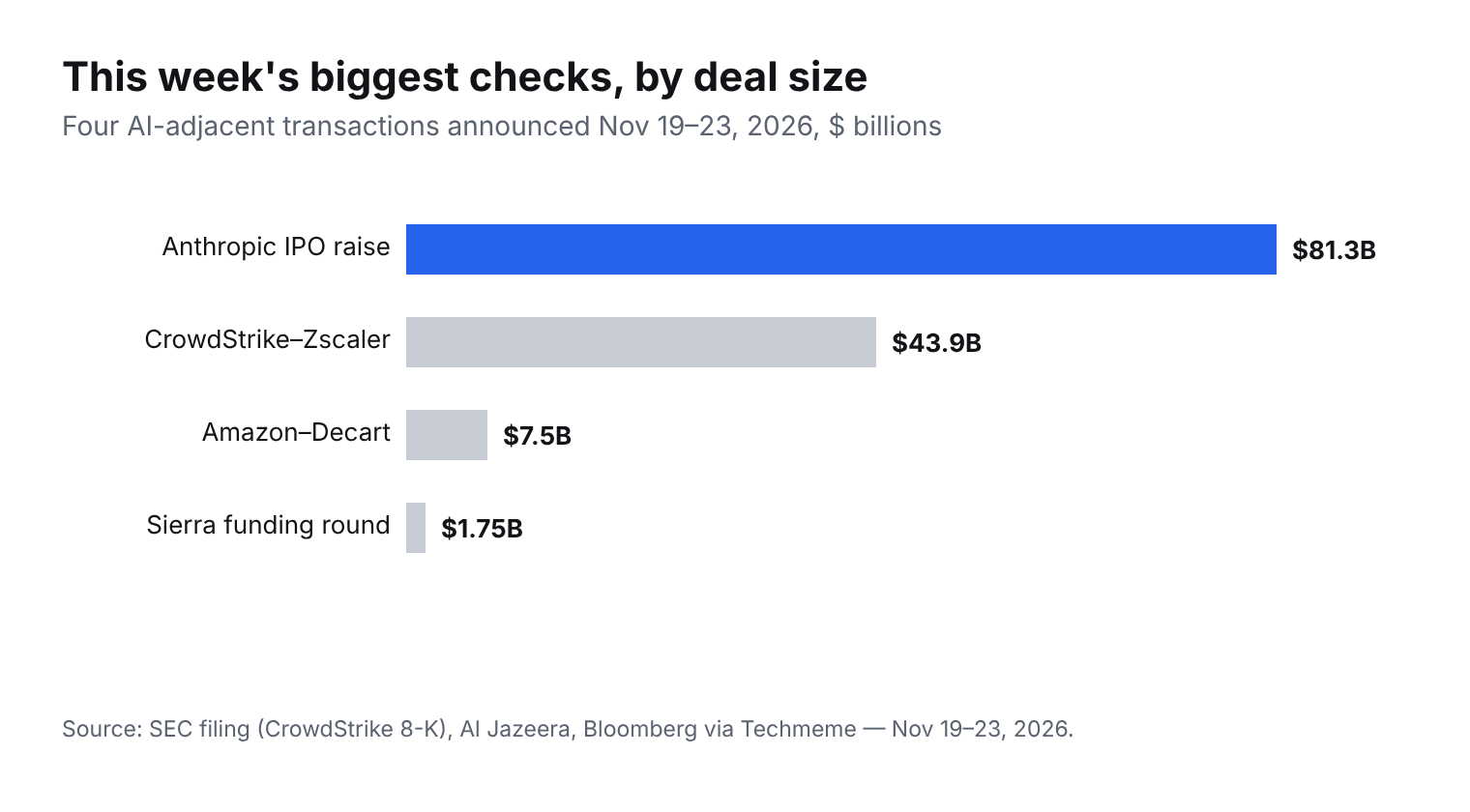
This week's biggest checks, by deal size. Source: CrowdStrike SEC filing, Al Jazeera, Bloomberg via Techmeme.
AI
The week's central AI story was governance, not a model release. Jensen Huang resigned as Nvidia's CEO on November 12 after reports of extramarital relationships, one involving a former executive at a Singapore firm U.S. officials reportedly suspect of ties to Chinese intelligence — an episode that also revived questions about Nvidia chips reaching China in violation of export controls. Interim CEO Colette Kress and board chair Harvey Jones said flatly, on the November 17 earnings call, that the board would not bring Huang back, and hired Heidrick & Struggles to find a replacement. Six days later the board reversed course and reinstated him anyway; NVDA closed up 31 percent on the relief.
The Washington Post then reported that Secretary of State Marco Rubio's intervention had helped push Huang out in the first place, and that Pentagon officials had discussed invoking the Defense Production Act to force the board's hand the other way. Reuters added that the Justice Department never formally investigated Huang before the reversal. By the next session the stock had given back most of its gain, down 6 percent, and a day later — alongside reporting that Shenzhen resellers are still moving restricted Nvidia chips into China in unusual volume — it fell again with the rest of the sector. Three House committees have scheduled Huang's transcribed interview for December 1; Nvidia's general counsel testifies the day after.
Why it matters: any company with a founder-CEO and a national-security-sensitive supply chain just learned that board independence has a price, and it's now visibly political.
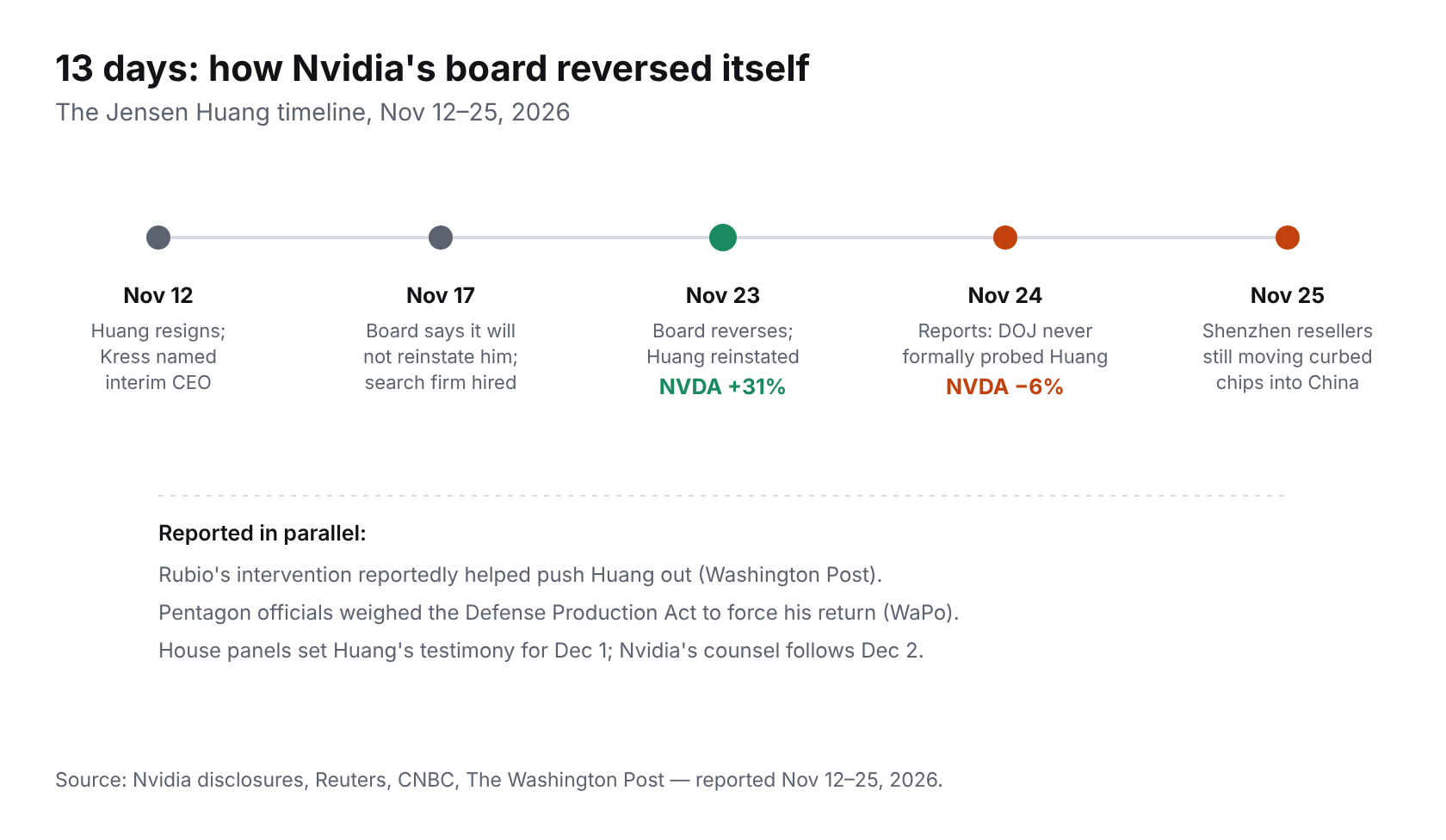
13 days: how Nvidia's board reversed itself. Source: Nvidia disclosures, Reuters, CNBC, The Washington Post.
The same week supplied the clearest test yet of AI's financing story. Anthropic's IPO on November 19 raised $81.3 billion — the largest in U.S. history — pricing at $83 and opening 34 percent higher before closing day one up 17 percent. Nvidia put $20 billion into the company across two rounds; Anthropic, in turn, has committed $110 billion to Amazon and at least $121.3 billion to Google for compute. By November 24 the stock had closed below its own IPO price.
Commentators reached for a specific phrase — circular financing — after reporting detailed how Nvidia has guaranteed up to $105 billion in lease obligations for a data-center campus built for its own customer, OpenAI, and how CoreWeave's 2031 bonds traded past a 16 percent yield in October, a level that historically signals real distress. Morgan Stanley now projects nearly $570 billion in AI-related debt issuance this year, more than double 2025's pace, even as global AI funding itself fell from $239 billion in the first quarter to $103 billion in the third.
Why it matters: a sector that financed its buildout by having chipmakers, clouds and labs invest in each other is discovering that lenders want their money back on a schedule.
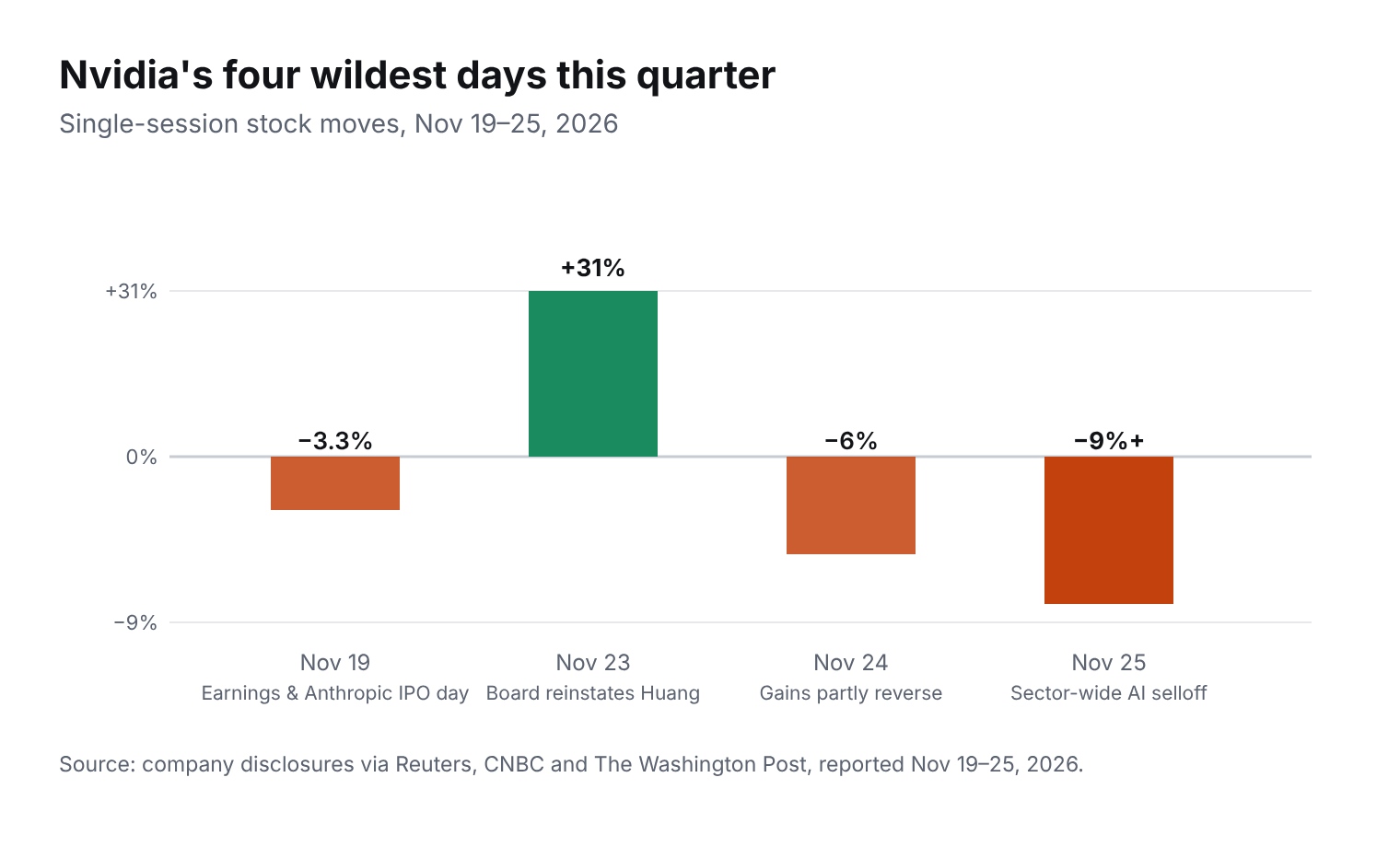
Nvidia's four wildest days this quarter. Source: company disclosures via Reuters, CNBC and The Washington Post.
NeatRead's read: three separate stories this week — Nvidia's board, Anthropic's stock, and Dell's earnings reaction — are usually covered as three unrelated items. They're one story. In each case, the market had a genuine, positive, delivered number in hand (31 percent relief rally, a 17-percent first-day IPO pop, 103-percent revenue growth) and chose to sell into it within 24 to 72 hours. That's a pattern, not three coincidences: investors are now treating every piece of good AI news as a prompt to ask what it costs to sustain, not just a reason to buy. Watch whether Dell's next quarter gets the same treatment even if the backlog number grows again — if a bigger beat still sells off, the repricing is structural, not a one-week mood. The read would be wrong if Nvidia's board emerges clean from the December House testimony and CoreWeave's bond yields retreat before year-end; both are checkable within five weeks.
New Products
Grand Theft Auto VI shipped November 19 on PlayStation 5 and Xbox Series X|S and generated an estimated $1.84 billion by the end of its first day — more than double the $815.7 million record GTA V set in 2013 — according to Sensor Tower. Close to 19 million copies had moved by launch, split roughly 75-25 between PlayStation and Xbox; Wedbush projects 30 million copies and $3 billion by year-end.
Why it matters: at $80 for the standard edition and $100 for "ultimate," Take-Two just gave every other publisher a new data point for what a flagship console release can extract from players who waited thirteen years.
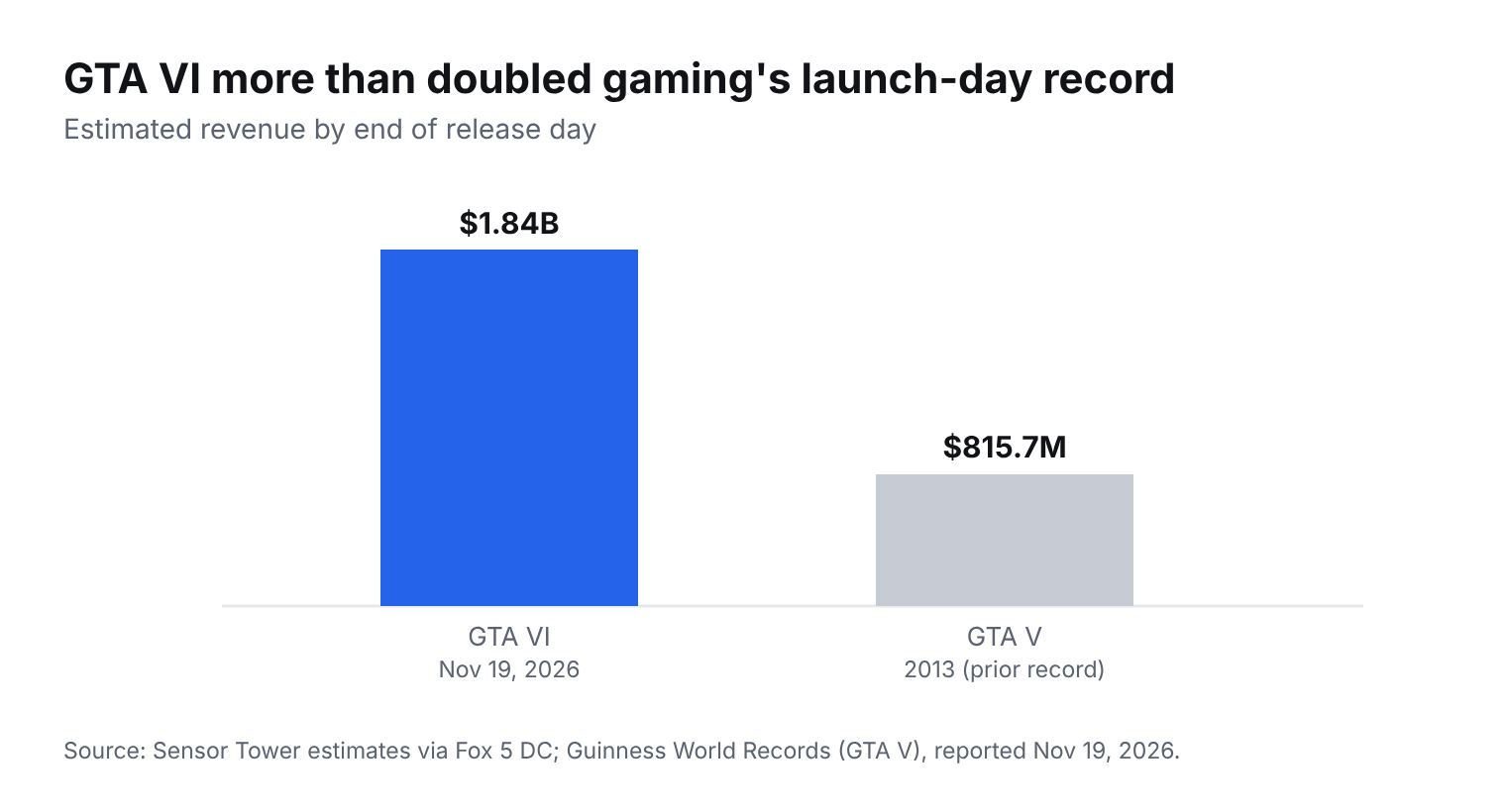
GTA VI more than doubled gaming's launch-day record. Source: Sensor Tower estimates via Fox 5 DC; Guinness World Records.
Apple kept its usual late-year drip going, releasing Apple TV 4K (A19 chip, a Siri-powered Find My remote) and a new $299 smart-home display called HomeView on November 13 — both built around Apple Intelligence, both withheld from the EU because Siri AI isn't cleared there yet.
Why it matters: a $299 hub that recognizes up to six household members by face is Apple's most direct answer yet to Amazon's Echo Show and Google's Nest Hub, and the EU holdback previews how fragmented AI feature rollouts will stay for the next year.
What to watch
December 1 and 2 bring Huang's and Tim Teter's House testimony, which should settle whether Nvidia's governance story is over or just starting. The Fed's December 9–10 meeting is Kevin Warsh's first as chair; watch whether he validates the 80-percent-plus odds of a cut or surprises a market that has already priced one in. The CrowdStrike–Zscaler deal still needs regulatory clearance, not a given on any fixed timeline given the deal's size. And keep an eye on CoreWeave's bond prices and any further data-center debt issuance — Morgan Stanley's $570 billion figure is a forecast, not a ceiling, and every additional basis point of yield is the market casting a vote on whether the AI buildout gets used.
If I had to act on one number from this week, it's Dell's 103 percent, and the fact that its stock fell anyway — not Nvidia's boardroom drama. A governance scandal is loud and eventually resolves itself one way or the other; a market that punishes real, delivered, backlog-backed growth is saying it has already priced in more AI capital spending than it believes will earn a return, and that's the harder problem to plan around. I'd treat Huang's reinstatement as noise for most planning purposes — boards reverse themselves under pressure more often than headlines suggest, and a House hearing is as likely to fizzle as to land a blow. What I'd actually track into next year is the gap between company-level AI revenue growth and how equity and credit markets react to it: Dell beat and fell, Nvidia beat and fell, and Walmart — spending on software agents rather than chips — beat and got rewarded. That gap, more than any single IPO or CEO drama, is where next year's spending decisions are actually going to get made.
References
- Anthropic starts trading in the US after blockbuster IPO — Al Jazeera
- NVIDIA Q3 FY2027 results: $115.8B revenue, up 103% — Guru3D
- Walmart U.S. comps rise 2.9% in Q3 as e-commerce grows 23% — The Shelby Report
- Traders bet big on Fed rate cut as December odds soar above 80% — Fox Business
- Senate confirms Kevin Warsh as next chair of the Federal Reserve — OPB
- AI bubble financing: Nvidia, CoreWeave and circular deals — Fortune
- Nvidia board says it does not intend to reinstate Jensen Huang as CEO — SCMP
- Nvidia rejects Jensen Huang CEO comeback — Digital Trends
- CrowdStrike to acquire Zscaler for $43.9 billion — SEC filing (8-K)
- GTA VI pulls in estimated $1.84 billion by release day — Fox 5 DC
- Apple launching two new products on November 13 — MacRumors
- FOMC meeting, December 9–10 — EY
Get NeatRead's best posts in one weekly email
One email a week, no password. Unsubscribe anytime.
or continue with email
With email, we send you a sign-in link.
By joining, you agree to the Terms and Privacy Policy.
Comments
No comments yet. Start the conversation.
Sign in to comment. It takes an email address, no password.