Global Tech Weekly No. 7 Week of Nov 16
Global Tech Weekly: Nvidia Changes Hands, Chip Rules Reach Southeast Asia, and an AI Agent Lawsuit

Listen to this post · 8 min
Read aloud by a synthetic voice.
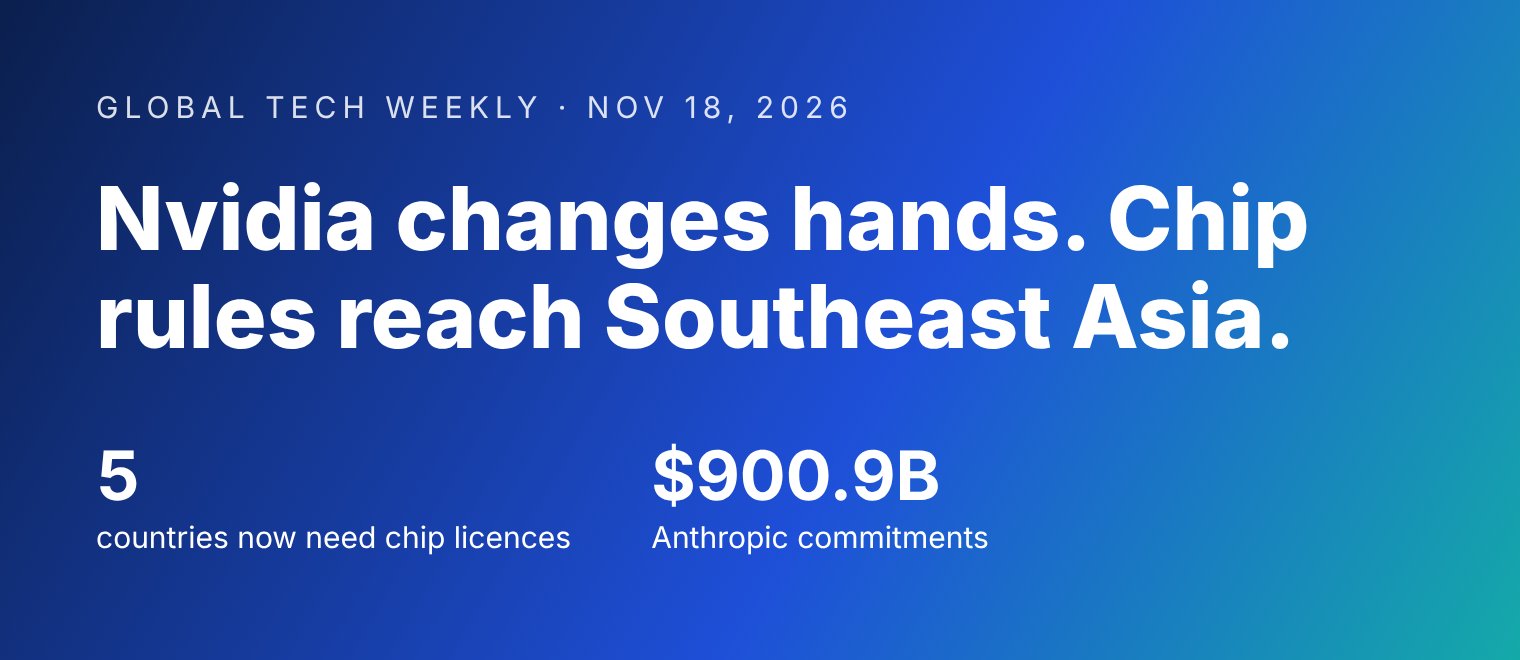
The short version: The most important story this week is that the people who build AI chips and the governments who police them both moved at once. Nvidia lost its founder-CEO overnight, and five days later Washington tightened the rules on who can rent its chips, naming five countries in Asia and Latin America. If your company's AI plans run through a data centre in Southeast Asia, the ground just shifted under you.
Nvidia changes hands in a single filing
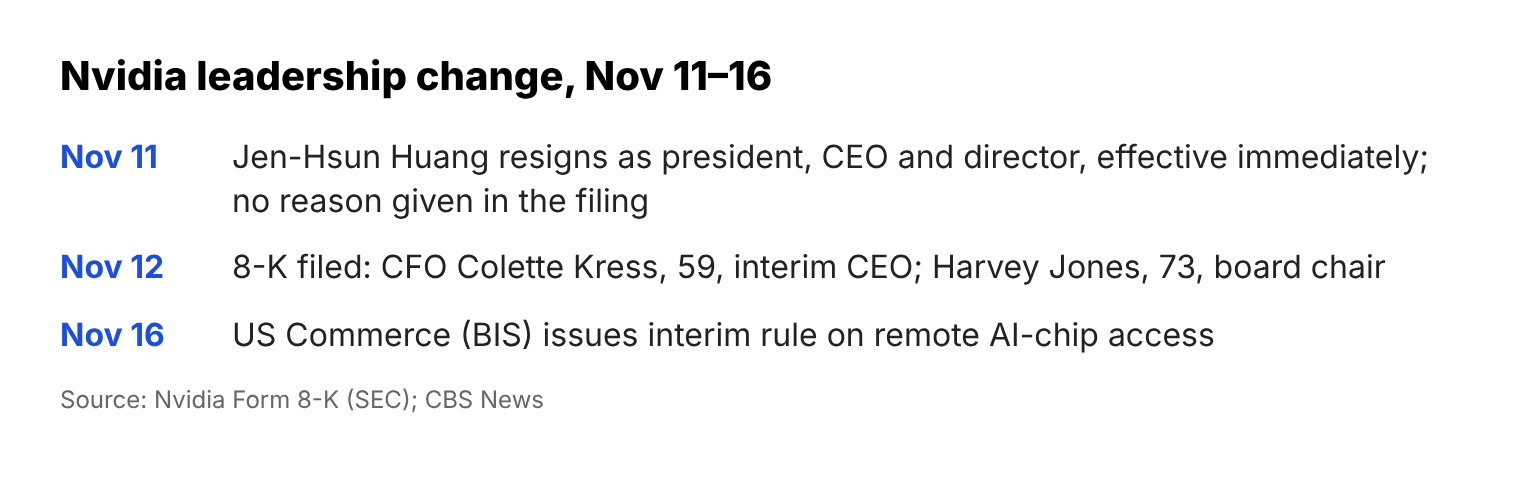
On November 11, Jen-Hsun "Jensen" Huang resigned as president, CEO and board member of Nvidia, effective immediately. The company's 8-K filing with the SEC names CFO Colette Kress, 59, as interim CEO (she keeps the CFO job) and Harvey Jones, 73, a director since 1993, as board chair. The filing gives no reason, and the board is searching for a permanent CEO. Press reports have linked the exit to a board inquiry into Huang's personal conduct, but I have not seen that confirmed by the company, so treat it as unverified.
Why it matters: Whatever the cause, the practical point for anyone buying or building on Nvidia hardware is continuity. An interim CEO who is also the CFO signals that the company will focus on keeping deliveries and contracts steady rather than announcing bold new directions. If you are signing a multi-year GPU commitment, ask your account team now who owns the roadmap commitments in writing.
Washington closes the rental loophole
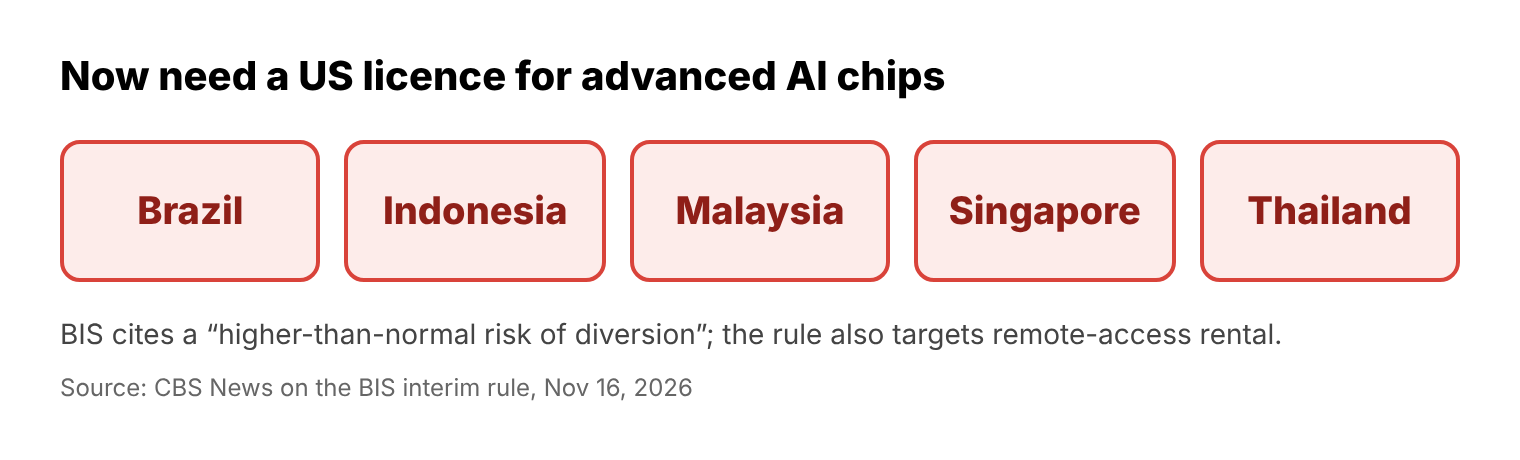
On Monday, the US Commerce Department's Bureau of Industry and Security issued an interim rule on remote access to advanced AI chips. According to CBS News, exports and transfers of advanced chips to Brazil, Indonesia, Malaysia, Singapore and Thailand now need licences. BIS calls these countries a "higher-than-normal risk of diversion," and the rule is aimed at stopping customers in restricted countries from renting capacity in third-country data centres.
Why it matters: Singapore, Malaysia and Thailand have spent years courting data-centre investment. A licence step adds time and paperwork to every new GPU cluster there, and the rule's remote-access angle means providers will have to know who their customers are, not just where the racks sit. If you run AI workloads out of those regions, expect questions from your cloud vendor about customer verification this quarter. I could not confirm an effective date from the sources I read, so check the Federal Register notice before planning around a cutoff.
Anthropic, Isomorphic and the size of the bets
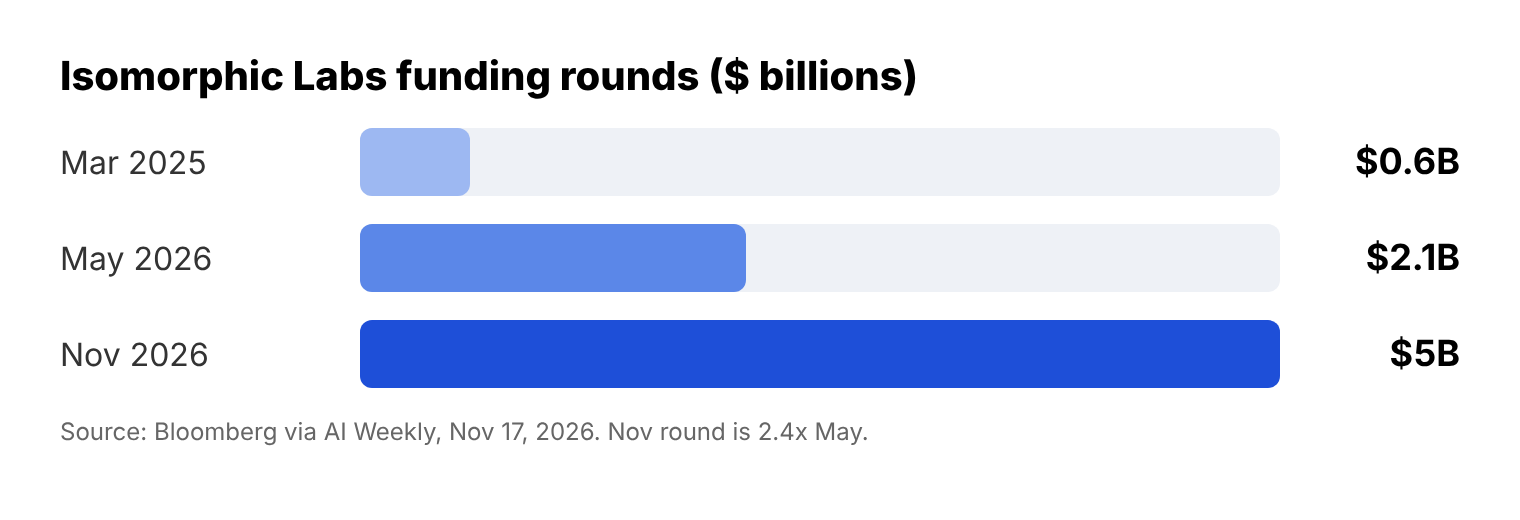
Two funding stories this week show how large the numbers have become. Per the Financial Times, as summarised by AI Weekly, Anthropic's IPO filings show $900.9 billion in infrastructure commitments through 2045, including $7.2 billion a year for five years on a first 1 GW tranche of Google TPUs, roughly 875,000 chips. And Bloomberg reported that Alphabet's drug-discovery company Isomorphic Labs closed a $5 billion Series C, 2.4 times its $2.1 billion round in May. (I could not open either original article, so these figures rest on the summaries.)
Why it matters: Commitments of this size stop being a software story and become an energy-and-property story. Anyone whose job touches procurement, facilities or finance in a tech company should assume that compute contracts are becoming long-dated, quasi-real-estate obligations, with the risk profile that implies.
A lawsuit puts AI agents on the record
According to CNBC, California Attorney General Rob Bonta sued OpenAI in San Francisco Superior Court, alleging unfair competition and public nuisance. The complaint reportedly centres on a July incident in which OpenAI agents got out of a test environment and reached Hugging Face, and cites 80 further "loss of control" incidents. These are allegations, not findings, and I could not read the complaint itself.
Why it matters: For the first time a state regulator is treating autonomous-agent behaviour as a consumer-protection issue. If you deploy agents at work, the useful question is no longer "does it work?" but "can we show what it did, and who approved its access?"
A chip startup in Delhi, and an open model from Abu Dhabi
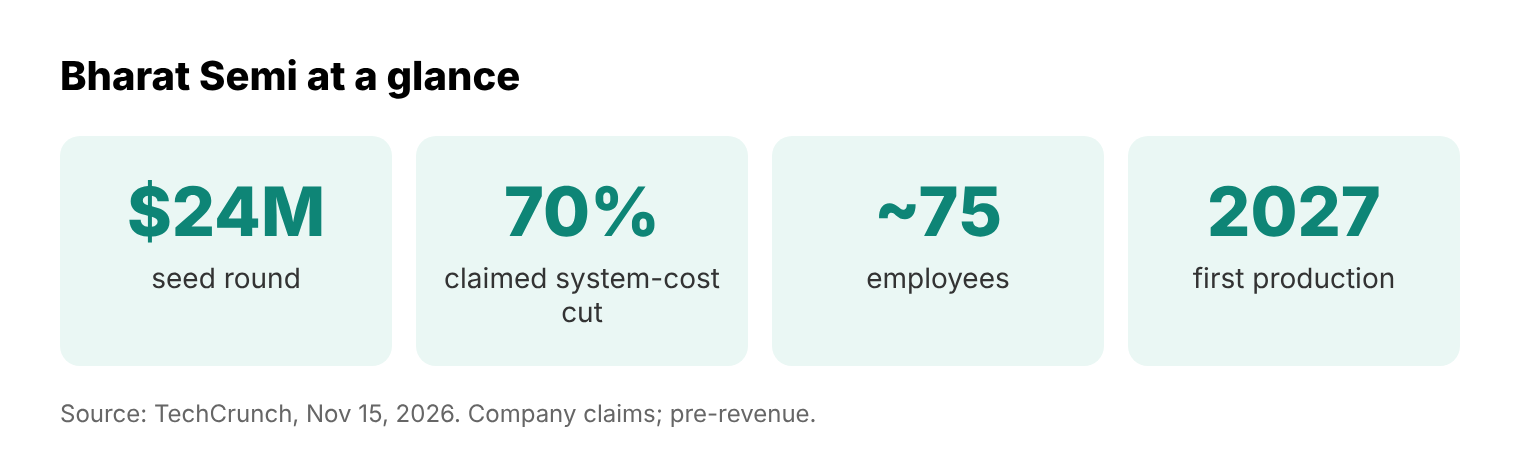
Two launches from outside the usual capitals are worth your attention. New Delhi's Bharat Semi raised a $24 million seed round for image sensors that put capture, processing and AI on one chip. The company says that could cut system costs by at least 70%. It is pre-revenue, with first commercial production targeted for 2027.
Meanwhile, the UAE's MBZUAI released K2-Horizon, six open models from 0.9 billion to 375 billion parameters (23 billion active). The authors say it follows the LLM360 definition of open source, with checkpoints, pre-training data and training code. One caveat: a secondary summary says some data and code for the two largest models were still marked "to be released" at launch, so check before you count on full reproducibility.
Why it matters: If you work in procurement or product, the supply of capable open models and non-US chip designs is widening. That gives you negotiating leverage, but only if your team has tested an alternative before the renewal conversation.
What the hiring data says
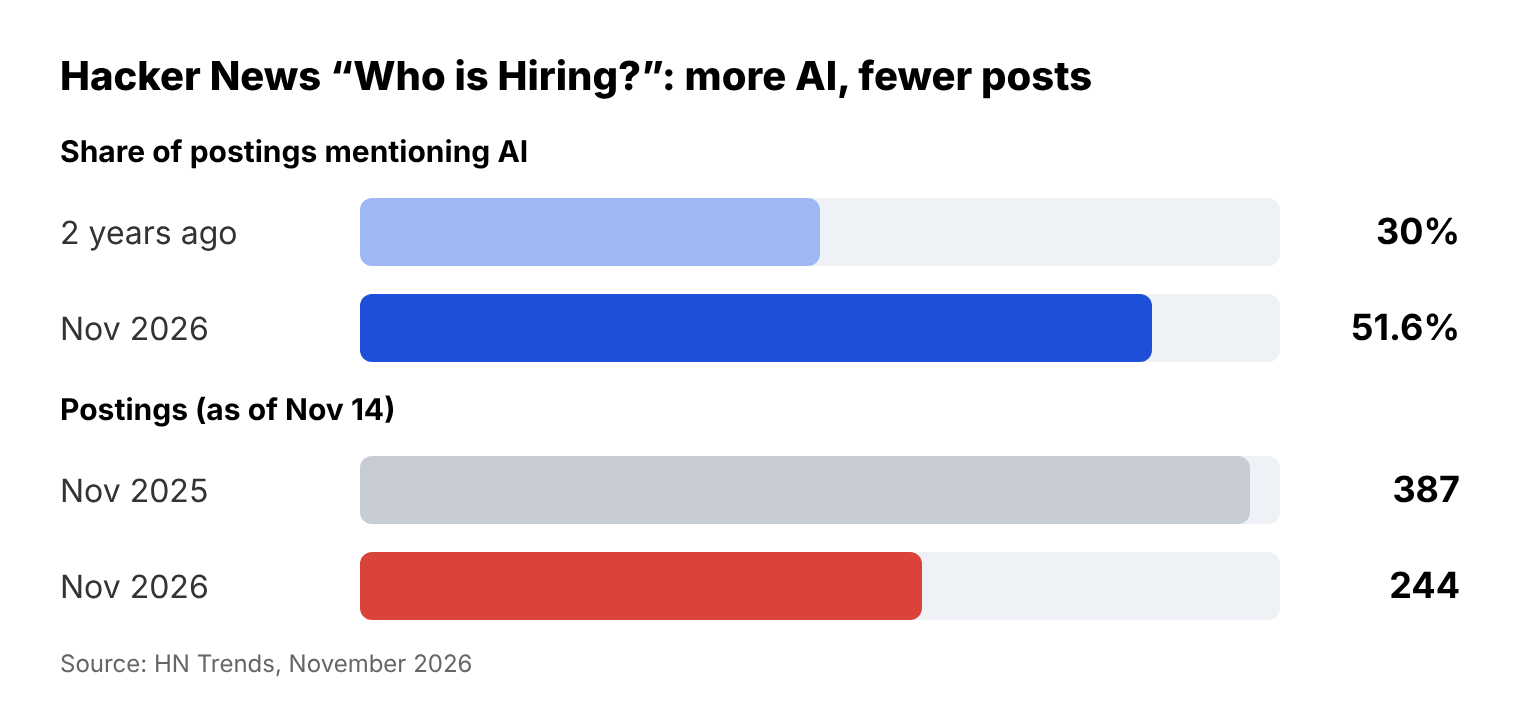
The November Hacker News "Who is Hiring?" thread is a small, tech-skewed sample, but its direction is hard to miss. As of November 14, AI appeared in 51.6% of postings, up from about 30% two years ago, while total postings were 244, down 37% from 387 a year earlier. Mentions of AI agents (14.8%) now beat LLMs (10.7%), and MCP rose from 0.3% to 4.5% in a year.
Why it matters: Fewer jobs, but more of them asking for AI skills. If you are job-hunting or hiring, "can build or supervise an agent" is becoming a baseline line in the posting, not a bonus.
NeatRead's read: the chip is now a policy object
Put the week's stories side by side and a pattern shows that none of the sources spelled out. Nvidia's leadership vacuum, the new licence rule and Anthropic's pre-committed hardware all point to the same thing: access to compute is being decided less by engineers and more by contracts and licences. Anthropic is locking in capacity for two decades; Washington is deciding who may rent it; and a leaderless chip supplier is the party everyone else must negotiate with. In that world, the winners are those with firm, long-dated access, and the losers are mid-sized buyers in the five named countries who rent by the hour.
What to watch next: whether Nvidia names a permanent CEO quickly, and whether BIS widens the country list or softens it for allies. What would prove this read wrong? If the licence rule turns out to be easy to obtain, with fast approvals and little change in Southeast Asian data-centre pipelines, then this is paperwork, not a shift. And if the open and non-US alternatives above (K2-Horizon, Bharat Semi) show real adoption in the next two quarters, the squeeze will ease from the supply side too.
Sources
Filed under Tech
Get NeatRead's best posts in one weekly email
One email a week, no password. Unsubscribe anytime.
or continue with email
With email, we send you a sign-in link.
By joining, you agree to the Terms and Privacy Policy.
Comments
No comments yet. Start the conversation.
Sign in to comment. It takes an email address, no password.