Who is winning the race for your wrist

Listen to this post · 7 min
Read aloud by a synthetic voice.
Apple, Huawei, Garmin and Samsung are all selling you the same promise. The numbers say the market is shifting under all of them.
Three watches, three jobs: health rings, outdoor tracking, plain timekeeping. Illustration made for this article.
Ask ten colleagues what is on their wrist and you will get ten answers. An Apple Watch, a Garmin that survived a marathon, a Huawei bought on a trip, a Galaxy Watch that mostly counts steps. That mess is the market in miniature, and the last two quarters of data show it moving faster than most people noticed.
The leaderboard changed hands
At the start of 2026 the picture looked simple. Counterpoint Research found global smartwatch shipments up 4% in the first quarter, with Apple in front at 23% share and Huawei second at 17%. Xiaomi had 10%, the children's-watch specialist Imoo 7%, and Samsung had slipped from 7% to 5%.
Then the second quarter flipped the order. Shipments across the whole market fell 4%, and Huawei took first place with a record 22% share. Apple dropped to second at 20.1%, though it posted the fastest growth of the top five, up 14% on the year. Xiaomi had the worst quarter, with sales down 38% and its share shrinking from 9.5% to 6.1%. Garmin finished fifth at 5.6%, helped by an 11% rise in shipments.
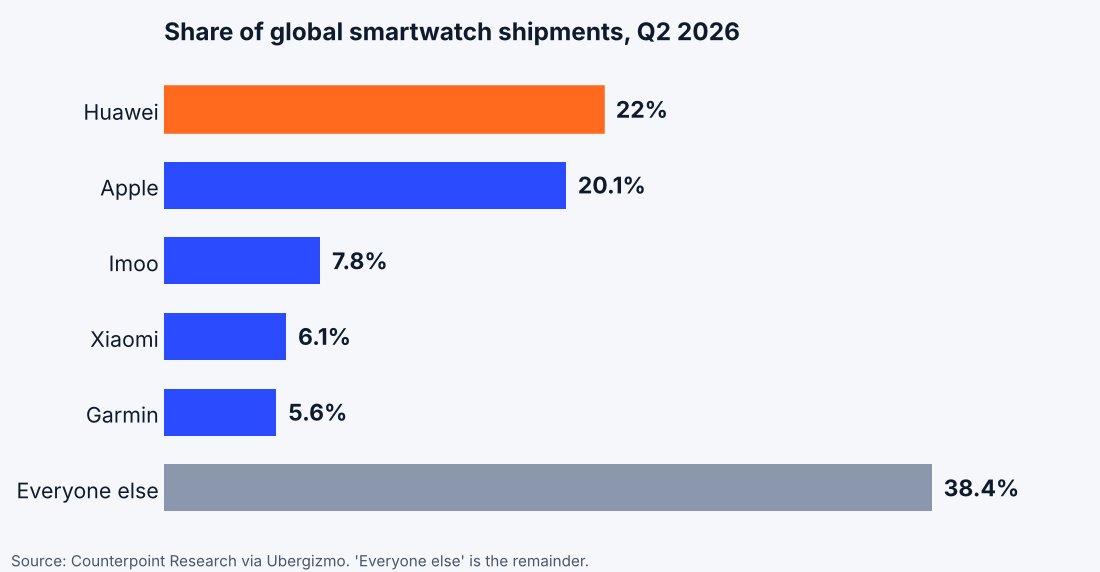
Before you read that as Apple losing, look at the calendar. Apple's share swings with its launch cycle. Counterpoint's quarterly series has it at 17% in the middle of 2025 and 32% in the last three months of the year, right after the fall launch. The first-place trophy changes hands several times a year. The trend underneath matters more than any single quarter.
Two different games
The biggest reason the table keeps reshuffling is that the world is not one market. In China, Huawei holds around 40% of shipments, and Imoo and Xiaomi follow. A government electronic subsidy scheme pushed buyers to upgrade, and the local brands collected most of the benefit. China's smartwatch shipments grew 15% in the first quarter.
North America is close to the opposite. One report on the first quarter put Apple at more than half of all smartwatch shipments there. Garmin grew 16% in the same region, while Samsung's shipments fell 24%. If you sell to, work with, or manage people in both places, expect a different default watch on every wrist in the room.
Apple wins by being everywhere in the West. Huawei wins by owning China. Nobody is winning both.
Apple keeps the upgrade small
On September 9 Apple announced the Series 12 and the Ultra 4. The Series 12 starts at $399, the same as last year, with a new S11 chip, tougher glass and a ceramic case option, the first since the Series 5. Reviewers noted that there were no price increases. The teardown site iFixit says the Series 12 looks identical to the Series 11.
That sounds underwhelming, and it is a deliberate choice. Apple's volume does not come from the newest flagship. The Series 11 and the budget SE 3 together made up more than 80% of its second-quarter shipments. People are buying last year's design at last year's price, and Apple has noticed.
The squeeze on Android
Samsung is the clearest casualty. Its global share fell from 7% to 5% in a year, caught between Apple at the premium end and cheap Chinese brands below. Google is fighting on features. Its Pixel Watch 4 shipped with emergency satellite connectivity before Apple had anything similar. But a good feature on a small base moves the totals very little.
Garmin is the quiet exception. It does not try to be a phone on your wrist. It sells battery life, maps and sports data to people who run, ride and hike, and that focus is paying off, with shipments up 16% in North America in the first quarter and 11% worldwide in the second.
A market that is slowing down
Counterpoint blames the second-quarter drop on weaker interest in entry-level watches with few sensors, and on people holding their watches longer while they wait for something genuinely new. Memory shortages and a shaky economy add pressure. The firm now expects only about 1% shipment growth for the full year of 2026 and roughly 3% a year through 2030.
New features did pull the market out of its 2024 dip: satellite connectivity, faster 5G RedCap cellular, on-device AI and better health sensing. The industry is betting those keep arriving. So far the rate of arrival is slower than the sales pitch.
Health is where the money is
Look at what each company talks about and one theme repeats. Huawei's lead in China is credited to health and sports features. Apple's biggest changes this year are in health and fitness, including a redesigned sensor array. Garmin sells training data. Even the satellite feature is a safety pitch.
For anyone with a desk job and a long commute, this is the part that actually touches daily life: sleep scores, heart-rate alerts, stress readings, reminders to stand up. The sensors keep improving, but the useful question is whether the numbers change what you do. A watch that nags you into a walk after lunch has done more than one that logs a perfect graph you never open.
It also means you are handing a company a steady stream of personal data. Before you pick a brand, look at what it collects, where it stores it, and whether your employer or insurer can ever see it. That varies by country, and it is worth five minutes of reading.
What to do if you just want a good watch
- Don't upgrade for the sake of it. If your watch is two or three years old and still lasts a day, the Series 12 changes little. Wait for a feature you will use.
- Start with your phone. An Apple Watch needs an iPhone, and Android watches work best with the phone they were designed around. This choice matters more than any spec.
- Buy the job, not the logo. Mostly notifications and sleep? A mid-range model is enough. Training for something? Look at Garmin. Heading to a trailhead without signal? Satellite messaging is now a real feature.
- Last year's model is the smart buy. With changes this small, the previous generation is usually a better deal than the new one.
- Check the region. Some of the strongest watches, especially from Huawei, are sold mainly in China. Features, apps and support vary by country, so confirm before you buy abroad.
The bottom line
The smartwatch race is turning into a slow grind. Hardware improves in small steps, prices hold steady, and the winners are decided by ecosystem and geography more than by any one launch. That is dull for the industry and decent news for the rest of us, because it means the watch you already own is probably fine.
Sources
- Counterpoint Research, Global Smartwatch Shipments Market Share (May 2026)
- Ubergizmo, Global smartwatch shipments drop 4% in Q2 2026 as Huawei takes lead
- SamMobile, Samsung's smartwatch shipment share falls as Apple extends lead
- Huawei Central, Q1 2026 global smartwatch sales
- Mezha, Global smartwatch shipments rise 4% driven by Apple
- Tom's Guide, Apple Watch Series 12 announced
- iFixit, Apple Watch Series 12
Filed under TechnologyLeisure
Comments
No comments yet. Start the conversation.
Sign in to comment. It takes an email address, no password.