Why Paper Books Feel Different from Tablets and E-readers
Listen to this post · 6 min
Read aloud by a synthetic voice.
It isn't just nostalgia. Your hands, your eyes and your memory treat a printed page as a different object from a screen, and that matters most for people who read for a living.
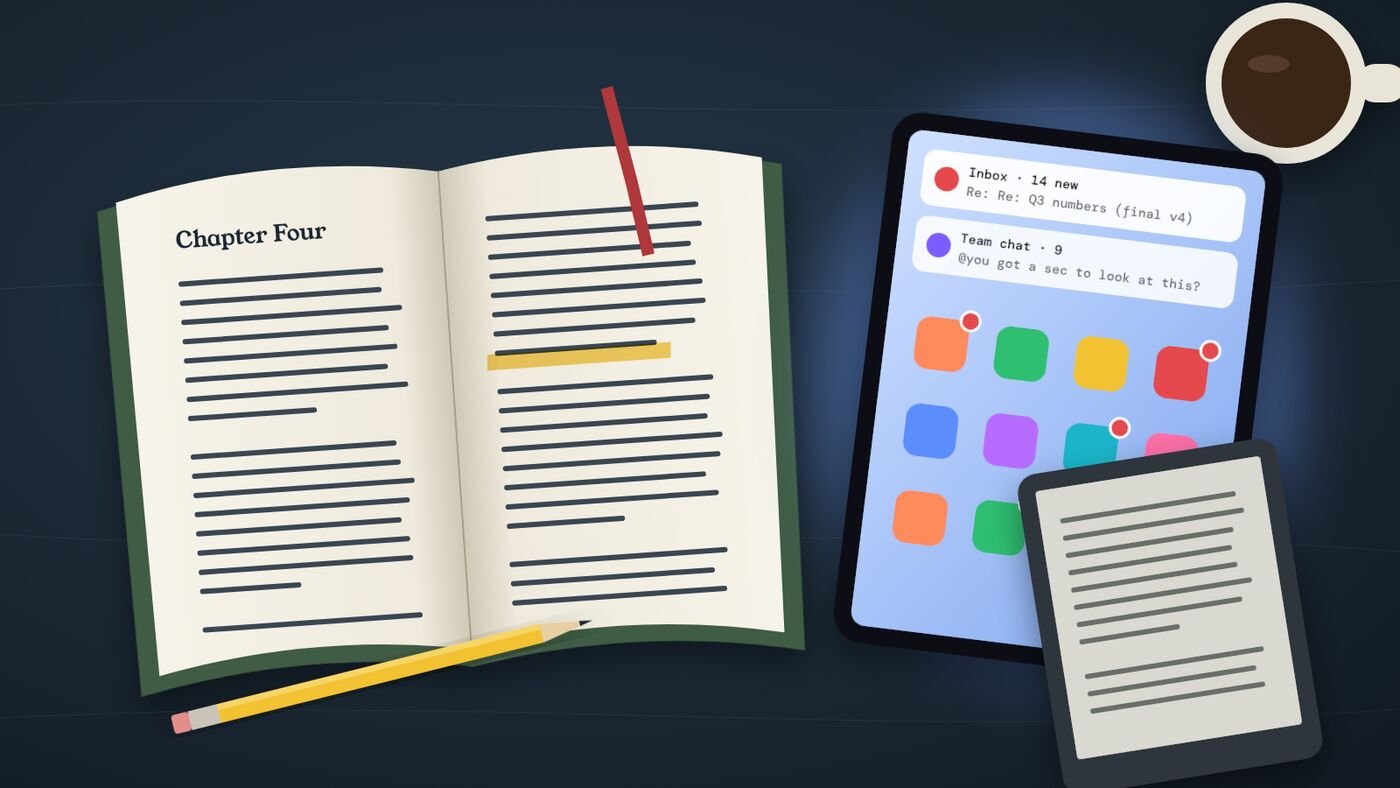
Three ways to read the same chapter. Only one of them has an inbox.
You probably know the feeling. After a day of email threads, slide decks and a browser with too many tabs, you pick up a paperback and twenty minutes go by before you notice. The same book has been sitting on your tablet for a month. You opened it four times and drifted off to something else four times.
It's tempting to call that sentiment, or a quirk of your generation. The research says something more interesting. Paper, e-ink and backlit glass ask different things of your attention, your eyes and your memory. Once you see how, you can choose the right one for the job instead of feeling vaguely guilty about whichever one you picked.
A book is a place, not a file
When you read on paper, you're building a rough map without trying. The quote you liked was near the bottom of a left-hand page. The twist came about two-thirds of the way in, when the right-hand stack got thin. Your fingers feel the weight shift from one side to the other as you go.
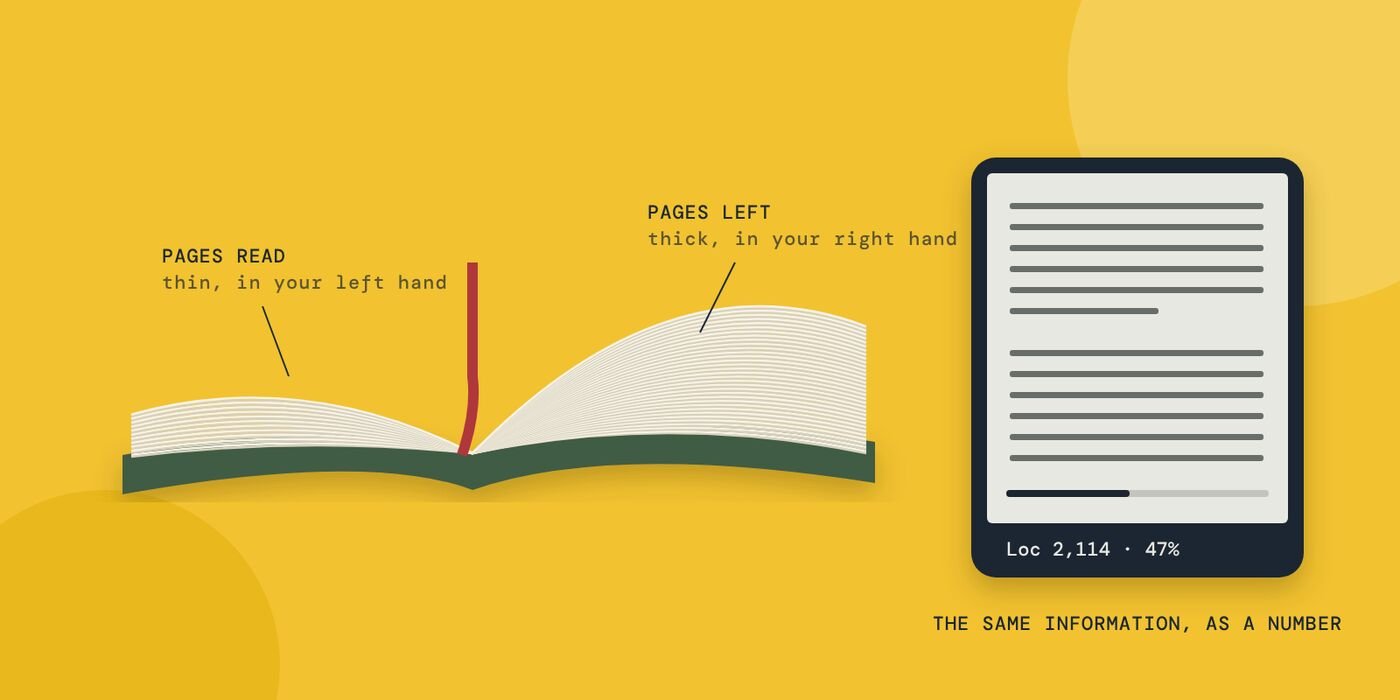
A paper book tells your hands how far you've come. A screen tells you with a percentage.
A screen flattens all of that. Every page sits in the same frame, at the same weight, in the same spot in your hand. You get a progress bar, which is accurate, but a number is something you read. The weight of a book is something you feel without reading anything.
A real example
In 2019, researchers led by Anne Mangen at Norway's University of Stavanger gave 50 adults the same 28-page Elizabeth George mystery, about 10,800 words. Half read it in a printed pocket book and half on a Kindle DX. Page numbers and the progress bar were hidden in both cases, so neither group could lean on them.
On most measures the two groups did equally well: they read at the same pace, felt equally engaged and remembered the same words and details. The difference showed up when they were asked to put key events from the story in the right order. The paper readers were clearly better at it. They were also better at answering questions about when things happened. The authors think the physical cues of a book, its weight and the pages moving from one hand to the other, help you keep track of where you are in a story.
That's a small study with one story, and the researchers say so. Still, it matches what many people feel. You can finish an e-book, enjoy it, and still find the shape of it oddly blurry a week later.
What the bigger studies say
One study proves little. A 2018 review by Pablo Delgado and colleagues pulled together 54 studies from 2000 to 2017, covering more than 171,000 readers. Overall, people understood what they read somewhat better on paper than on screens. The gap wasn't huge, but it was consistent, and three details stand out for anyone with a job.
First, the paper advantage was bigger when people were under time pressure, which describes most reading at work. Second, it showed up for informational text such as reports, articles and explainers, not for stories. Third, the gap got wider over the years, not narrower. You might expect people raised on screens to have closed it by now. They haven't.
A likely reason is habit. On screens we skim. We scroll, jump, scan for the bold bits and move on. That's fine for a news update and poor for a contract, a strategy memo or a chapter you need to remember. Many of us carry that skimming habit into anything with a glowing frame around it.
Light that bounces versus light that shines
The physical difference matters too. Paper doesn't make light. It bounces back whatever light is in the room. An e-ink reader such as a Kindle or Kobo, with its front light off, works the same way, which is why it feels much closer to paper than a tablet does. A tablet or phone is a small lamp pointed at your face.
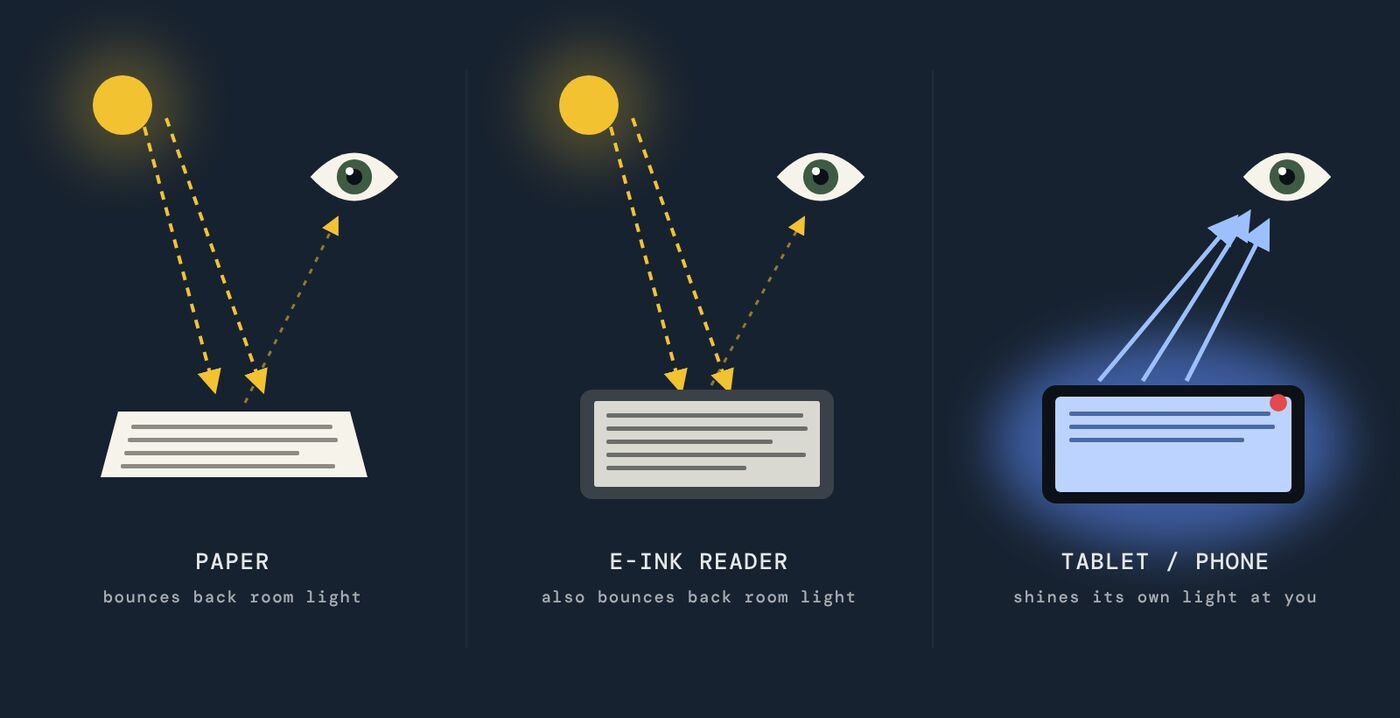
Paper and e-ink reflect the light in the room. Tablets and phones make their own.
That matters most at night. In a 2015 Harvard study, a small group of adults read for four hours before bed on light-emitting e-readers for five nights, and from printed books on five other nights. After the screen nights, they took longer to fall asleep, produced less melatonin, and felt groggier the next morning. If the last thing you do each day is read, the medium affects more than the reading.
Nothing else lives inside a book
The simplest difference is the one we feel every day. A printed book does one thing. It has no notifications, no "one quick check" and no other apps a swipe away. A tablet is a reading device that also holds your inbox, your team chat, the news and every game you've installed. Even with notifications muted, you know they're there.
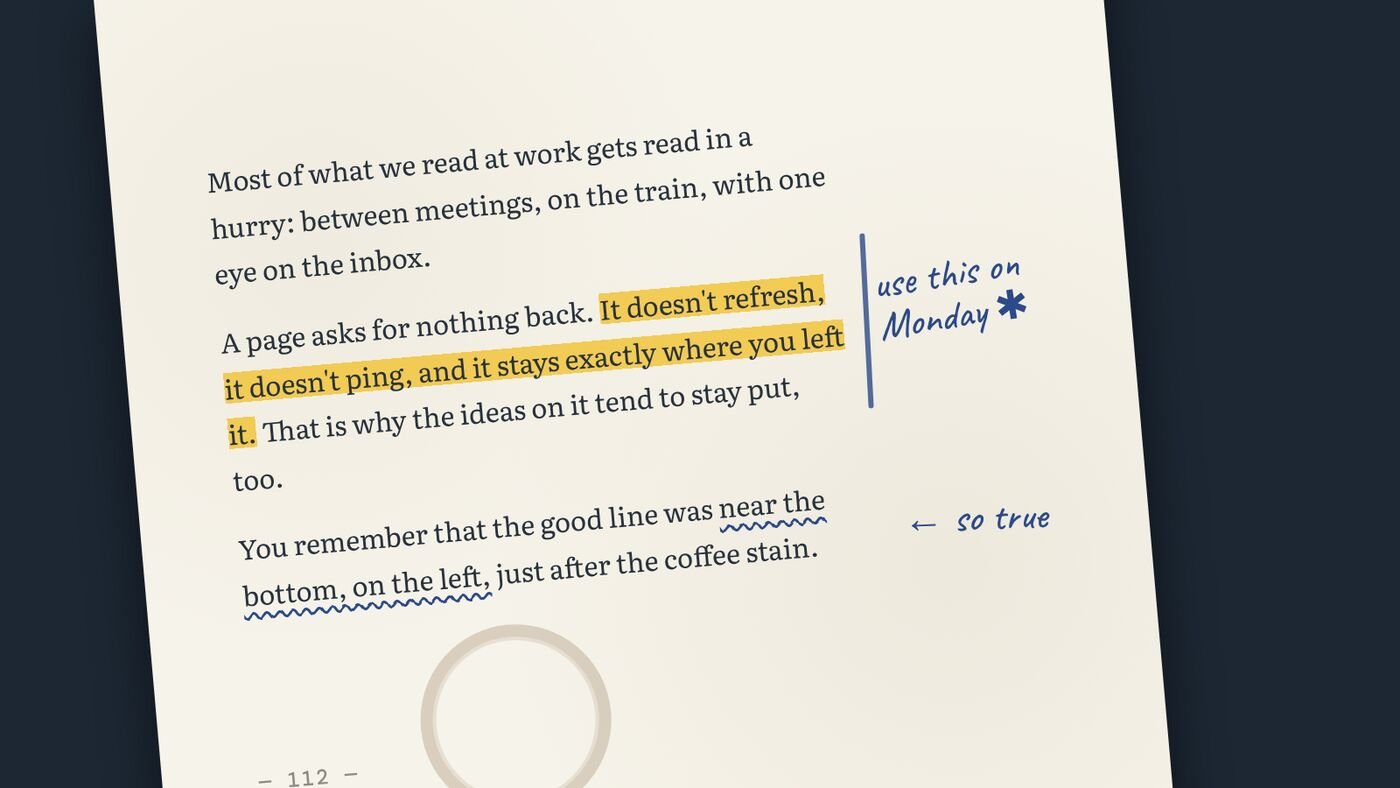
Highlights, a note to yourself, a coffee ring. A page keeps a record of how you read it.
Readers notice this almost everywhere. When the linguist Naomi Baron surveyed university students in the United States, Japan, Germany and Slovakia, 92 percent said they concentrated best on paper. That was true across countries, cultures and reading habits. People said the same things: fewer distractions, less eye strain, and the feeling that the book was actually in their hands.
So which one should you use?
None of this means you should throw your tablet away. E-readers are wonderful when you travel. They're lighter than a single hardback, you can make the text bigger, they're easy to hold on a crowded train, and they carry a whole library. Tablets are hard to beat for searching, quick reference and anything with colour charts. The trick is to match the medium to the job.
- Print what you need to understand and remember. Contracts, board papers, a strategy document before a big meeting. Read it on paper with a pen in your hand.
- Use an e-reader for long reading on the move. Novels and long non-fiction on a commute or a flight, especially with the front light low.
- Use the tablet for looking things up. Searching, checking a figure, glancing at a chart. Skimming is what screens are good at.
- Keep the last half hour of the day on paper or e-ink. Your sleep will notice the difference before you do.
Paper feels different because it is different. It's a physical object you can find your way around, it uses the light in the room, and it can't interrupt you. For people whose working day is mostly made of screens, that may be the best reason to keep a real book within reach.
Sources
- Mangen, A., Olivier, G. & Velay, J.-L. (2019). Comparing comprehension of a long text read in print book and on Kindle. Frontiers in Psychology.
- Delgado, P., Vargas, C., Ackerman, R. & Salmerón, L. (2018). Don't throw away your printed books: A meta-analysis on the effects of reading media on reading comprehension. Educational Research Review.
- Chang, A.-M. et al. (2015). Evening use of light-emitting eReaders negatively affects sleep, circadian timing, and next-morning alertness. PNAS.
- Baron, N. S. (2015). Words Onscreen: The Fate of Reading in a Digital World. Oxford University Press.
Filed under Leisure
Comments
No comments yet. Start the conversation.
Sign in to comment. It takes an email address, no password.