Where Your Ad Budget Works Hardest
Listen to this post · 8 min
Read aloud by a synthetic voice.
Online Advertising Platform Comparisons
A plain guide to Google, Meta, TikTok, LinkedIn and Amazon, for people who have a budget and a deadline.
October 2026 · 7 minute read · Prices in US dollars
Most of us do not choose an ad platform from a blank page. A boss says the company should be on TikTok. An agency renews the Meta contract. A founder remembers that Google worked well in 2019. Then the invoice arrives and nobody can explain why one channel cost four times as much as another.
This guide compares five places you can buy ads today. It leans on 2026 benchmark reports and says so when those reports disagree, which happens a lot. Your own account will not match any average, so read the numbers as a reason to run a test and not as a forecast.
Two prices that mean different things
You will see two prices everywhere. CPM is what you pay to show an ad to 1,000 people. CPC is what you pay each time someone clicks. A low CPM looks like a bargain, but it only helps if those viewers care about what you sell.
One 2026 cost guide makes the point well. A $6 CPM on TikTok and a $14 CPM on Google Search cannot be compared, because a TikTok view is a passing glance and a search impression comes from someone already hunting for an answer.
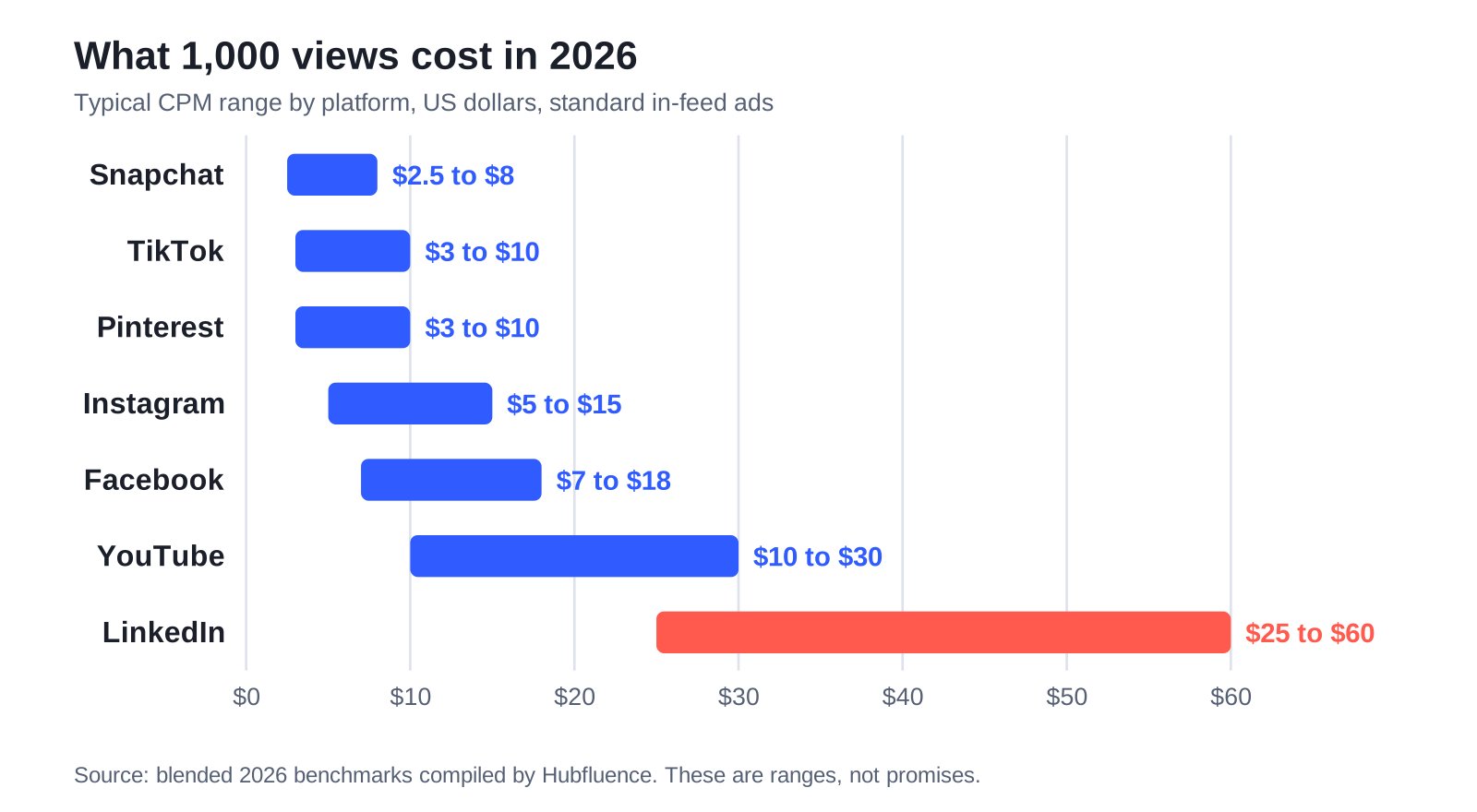
Read the chart as a map of price tiers. Snapchat, TikTok and Pinterest are cheap to reach. Instagram and Facebook sit in the middle. YouTube costs more. LinkedIn lives in a tier of its own.
Google, for people who are already searching
Google Search still has the best claim on buyers who know what they want. The 2026 average click costs about $5.42, according to a Whatagraph roundup of PPC benchmarks. The same roundup puts the average conversion rate near 8 percent and the cost of a lead near $67. A click cost $2.32 in 2016, so the price has more than doubled in ten years.
Prices swing by trade. Another source puts clicks anywhere from $1.63 for arts and entertainment to $9.87 for legal services, and says the overall average held steady this year after a long run of increases. Display ads on Google are far cheaper, around $3 per thousand views, but they reach people who were not looking for you.
Good fit: a plumber, an accountant, software with a clear category name. Poor fit: a brand-new product that nobody knows how to search for. You would be bidding on words your customers never type.
Meta, for finding people who did not know they wanted you
Facebook and Instagram reach an enormous audience and are good at showing a product to people who were not searching for it. The median CPM is about $14 in 2026. Triple Whale data covering nearly 35,000 ecommerce brands shows it rising about 20 percent in a year, from $11.82 to $14.19. More advertisers are fighting over the same attention.
Clicks look cheap, roughly $0.70 to $0.78 on traffic campaigns. Be careful with that figure. Meta's default click count can include reactions and media taps, so a cheap click is not always a visit to your site. Where you advertise matters too. One report found about a ninefold gap between the cheapest and the dearest countries, so a global campaign needs a budget for each market. Reels and Stories placements usually cost 10 to 30 percent less than the main feed.
Good fit: consumer products, local shops, anything that looks good in a photo or a short clip.
TikTok, cheap reach for people who like video
TikTok passed 1.9 billion monthly users early this year, according to Business of Apps. Its prices are the most disputed in this guide. One roundup puts CPMs between $3 and $10. Another puts the all-in benchmark near $13. Each counts things differently, so plan with the range and check your own account after the first week.
Industry costs cluster tightly, from about $3.79 for sports and outdoors to $6.33 for food and drink in Triple Whale's 2025 data. The platform rewards ads that look like ordinary posts. One marketing blog describes a software founder who posts five short videos a week, promotes the best one, and sees cost per lead drop well below what LinkedIn delivered.
Good fit: products that show well on video and buyers who scroll. Poor fit: anything whose buyers simply do not use the app.
LinkedIn, expensive on purpose
LinkedIn is the priciest platform here. The median CPM is about $31 and climbs to between $55 and $150 for narrow business targeting, roughly four to eight times Meta, according to Meet Lea. Clicks run from about $6.88 to $11.04 in the Whatagraph data. A Dreamdata comparison from March 2026 found about 5.98 euros per click against about 1.60 euros on Meta.
You pay for precision. You can aim at job title, seniority and company size, and no other platform here does that as well. If one new customer is worth $50,000, a $150 lead is a fine deal. If you sell a $30 product the numbers will not work, and one pricing guide says LinkedIn almost never makes sense for consumer brands.
Amazon and retail media, where shoppers already are
Retail media means ads on a store's own site or app. WARC forecasts global retail media spend at $200.4 billion in 2026, rising to $223.4 billion in 2027, which is slower growth than the channel has seen before. Amazon dominates. In France, Germany, Italy, Spain and the UK, more than two thirds of retail media investment went to Amazon.
In the US, EMARKETER expects Amazon and Walmart to take $9.42 billion of the $10.53 billion in new retail media spending in 2026. That is a share of growth, not of the whole market, but it shows where the momentum sits.
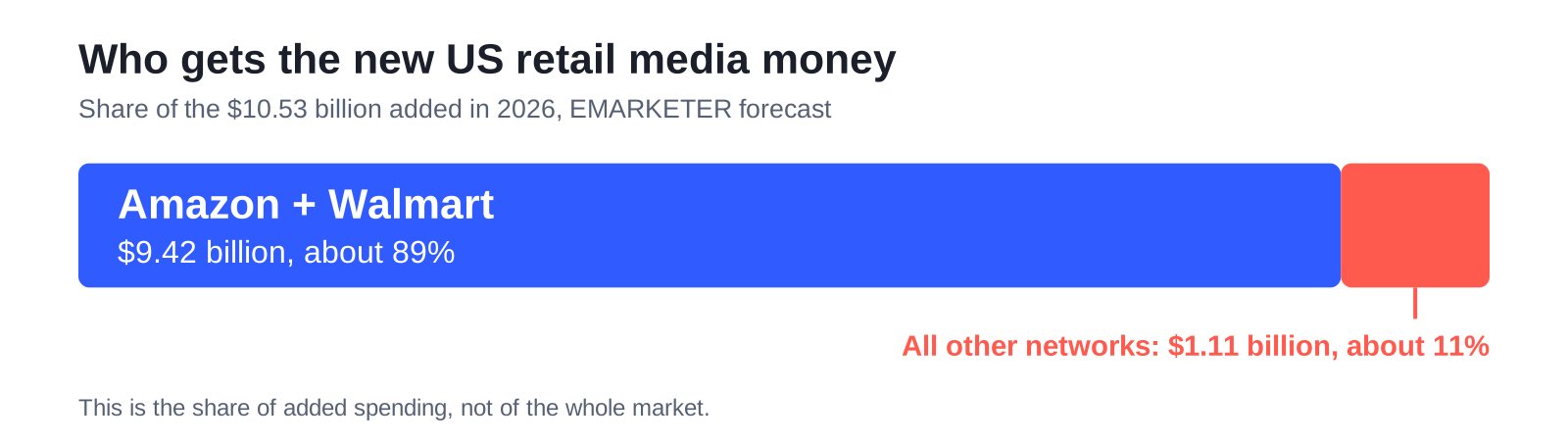
The weak points are worth knowing. WARC found that Amazon, Home Depot, Macy's and Walmart each show more than 20 ads per page on average, so your ad competes with a crowd. A McKinsey survey of US media buyers found that retail media money has largely been moved from other digital budgets, so for many consumer goods brands it is a reshuffle of the same dollars.
Good fit: anyone who sells physical products through a major retailer. Poor fit: services and software.
The five side by side
| Platform | What you pay in 2026 | Best at | Watch out for |
|---|---|---|---|
| Google Search | About $5.42 per click on average | Catching people who are already looking | Few searches for brand-new products |
| Meta | About $14 per 1,000 views, cheap clicks | Introducing products to people who did not know | Costs up about 20 percent in a year, big gaps between countries |
| TikTok | $3 to $13 per 1,000 views, depending on the study | Cheap reach with short video | Passive viewers, disputed benchmarks |
| About $31 per 1,000 views, $55 to $150 when narrow | Reaching job titles and company sizes | Low-priced products cannot afford it | |
| Amazon | Set by auction, varies by category | Shoppers who are ready to buy | Crowded pages, money often moved and not new |
Three mistakes that quietly waste money
The first is judging a platform by its CPM. A cheap thousand views means little if none of those viewers can buy. The second is spreading a small budget across every platform at once. Each campaign needs enough spend to get past its learning phase, and five thin campaigns teach you less than two solid ones.
The third is running the same ad everywhere. A polished banner that works on a Google display page can look strange between two friends' videos on TikTok, and a casual phone clip can look careless on LinkedIn. Make a version for each place, even when the message stays the same. None of this needs a big team. It needs patience and a notebook.
How to choose without a spreadsheet war
Ask one question first. What does your customer do just before buying?
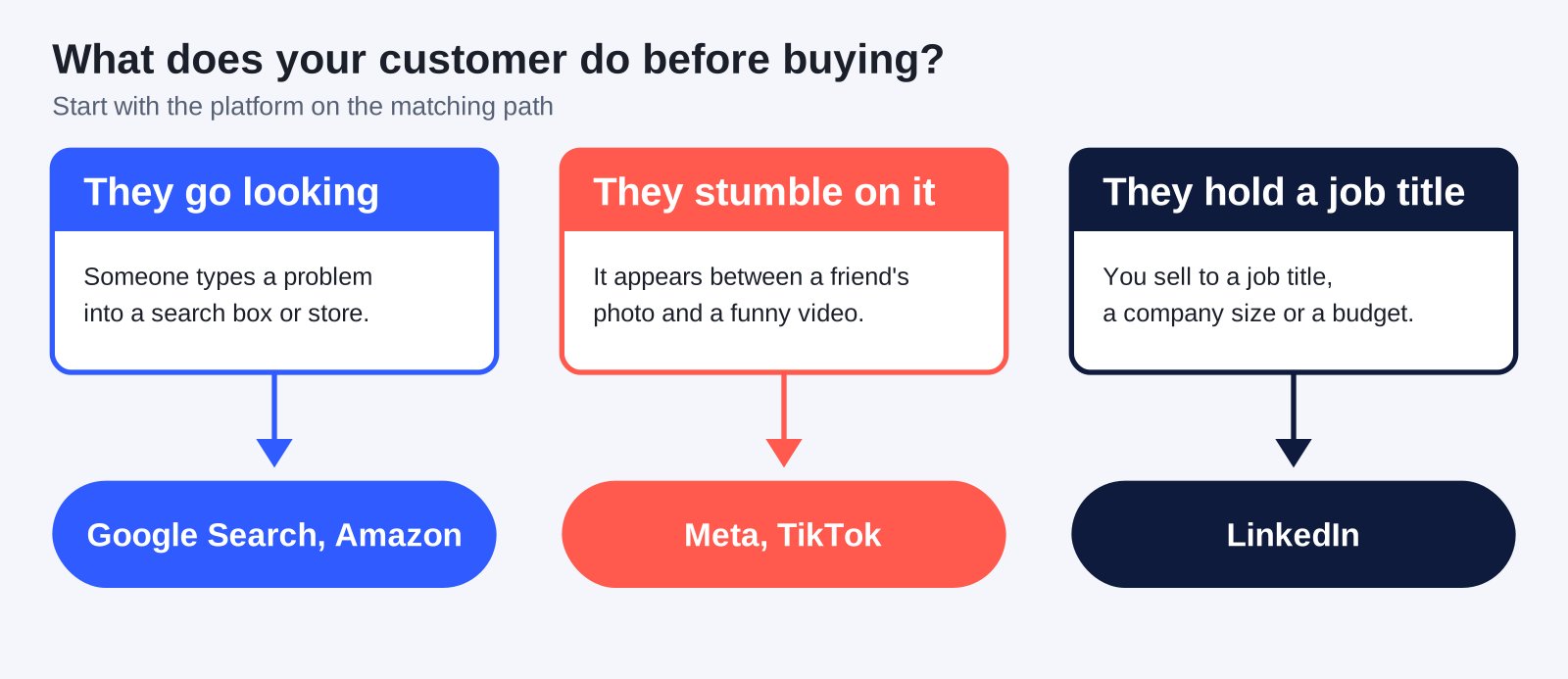
Then follow a few simple rules. Start with two platforms, not five. Give each at least four weeks, because the first week is mostly the platform learning who to show your ads to. Compare cost per sale and ignore CPM and clicks when the two disagree. Write a stop rule before you spend a cent, for example pausing any channel that costs more than twice your target per customer after four weeks.
A note on the numbers
Benchmarks are averages across industries, countries and budgets, so any single account can sit far from them. Many of these reports come from companies that sell ad software or agency services, and they do not all count things the same way. Where two sources disagreed above, the gap was real. Use the figures to decide what to test first, then trust your own data.
Sources
- Whatagraph, 100+ PPC Benchmarks 2026
- Argil, 12 Internet Advertising Platforms Compared for 2026
- Stackmatix, Platform ad cost benchmarks 2026
- Hubfluence, 2026 cross-platform ad benchmarks
- ContentStudio, Meta ads benchmarks 2026
- AdMake, What is CPM, 2026 benchmarks
- The Ad Spend, Cost per click
- EMARKETER, Retail media ad spending forecast
- Mediaweek, Retail media hits $200bn (WARC)
- Osmos, Retail media network market landscape 2026
Filed under Market
Comments
No comments yet. Start the conversation.
Sign in to comment. It takes an email address, no password.