Four Titles, One Gap: What "PM" Really Means

Listen to this post · 12 min
Read aloud by a synthetic voice.
Hand a business card that says
"PM" to an engineer at an electronics plant in Shenzhen or Guadalajara, and there's a fair chance they'll assume you ship laptops. Hand the same card to someone in San Francisco or Berlin and they'll assume you run an app. Each guess is right somewhere. The two letters cover at least four separate jobs (project manager, program manager, product manager and product owner), and they stretch further when the product is a circuit board instead of a codebase.
That would be a vocabulary quibble if it were cheap. It isn't. In May 2025 the Project Management Institute warned of a global shortfall of up to 29.8 million project professionals by 2035. That same year, entry-level product managers in the US and Europe struggled to get a screening call. A shortage and a glut, measured at the same time, for jobs that share an acronym.
The three questions people usually ask separately share one answer: how the PM roles differ, how hardware differs from software, and why companies and candidates keep missing each other. Each role is defined by what the person is accountable for and by how expensive a wrong call is. A job title carries neither fact. So hiring runs on the title and breaks on the context.
Four roles, sorted by what gets you fired
The cleanest way to tell the four apart is to ask what failure looks like for each. A project manager fails when the thing arrives late or over budget. A program manager fails when every project lands on time and the business still doesn't get what it paid for. A product manager fails when the team ships exactly what was planned and customers shrug. A product owner fails more quietly: the sprint reviews go smoothly, and the backlog they ordered turns out to have been the wrong list.
The project manager is the oldest and most codified of the four. PMI, which certifies the role through the PMP exam, treats a project as a temporary effort with a defined result. The job is scope, schedule, budget and risk, and it ends when the project closes. Migrating a bank's core system is a project. So is fitting out a hospital wing.
The program manager sits one level up. PMI defines a program as a set of related projects run together because coordinating them yields benefits that managing each alone would not. In practice the job is dependencies and gates: which team is blocking which, and whether the combined launch still makes sense. Amazon and Google call the engineering version a technical program manager. At contract manufacturers from Shenzhen to Guadalajara, the same work often travels under the plain title "PM," held by the person who keeps a notebook or server platform together across mechanical, electrical, thermal and supply-chain teams while answering to the brand customer's schedule.
The product manager is the odd one out because the job has no end date. Marty Cagan, whose books shaped Silicon Valley's version of the role, draws the line bluntly: a product manager answers for a product's value and viability, meaning whether customers want it and whether the business can sustain it (as reported from his 2022 School of Product talk). Most of the work is deciding what should exist at all. Success shows up in retention and revenue months after anything ships.
The product owner is where the confusion lives. The title comes from Scrum rather than from any management tradition. The 2020 Scrum Guide makes the product owner accountable for maximizing the value of what one Scrum team produces, through the product backlog. It insists the role is "one person, not a committee" and that the whole organization must respect that person's decisions. On paper, that is most of a product manager's job. In practice, plenty of companies gave the title to someone who writes tickets while a product manager or a vice-president makes the real calls. Cagan's slide at that 2022 talk called the product owner simply a role in a delivery process. Scrum's defenders reply that he is describing the bent version of the role. Both camps are right, which is exactly the trouble: the same title names a decision-maker at one company and a scribe at the next.
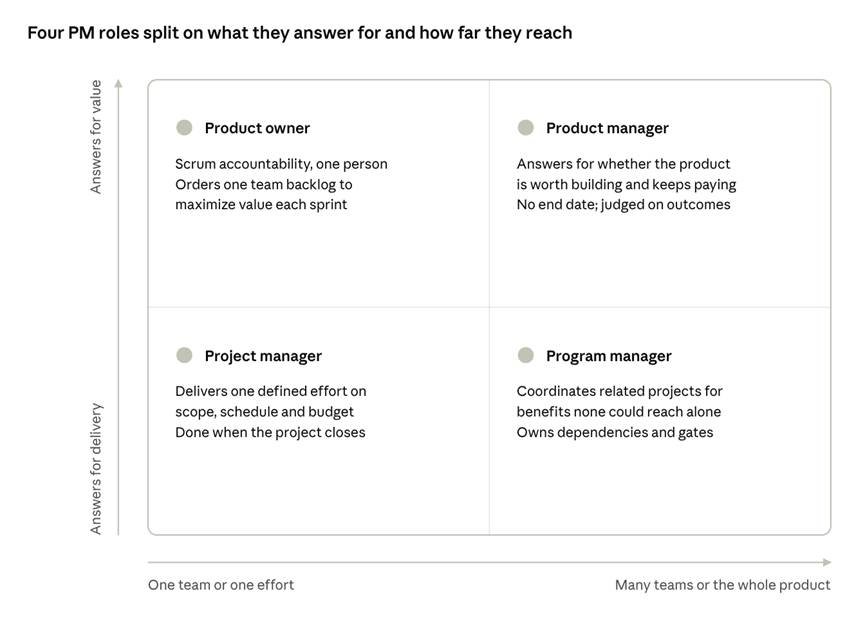
Four PM roles on two axes · sources: 2020 Scrum Guide, PMI definitions, Cagan
Read the picture as two questions. Up and down: does this person answer for delivering the thing, or for the thing being worth delivering? Left and right: does their authority stop at one team or one effort, or spread across many? Someone who has done bottom-left work for five years is not a product manager wearing a different badge, whatever the job board's search filter believes.
Hardware raises the price of being wrong
Move the same four roles from an app to a device and the org chart barely changes. The economics do. In software a bad decision is usually one release from being undone; Cagan's own case for fast teams rests on small, frequent, uncoupled releases. A hardware team gets a handful of chances, and each one costs a build.
Consumer electronics runs on three validation builds. EVT, the engineering build, proves the design works, usually on 5 to 20 units. DVT proves it meets spec and survives reliability testing on 50 to 200. PVT proves the factory can make it at rate, on 100 to 1,000 units off final tooling. Between those gates sits the item that shapes every hardware schedule: the mass-production mold. Instrumental, which sells inspection software to electronics lines, puts tool fabrication at about 12 weeks and says most teams start cutting steel alongside DVT instead of waiting for it to finish. That is a bet the design will hold. When it doesn't, Instrumental's worked example shows the neat sequence dissolving into a continuous build and a launch slipping by as much as 15 weeks. For a product aimed at Christmas, that means February.
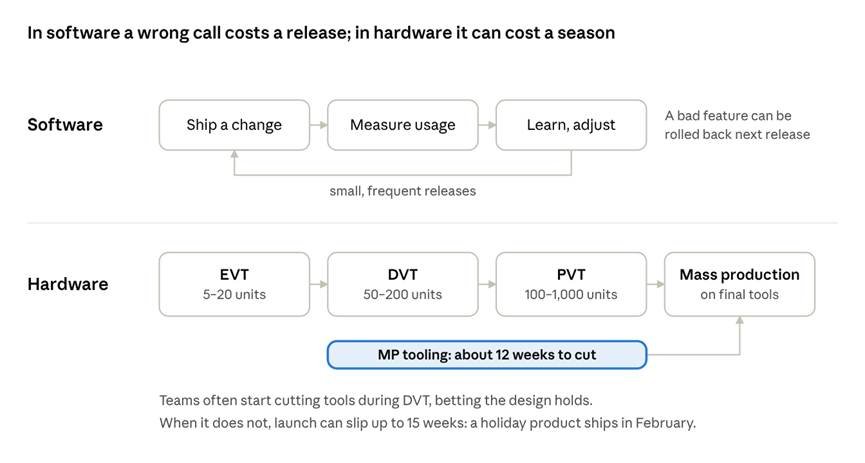
Build stages and tooling lead time · sources: Instrumental, Venture Outsource, SVPG
This changes who holds the power. At a software company the product manager usually outranks the schedule; if the data says a feature is wrong, the roadmap bends. In hardware the schedule outranks almost everyone, because the tooling, the component orders and the factory slot were committed months earlier. The hardware product manager has to decide earlier, on thinner evidence, and then defend a requirements freeze against their own later ideas. The program manager becomes the senior operational voice in the room. Scrum's product owner barely survives the trip: a sprint increment that can't reach a customer is hard to value, so teams tend to run Scrum for firmware and keep the physical product on gates.
Electronics contracting shows the split at industrial scale. A brand in California, Seoul or Munich defines the product. A contract manufacturer with lines in China, Vietnam, Mexico or India builds it, and its "PM" is usually a program or project manager who owns the customer's schedule, the bill of materials and the build plan. Job boards in most markets file both kinds of work under the same two letters. An engineer who has taken three laptop platforms from EVT to mass production has done some of the hardest delivery work in the industry. When she applies for a product manager role at a SaaS company in London or Austin, the screener sees "PM," finds no A/B tests, and moves on. The title transferred. The job didn't.
One shortage, one glut, one title
On paper the market for PMs contradicts itself. PMI's Global Project Management Talent Gap report counts 39.6 million project professionals worldwide and expects demand to grow 64 percent between 2025 and 2035, leaving a shortfall of up to 29.8 million. The World Economic Forum's Future of Jobs Report 2025 ranked project manager the 12th fastest-growing role on the planet.
Product managers in tech, meanwhile, spent 2025 in a queue. Bandan Singh's review of LinkedIn and recruiter data put open PM roles worldwide at around 23,000 in April 2025, against more than 2.6 million people who list "Product Manager" as their title. Most of them aren't job-hunting, so one opening per 113 title-holders is a crude ratio. It still isn't an encouraging one. EEA listings were down 17 percent year on year, UK listings 18 percent, and PMs laid off between 2022 and 2024 were more than twice as likely to be cut as engineers. Among one aggregator's active product manager postings in 2026, 27.3 percent were labelled senior and 2.8 percent entry level.
Both sets of numbers hold because they describe different rooms. PMI's shortage sits in construction, manufacturing, IT services and healthcare, and grows fastest in South Asia, Sub-Saharan Africa and China. The glut sits in software product management at tech firms in the US and Europe. The shared acronym links them on job boards and résumés, and very little else does.
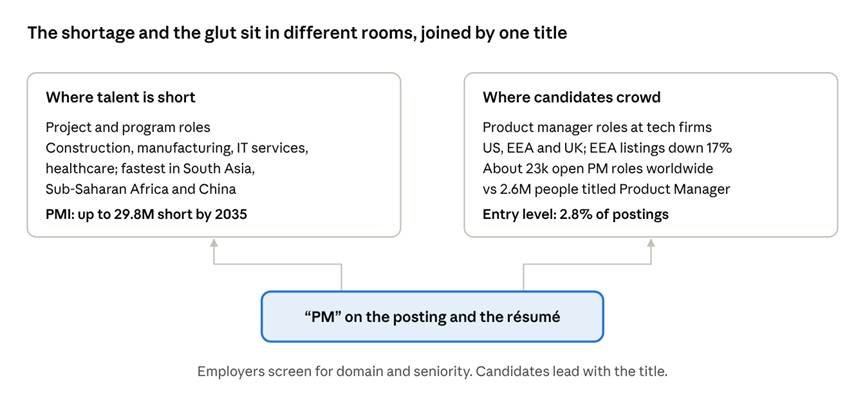
Where the PM shortage and the PM glut sit · sources: PMI 2025, Productify, JobsPipe
Employers widen the gap in a specific way: they post for the title and screen for context. In a Mind the Product survey of 50-plus UK hiring managers, 65 percent prioritized mid-level hires in 2024, and only 16 percent named new product initiatives as their top priority, down from 32 percent a year earlier. Recruiters told the same publication that companies were hiring fewer trainee PMs, product analysts and product owners, and wanted senior individual contributors who could run sprints and cover the output of two people. That is rational for one quarter. Over five years it means nobody trains the next senior PM, a risk the survey's authors flagged themselves.
Candidates widen it from the other side. They sell the title and bury the context. A résumé reading "PM, 6 years" invites a product screener to hunt for discovery work that was never part of a project manager's job. A hardware program manager who lists platforms but leaves out the gate decisions she forced reads, to a SaaS recruiter, like a coordinator. The accountability, which is the one fact that separates these jobs, is the part both sides leave off the page.
Hire the accountability, not the acronym
The fix is unglamorous. Companies can write the posting around what the person answers for and what a mistake costs. "Owns the go/no-go call at each build gate for a notebook platform" tells a candidate far more than "PM, 5+ years." Employers can also admit that a shortage of senior people is a training problem they helped create, and open junior coordinator seats in the plants, fabs and data-center builds where PMI says demand is heading.
Candidates can translate before they apply. Swap the title for the accountability, name the cost of change you worked under, and choose the room on purpose. A software PM eyeing hardware should understand why a 12-week tool reshapes every conversation. A hardware program manager eyeing product work should show at least one decision where she argued about what to build as well as when.
Four jobs will keep sharing two letters; nobody is about to rename them. The people who get hired will be the ones who stop expecting the letters to explain them.
References
1. Project Management Institute, [Global
Project Management Talent Gap]{.sm} (2025).
2. Project Management Institute, [Shortage
of Project Talent Endangers Global Growth]{.sm}, press release,
7 May 2025.
3. Ken Schwaber and Jeff Sutherland, The 2020 Scrum Guide.
4. Pablo Pernot, [PO or PM?
The great muddle]{.sm} [(2023), reporting Marty Cagan's School of Product 2022
slide.]{.sm}
5. Hands-on Agile, [Marty
Cagan on the Product Operating Model (and Scrum)]{.sm}.
6. Instrumental, [Why
hardware products get delayed: EVT, DVT, PVT Decoded, Part 2]{.sm} (2018).
7. Venture Outsource, EVT vs DVT vs PVT.
8. Bandan Singh, [2025
Product Management Job Market Review (US, EU, India)]{.sm}, Productify, May 2026.
9. JobsPipe, [Product
Manager job postings: what employers ask for]{.sm} (2026).
10. Mind the Product, [UK
hiring managers reveal the realities of hiring product managers]{.sm}.
11. Mind the Product, [How
much were product managers paid in 2025?]{.sm}
Filed under Technology
Comments
No comments yet. Start the conversation.
Sign in to comment. It takes an email address, no password.