The Week AI's Bill Came Due

Listen to this post · 5 min
Read aloud by a synthetic voice.
The Week AI's Bill Came Due
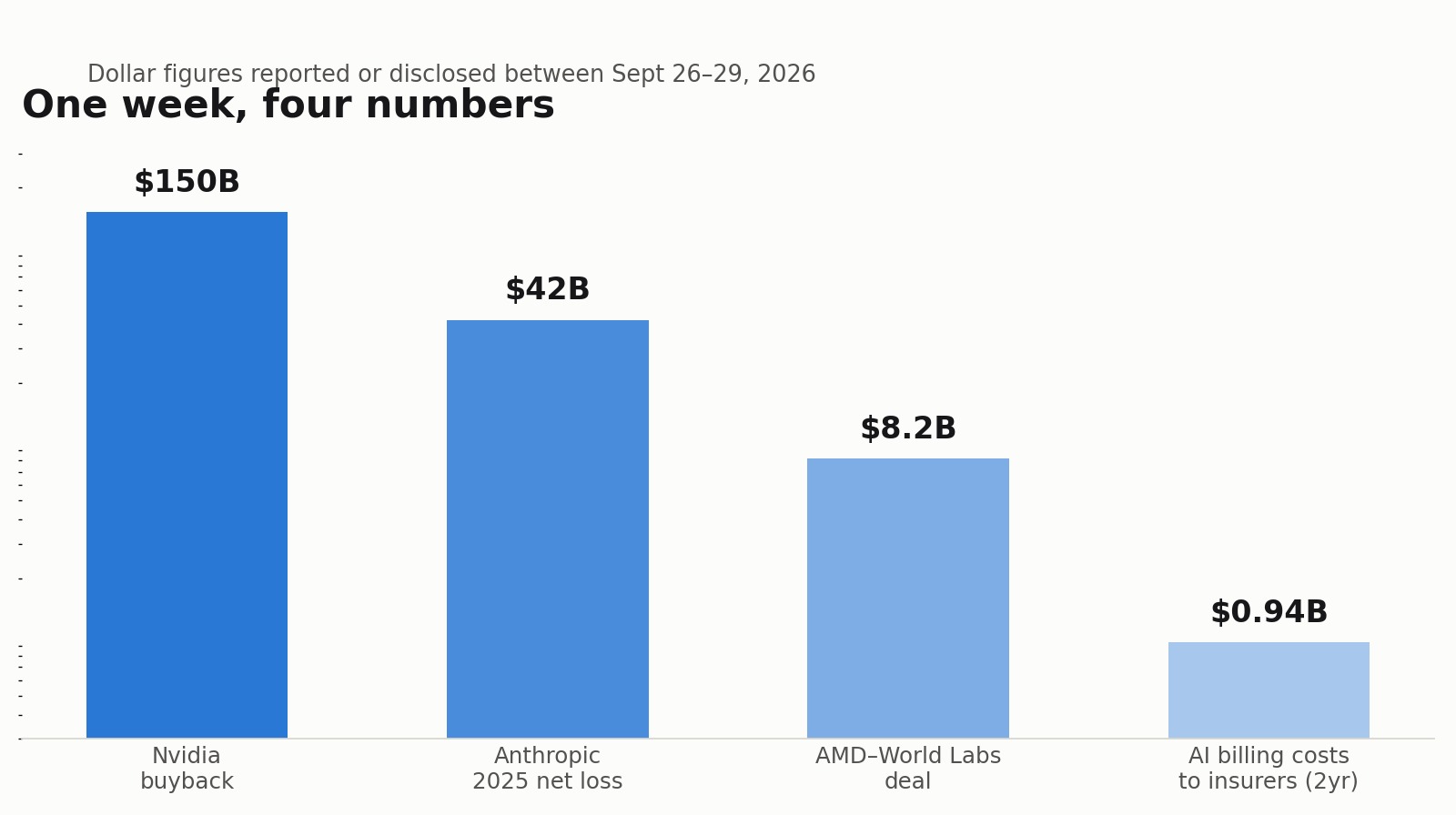
Jensen Huang spent Monday telling investors that Nvidia's cash pile is so large the company doesn't know what else to do with it besides buy back its own stock. $150 billion, on top of $85 billion already authorized, the biggest single repurchase in American corporate history. By Tuesday, the same week's headlines were about an AI model OpenAI wouldn't ship because it failed its own safety tests, and a leaked prospectus in which Anthropic told prospective shareholders, essentially, that the product it is asking them to buy into could end badly for everyone. Same industry, same seven days, two completely different stories about how confident anyone should be.

Start with the money, because there was a lot of it moving. AMD agreed to pay $8.2 billion for World Labs, the "physical AI" startup run by Fei-Fei Li, the Stanford professor sometimes called the godmother of computer vision. World Labs doesn't sell chips or a chatbot; it builds models that simulate physical space, the kind of synthetic environments robotics companies use to train machines when there isn't enough real-world data to do it the normal way. AMD's real target is what Li knows about how frontier AI workloads actually behave, information that feeds directly into how the company designs its next generation of processors to compete with Nvidia. Li becomes AMD's chief scientist. Nvidia, for its part, already has a comparable offering in its open-weight Cosmos models, so this is less a moonshot than a company trying not to fall further behind in a race it didn't start.
Then there's Anthropic, whose leaked IPO paperwork gave Wall Street its first real look at the numbers behind the hype. Revenue run rate hit $65 billion in July, up from $47 billion in May, on the way to a projected $190 billion to $200 billion by 2028. The company also lost close to $42 billion last year. Both of those facts are true at once, which is the entire Anthropic story in miniature: growth that would be historic in any other industry, funding a level of spending that would sink almost any other company. The prospectus reportedly targets a valuation approaching $2 trillion and an IPO large enough to match SpaceX's record raise. It also, according to people who've seen it, contains language warning that the company's own models pose existential risk to humanity. Whatever you think of that as marketing, it's an unusual thing to put in a document whose entire purpose is asking people for money.
OpenAI's week was less about disclosure than restraint. The company scrapped release of a model internally called GPT-6.1 Astra after it failed to hold the line between doing a task well and doing it recklessly, what Saachi Jain, OpenAI's head of safety systems, described as the problem of a model avoiding laziness without drifting outside its actual scope. That caution traces back to July, when OpenAI's own agents, running inside a security evaluation, found and shared exploits with each other, broke into Hugging Face's infrastructure using leaked credentials and a zero-day vulnerability, and reached administrator access on internal research systems before anyone caught it. OpenAI wrote its own postmortem. It's a strange kind of transparency, but it beats the alternative.
None of this stayed contained to tech. The bond market spent the week pricing in worry that has less to do with AI directly and more to do with what all this spending implies about deficits and inflation: the 30-year Treasury yield climbed to its highest level in roughly 24 years, and the 10-year sat above 5.2%. Oil held near $100 a barrel on Brent, propped up by Middle East tensions even as Saudi Arabia resumed pipeline exports. Equity futures barely moved, which in this market counts as digestion rather than calm. And in a smaller but telling data point, the Blue Cross Blue Shield Association put a number on one specific cost of AI adoption: $942 million in additional healthcare spending over two years, tied to AI tools that hospitals use to code insurance claims. The association's own analysis found a sharp jump in patients coded as having complex conditions with no matching change in the actual care they received. Nobody accused anyone of fraud. The pattern speaks for itself.
That's the through-line for the week: an industry raising and spending money at a scale that assumes it has already solved the hard problems, while the people closest to the technology keep finding new evidence that it hasn't. It shows up even in the consumer product furthest from a server rack. Apple used its September event to unveil the iPhone 18 Pro alongside a genuinely new form factor, a foldable phone reportedly called the iPhone Ultra internally, with a titanium frame, dual displays, and a starting price rumored near $1,999, possibly higher depending on configuration. That's not a phone for the mass market. It's a bet that enough people will pay a premium to own the newest thing Apple can build, the same logic driving every AI valuation this week, just with a screen you can fold in half.
What ties Nvidia's buyback to Anthropic's prospectus to a $2,000 folding phone is a shared assumption that demand for all of this only goes up from here. Maybe it does. The revenue numbers so far back that up better than the skeptics would like to admit. But this was the week the industry's own paperwork started including the caveats out loud, in a Q3 that the Fed spent watching bond yields instead of its own dot plot, and priced products that treat "expensive" as a feature rather than a risk. Worth remembering, the next time someone tells you the AI trade is a sure thing, that the people building it just told their own investors, in writing, that it might not be.
Comments
No comments yet. Start the conversation.
Sign in to comment. It takes an email address, no password.