How I'd Study for the PMP With AI

Listen to this post · 6 min
Read aloud by a synthetic voice.
If I were sitting the PMP today, I'd use AI as a sparring partner, not a textbook. It would quiz me, argue with me, and explain why my wrong answer felt right. It would never be my only source.
Here's the thing nobody tells you. The PMP isn't hard because of the content. It's hard because every question asks what a project manager should do, and four answers all sound reasonable. You don't beat that by reading more. You beat it by practising judgment, over and over, with fast feedback. That's exactly where AI earns its keep.
The timing matters too. PMI changed the exam in July 2026, so a lot of older prep material is quietly out of date. Below is the plan I'd follow: what the exam looks like now, the daily loop I'd run, an 8-week schedule, the prompts I'd copy, and the traps to avoid.
Step 1: Know which exam you're actually taking
The biggest change is the weighting. Business Environment went from a footnote to a quarter of the exam. People dropped from 42% to 33%, and Process from 50% to 41%.
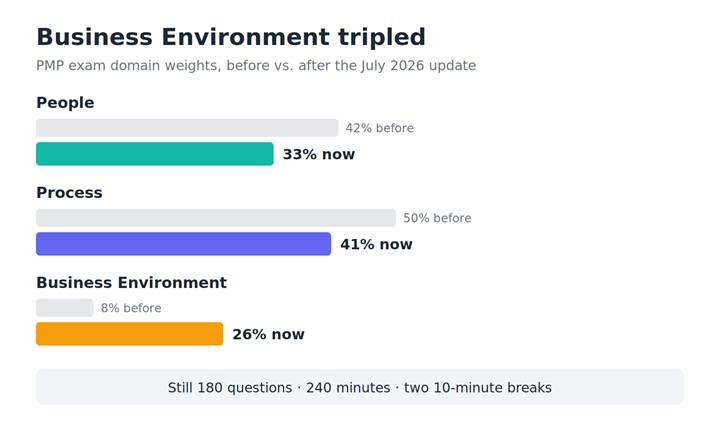
The length hasn't changed: 180 questions in 240 minutes, with two 10-minute breaks. What's new is the mix. You'll see case-study sets, drag-and-drop, matching and point-and-click items next to plain multiple choice. AI in project management and sustainability are now fair game too.
Don't panic, though. Much of the "new" Business Environment content is old material moved under a new heading, like change and risk. So my first move would be simple. I'd download PMI's free Exam Content Outline, paste it into an AI chat, and ask for a one-page map of every task. That page lives next to my desk for eight weeks.
One warning. Any course, book or question bank dated before July 2026 is teaching the old weights. Check the date before you pay for anything.
Step 2: Run one loop, every single day
Most people use AI backwards. They ask it to explain a topic, nod along, and feel productive. Then they miss the same kind of question on test day.
I'd flip it. I answer first, alone, under a timer. AI only comes in afterwards, to pick apart my thinking.
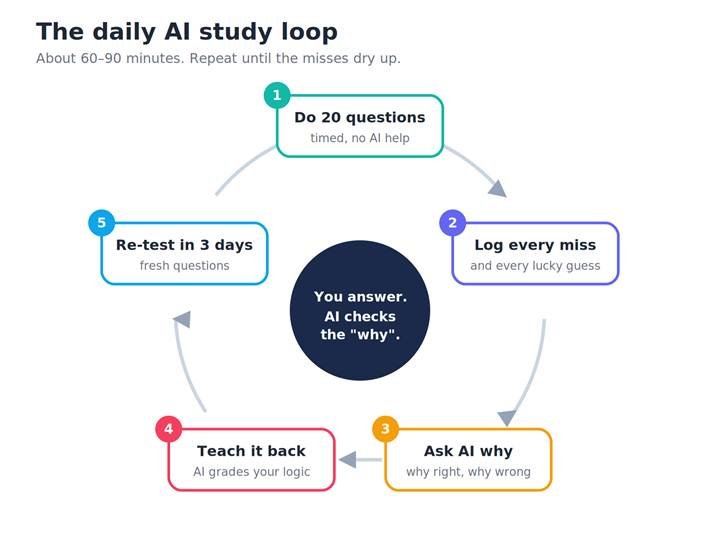
Here's how each step plays out:
\1.
Do 20 questions.
Timed, no AI, no notes. Use a proper question bank, not questions the AI made
up.
\2.
Log every miss.
Include the ones you guessed right. A lucky guess is a miss that hasn't caught
up with you yet.
\3.
Ask AI why.
Paste the question, your answer and the correct one. Ask why the right answer
wins and why yours felt so tempting.
\4.
Teach it back.
Explain the idea in your own words and let the AI poke holes in it. If you
can't explain it, you don't own it.
\5.
Re-test in 3
days. Ask for three fresh questions on the same idea. Spacing it out is
what makes it stick.
That step 4 is the one people skip, and it's the one that works. Reading an explanation feels like learning. Saying it out loud and getting corrected actually is.
Step 3: Stretch it over 8 weeks
Eight weeks at one to two hours a day is realistic if you already work in projects. New to agile? Give yourself ten or twelve.
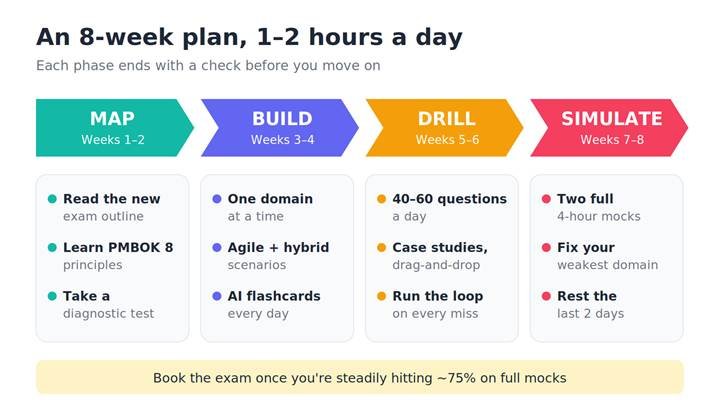
Weeks 1–2, Map. Read the outline and skim the PMBOK 8 principles. Then take a diagnostic test cold. The score will sting. That's fine; it's a baseline, not a verdict.
Weeks 3–4, Build. Go one domain at a time. Spend extra hours on Business Environment and on agile and hybrid scenarios, because that's where the exam moved. Ask AI to turn each day's notes into 15 flashcards.
Weeks 5–6, Drill. This is volume time: 40 to 60 questions a day, with the loop running on every miss. Practise the new formats on purpose, since case-study sets need a different rhythm.
Weeks 7–8, Simulate. Sit two full four-hour mocks, breaks included. Fix whatever domain is dragging. Then rest for the last two days. Cramming the night before costs more than it gives.
The ~75% mark on the image is my own rule of thumb, not an official PMI number. PMI doesn't publish a pass mark. Consistency across two or three mocks matters more than one lucky score.
Step 4: The prompts I'd actually copy
Good prompts are specific and a little bossy. These are the four I'd keep pinned:
The autopsy
Here's a PMP question, my answer, and the correct answer. Explain why the correct one is the best choice for a PMI-minded project manager. Then explain why my answer felt right and what trap I fell into.
The examiner
I'll explain [topic] in my own words. Act like a strict PMP examiner. Point out anything vague, wrong or missing. Don't rewrite it for me; ask me questions until I fix it.
The scenario builder
Write 3 scenario questions on [topic] in a hybrid project. Four options each, two of them plausible. Hide the answers until I reply.
The weekly review
Here's my error log for the week. Group my mistakes by pattern, not topic. What am I consistently getting wrong about how PMI thinks?
That last one is gold. After a few weeks, you'll notice your mistakes aren't random. Maybe you jump to escalation too fast, or you fix things yourself instead of coaching the team. Seeing the pattern is half the cure.
Where AI will lead you astray
AI is a brilliant tutor with one bad habit: it sounds sure even when it's wrong. Here's where I'd keep my guard up.
•
Made-up
questions. AI-written questions are fine for drilling a concept. They're
not a stand-in for a real bank, because they rarely match PMI's tone or
trickiness.
•
Old exam info.
Most models learned from years of pre-2026 material. If an answer mentions 42%
People or the old 35 tasks, it's out of date.
•
Real-world
logic. In real life, you might escalate or just fix it yourself. On the
PMP, the right answer usually assesses first, then involves the team. Ask the
AI to answer "the PMI way", every time.
•
Easy comfort.
Chatting about a topic feels like studying. It isn't. If you're not answering
timed questions most days, you're drifting.
When the AI and PMI's own materials disagree, PMI wins. No exceptions.
The short version
Use AI to argue with you, not to lecture you. Answer first, then ask why. Log your misses and hunt for patterns. Give it eight honest weeks and a couple of full mocks, and you'll walk in having already practised the thing the exam really tests: judgment.
Good luck. You've got this.
Sources: PMI: the new PMP exam · PMP Exam Content Outline, July 2026 (PDF) · PM Illustrated: 2026 exam format
Filed under StrategyTechnology
Comments
No comments yet. Start the conversation.
Sign in to comment. It takes an email address, no password.