How Do We Relieve Blue Monday Symptoms?
Listen to this post · 7 min
Read aloud by a synthetic voice.

It's Sunday, around six in the evening. Nothing is actually wrong. The weekend is still technically yours, and yet a small grey cloud has parked itself over the rest of the night. You catch yourself mentally scrolling Monday's inbox. Your shoulders creep toward your ears. Somewhere, someone is already scheduling a 9 a.m. meeting.
If that sounds familiar, you are in very large company. Here is the short answer to the question in the title: you can't delete the Monday dip, but you can shrink it a lot. The tools are small and a little boring, and they work best on Friday, on Sunday night, and in the first hour of Monday. None of it needs a retreat, a cold plunge, or a new personality.
What “Blue Monday” actually is
The name has a slightly embarrassing origin. It traces back to a 2005 press release from a UK travel company, which crowned the third Monday of January “the most depressing day of the year” using a formula that scientists have long dismissed. It was a marketing stunt. No calendar date carries that much gloom.
But the feeling behind it is real. Surveys of everyday mood tend to find that people feel better on Fridays and weekends than at the start of the working week, and many workers describe a Sunday-evening dread that has nothing to do with January. It also isn't a Northern Hemisphere thing: in Australia, mid-January is the middle of summer holidays. And in countries where the working week starts on a Sunday, the dip simply moves.
So in this piece “Blue Monday” means the ordinary, weekly kind: low energy, a bit of dread, a short fuse, and a sense that everything is slightly harder than it should be. It's common, it's usually temporary, and it responds well to small changes.
Why Mondays feel heavier than they should
Three things tend to stack up, and each one is fixable.
Your body clock slips over the weekend. Late nights and long lie-ins shift your internal clock, a pattern sleep researchers call “social jet lag.” On Monday you wake up feeling as if you flew across a couple of time zones overnight, without the fun of the trip.
Your brain rehearses problems it can't solve yet. Sunday dread is often worse than Monday itself. You are running through the week's difficulties in your head, but you're on the sofa, so you can't do anything about them. Unfinished tasks make this worse. Psychology research on open loops suggests they keep nagging at us until we make a specific plan for them, and then they quiet down.
You lose control all at once. The weekend is mostly your own schedule. Monday hands your calendar back to other people's requests, in a rush. That sudden drop in autonomy is stressful, even if you like your job.
Notice what these have in common: none of them says you're weak, lazy, or ungrateful. They are predictable reactions to a predictable switch. Predictable things can be planned for.
The Sunday reset (it starts on Friday)
The best Monday relief is built before Monday arrives. Try this sequence, and keep whichever parts stick.
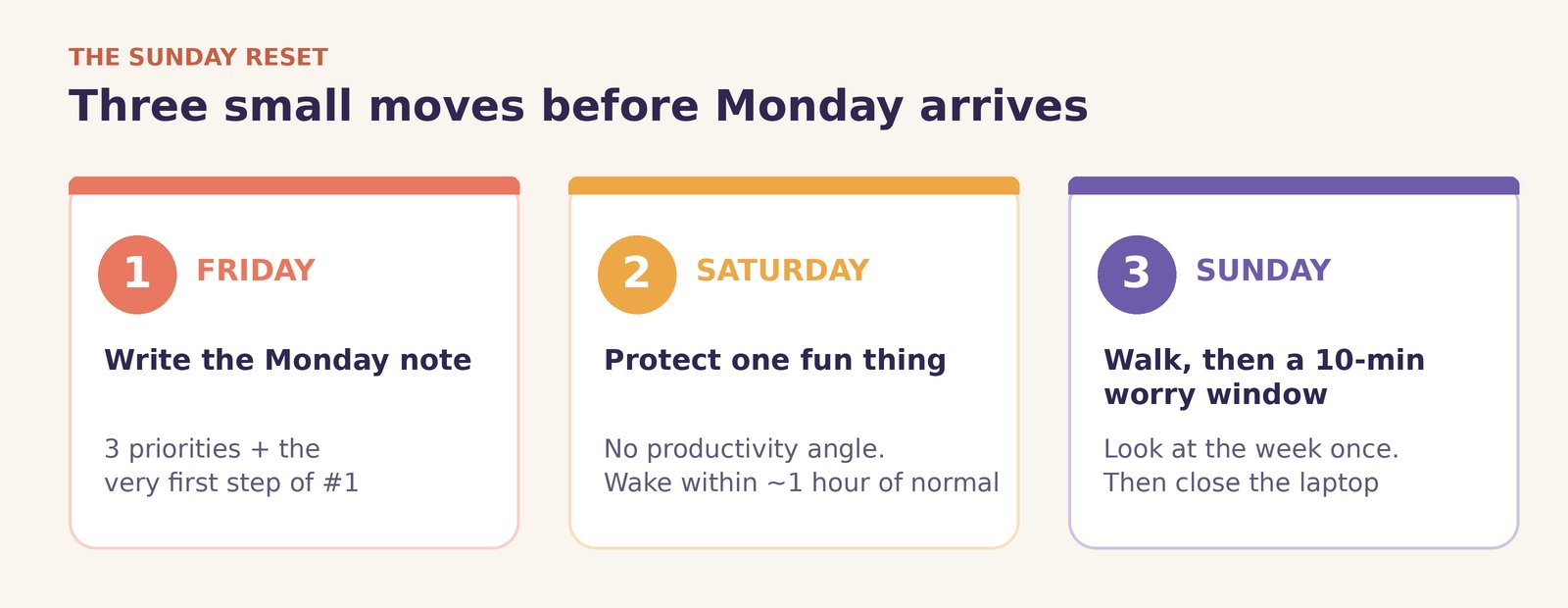
- Friday, last ten minutes: write the Monday note. List the three things that matter most on Monday, and write down the very first physical step of the top one (“open the budget file and fix tab 2”). This closes the open loops, so your brain can stop guarding them all weekend.
- Saturday: protect one unstructured, genuinely fun thing. Something with no productivity angle. A long lunch, a bad movie, a football match, a market wander. Joy on Saturday makes Sunday less of a cliff.
- Keep your wake-up time within about an hour of normal. You don't have to be strict. A modest lie-in keeps the body clock close to where it needs to be on Monday.
- Sunday afternoon: get outside and move. A walk in daylight is enough. It lifts mood now and helps you sleep tonight.
- Sunday evening: schedule a ten-minute worry window. Open your calendar, look at the week once, adjust one thing, and then close the laptop. Worry has somewhere to go, and it has a time limit.
- Put one small pleasure on Monday evening. A dinner with a friend, a call, a series you're saving. Monday stops being the end of the fun and becomes a day with a reward at the end.
- Aim for your usual bedtime. The goal is simply not to turn Sunday night into a negotiation with your alarm clock.
Monday morning: three small moves
When the day arrives, resist the urge to out-willpower it. Aim for three gentle nudges instead.
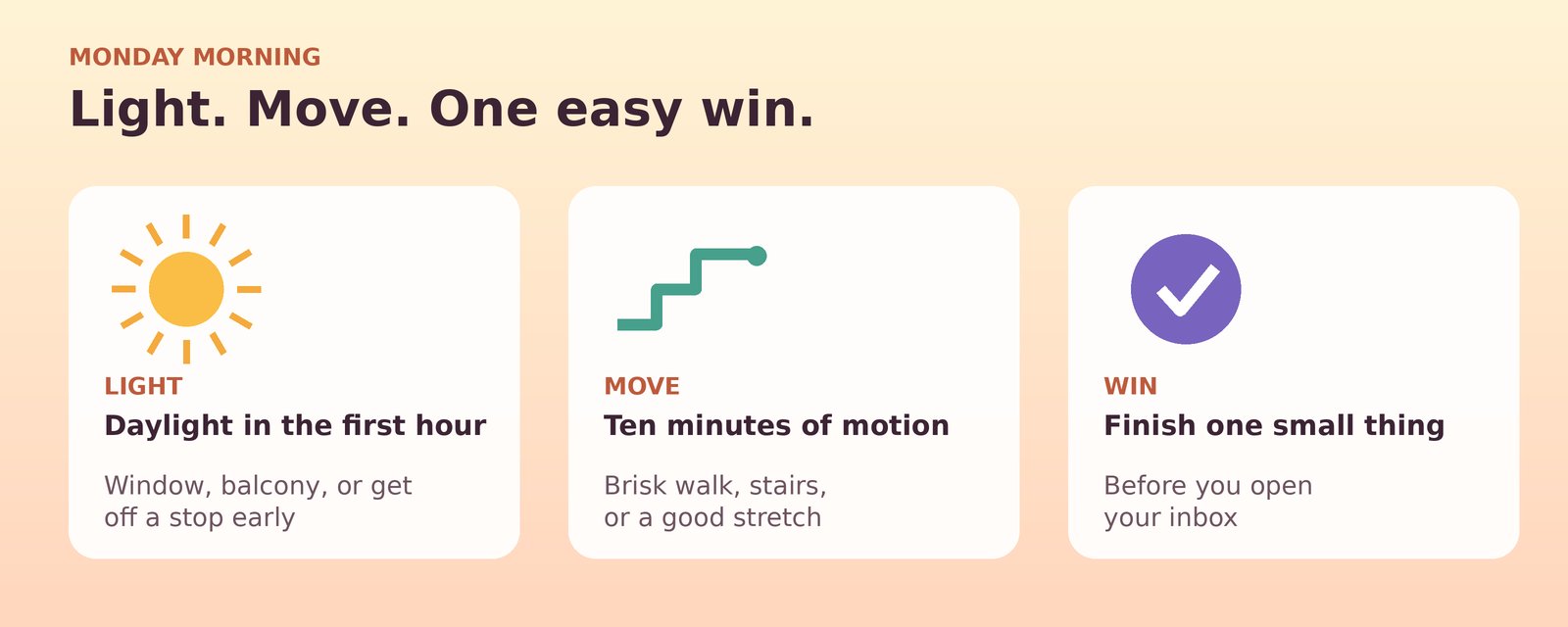
Get light early. Daylight in the first hour or so of the day helps anchor your body clock and wakes you up more kindly than a second coffee. Drink the first coffee by a window, take the call on the balcony, or get off the train a stop early.
Move for ten minutes. A brisk walk, some stretching, or a few flights of stairs. Even light movement tends to lift mood, and Monday doesn't need a heroic workout. It needs your blood moving.
Bank one easy win before the inbox. Pick something small and finishable from your Friday note, and complete it first. The point is momentum. A checked box at 9:20 changes how the rest of the morning feels, and it is hard to feel stuck while you are finishing things.
Then do the hard task in your best energy window rather than the first available one. For many people that is mid-morning, not 8:45. And be a little generous with yourself on the commute: play the song you love, take the scenic route, wear the shirt you like. It sounds trivial, and it is, which is exactly why it works on trivial-sized dread.
At work, and a few ideas worth borrowing
If you manage people, you have more power over Monday than you think. Keep the first hour free of heavy meetings. Use Monday for planning and prioritising, not for surprise requests. Send the weekly agenda on Friday so nobody opens the week to a blank. These are low-cost changes, and they tell your team that the dip is understood rather than judged.
If you don't manage anyone, you can still protect your first hour. Block it on your calendar for focused work, and let one colleague know you are doing a gentle start. Shared dread weighs less than private dread.
It also helps to steal from other places, because plenty of cultures have built small rituals around exactly this problem:
- Japan has a name for it. “Sazae-san syndrome” is the Sunday-evening gloom people feel when a long-running family anime that airs on Sunday evenings begins, because it signals the weekend is over. Naming a feeling takes a little of its power away.
- Sweden has fika, a coffee-and-something-sweet break taken with other people. A real, social pause in the middle of Monday is more restorative than scrolling alone at your desk.
- Italy has the passeggiata, the unhurried evening stroll. A slow walk after work is a cheap way to leave the day behind.
- Finland has the sauna, a regular, unhurried reset that people treat as ordinary maintenance, not a luxury.
You don't need the country to borrow the habit. Pick one and make it yours.
When it's more than a Monday thing
A weekly dip is normal. A low mood that stays is different. If you feel flat, hopeless, or anxious on most days for two weeks or longer, if your sleep or appetite has changed, or if the dread covers the whole week and not just Monday, please talk to a doctor or a mental health professional. Many workplaces offer a confidential employee assistance programme, and it is worth checking. Sometimes the problem is not your Monday habits but the job itself: workload, a difficult boss, or a role that no longer fits. That's a problem to solve, not a flaw in you.
For everyone else, here is the smallest possible version of everything above. Tonight, write down the first physical step of tomorrow's most important task. Close the laptop. Do one thing you enjoy. Then tomorrow, open a window, take a ten-minute walk, and finish one easy thing before you open your email.
That's it. Monday will still be Monday. But it will have a little less weight, and you'll have a little more say.
Filed under Cool
Comments
No comments yet. Start the conversation.
Sign in to comment. It takes an email address, no password.