Don’t Buy AR Glasses Until You Read This ($299 vs $1,279)
Listen to this post · 8 min
Read aloud by a synthetic voice.
Eight pairs, three different jobs, and the one question to answer before you spend a cent. Prices checked 13 October 2026.
A colleague asked me last month which AR glasses she should buy for her commute. I asked what she wanted them for. She said, "AR." That is where most shopping goes wrong. In 2026 the label covers three quite different products, and they all look like slightly chunky sunglasses.
Some are a screen you wear on your face. Some are a tiny display that shows you a text message and then gets out of the way. A few are the real thing, with cameras that map the room around you. Prices run from $299 to $1,279, and the cheapest pair is the right answer for more people than you would expect.
One caveat before we start. I have not worn every pair here, so this guide leans on published reviews, spec sheets and the makers' own pricing, and I say so where a number comes from a company rather than a lab. Prices are in US dollars unless noted.
Three kinds of glasses with one name
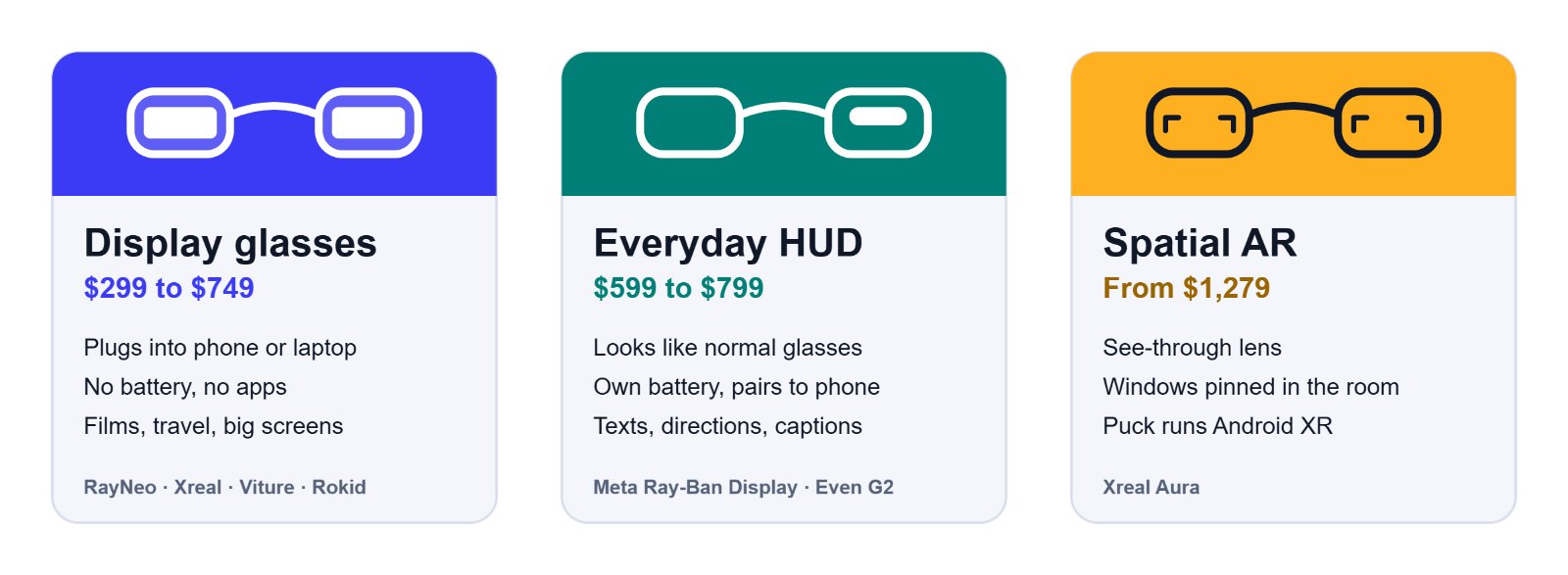
Display glasses are the biggest group. RayNeo, Xreal, Viture and Rokid all sell them. They have no battery and no operating system. You plug them into a phone, laptop, Steam Deck or console over USB-C, and they show whatever that device sends, as a virtual screen that looks roughly 135 to 200 inches wide. Your source needs a USB-C port that can output video. Older iPhones and some consoles need an adapter.
Everyday HUD glasses look like ordinary eyewear. Meta's Ray-Ban Display and the Even Realities G2 put a small display in the lens for notifications, directions and captions. They run on their own battery and pair with your phone.
Spatial AR glasses sit at the top. You see the room through the lens while digital windows hover in it. Xreal's Aura is the first pair from outside Samsung to run Android XR, and it is the only one here that needs a separate processing puck.
What each pair costs
The spread is wide, but it falls into clear steps. Up to about $600 you are buying a display pair. Around $800 you are paying for a lens display and a wristband. Beyond $1,200 you are buying a small computer.
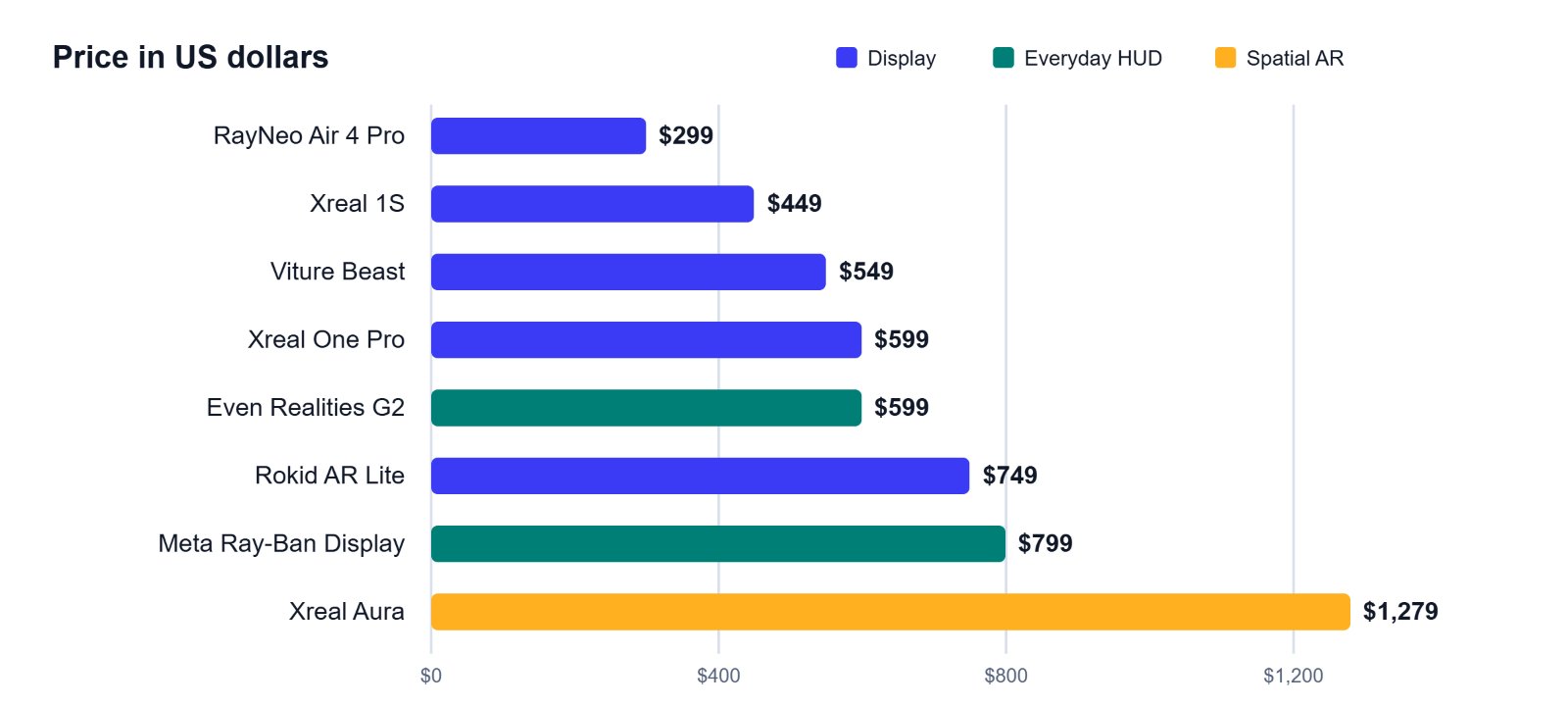
Regional prices move around. RayNeo's Air 4 Pro lists at $299 in the US, but a German retailer quoted a €399 list price, and a Prime Day deal in June took the US price to $239.20. Check your own market before you decide.
Display glasses, the ones you can buy today
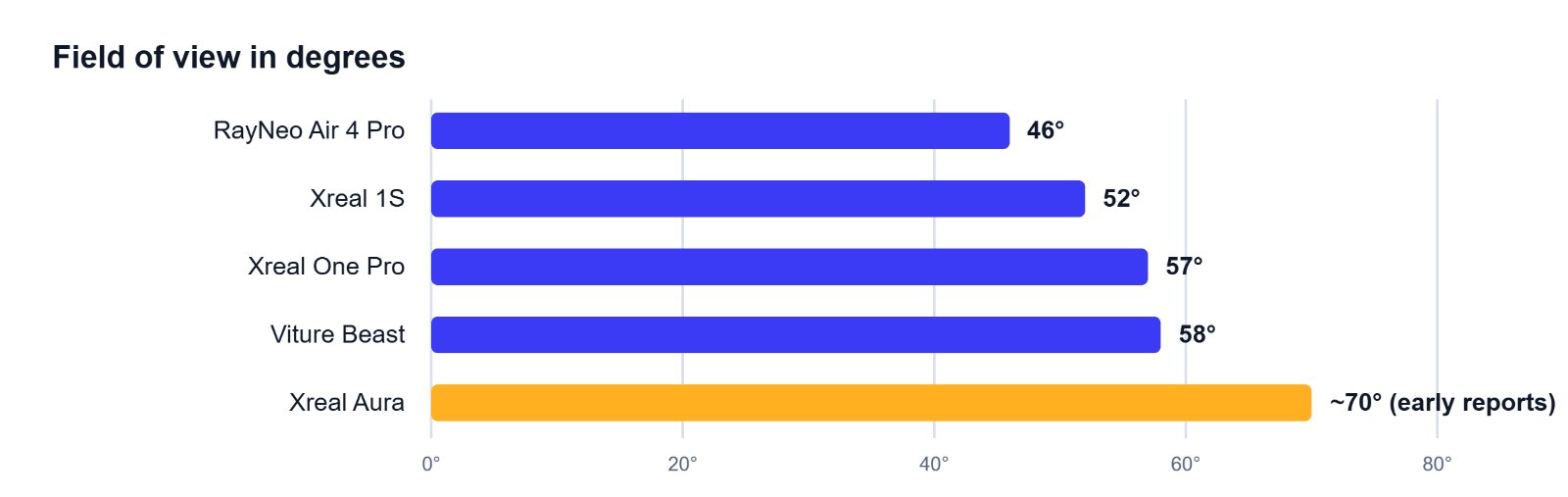
RayNeo Air 4 Pro, $299. This is the one I would hand a first-timer. It weighs 76 grams, the lightest here, and RayNeo says it is the first pair with HDR10 support. The panels are 1080p micro-OLED at up to 120Hz, peak brightness is around 1,200 nits, and the audio is tuned by Bang & Olufsen. The view is the narrowest in this group at 46 degrees, so the screen feels smaller than on pricier pairs, and there is no head tracking. For flights, hotel rooms and an hour with a Steam Deck, that is fine. RayNeo also cites Counterpoint Research putting it first in global AR glasses shipments in the first quarter of 2026, with a 23.7 percent share.
Xreal One Pro, $599, and Xreal 1S, $449. Xreal is the name reviewers reach for when the glasses will be used for work. The One Pro was cut from $649 earlier this year, weighs 87 grams and gives about 57 degrees of view. The cheaper 1S gives up some of that, at roughly 52 degrees, and keeps the stable image that reviewers like. A camera is an optional add-on for the One Pro, not part of the frame. If your plan is a laptop and a spreadsheet on a train, start here.
Viture Beast, $549. It has the widest view of the group at about 58 degrees, a 174-inch virtual screen, up to 1,250 nits and nine levels of lens dimming, so you can fade the real world in or out. It weighs 88 grams. Tom's Guide gave it an Editor's Choice badge after living with it for 10,000 miles, and also found fewer settings than Xreal offers and less accurate colour for work. Some owners report soft text near the edges of that wide screen. It is the movie pair.
Rokid AR Lite, $749. One review called its picture and sound the best in the category. The trade is a two-piece setup with a separate unit, and the highest price of the display group. I would only pick it if you watch a lot of film on the road and your budget has room.
| Pair | Price | Weight | View | Best for |
|---|---|---|---|---|
| RayNeo Air 4 Pro | $299 | 76 g | 46° | Travel, first pair |
| Xreal 1S | $449 | n/a | ~52° | Laptop work, value |
| Viture Beast | $549 | 88 g | ~58° | Films and games |
| Xreal One Pro | $599 | 87 g | ~57° | Work and play |
| Rokid AR Lite | $749 | n/a | n/a | Picture and sound |
n/a means I could not confirm a figure in the sources I used.
The pairs that look like glasses
Meta Ray-Ban Display, $799. A full-colour display sits in the right lens and shows notifications, navigation, camera framing and short bits of context. You control it with small hand movements, read by the Neural Band on your wrist, which is included. It works with iPhone and Android. Elsewhere the price is £749 in the UK and CA$1,149 in Canada. In France, Italy and Germany it goes on sale today, 13 October, at €899. Meta pushed Europe back from early 2026, citing demand and stock, while Bloomberg reportedly pointed to an EU rule that batteries must be easy to remove.
If all you want is a camera, speakers and an assistant, skip the display. Ray-Ban Meta Gen 3 starts at $449 and Gen 2 has sold for $379, about half the price of the Display. The Display makes sense if you read a lot of messages while walking, or follow turn-by-turn directions in a city you do not know.
Even Realities G2, listed at $599, is the subtle option. It aims at glanceable text rather than video. I found less independent testing of it than of the others, so try a pair in a shop before you commit.
Xreal Aura, a glimpse of what comes next
Aura starts at $1,279 for the 12GB and 256GB model, and Xreal says it ships in mid-November. The first delivery wave is meant to arrive before the holidays, with a second wave probably in early 2027. You see the room through the lens, and early reports describe a field of view near 70 degrees. A puck holds the battery, the processor and Android XR. Reserving took a $199 priority deposit that counts toward the price. For most working people this is a wait-and-see product, since Android XR is young and the app list will grow after launch. Developers and early adopters will want one now.
Which pair for which person
- Frequent flyer or hotel-room worker: RayNeo Air 4 Pro. It is the lightest and cheapest, and losing it in a seat pocket hurts less.
- Laptop all day on trains and hot desks: Xreal One Pro, or the 1S if you want to save $150.
- Films and games after hours: Viture Beast, or Rokid AR Lite if sound matters most.
- Messages and directions on the move: Meta Ray-Ban Display, once you have tried the wristband.
- Developer or early adopter: Xreal Aura.
Before you buy
Three habits will save you money. First, check the port. Display glasses need USB-C video output, and a phone without it turns the glasses into a paperweight until you add an adapter. Second, if you wear prescription lenses, look for a model with insert lenses, because clarity drops when the optics sit over your own glasses. Third, buy where returns are generous and wear them for a full two hours on a real commute. Neck strain, edge blur and heat show up late.
My own pick for most working people is the RayNeo Air 4 Pro, and I would spend part of the savings on a good USB-C cable and a hard case. If the first month goes well, you will know exactly what you want from a pricier pair. If it does not, you are out the price of a pair of headphones.
Sources
- Road to VR, Viture Beast launch and comparison sheet
- Tom's Guide, Viture Beast review
- 9to5Google, Xreal Aura pricing and One Pro price cut
- Reality Atlas, Meta Ray-Ban Display prices by region
- Presse-citron, Meta Ray-Ban Display Europe launch
- iDevice, Xreal Aura price and shipping
- We Must Be Geeks, One Pro vs Rokid AR Lite vs RayNeo Air 4 Pro
- PC-Welt, RayNeo Air 4 Pro specs and Prime Day price
- Next Reality, RayNeo Prime Day price and market share
Filed under CoolTechnology
Comments
No comments yet. Start the conversation.
Sign in to comment. It takes an email address, no password.